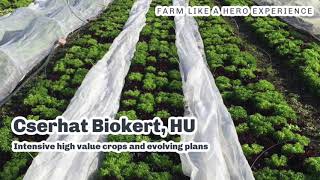
Barnabas, a market gardener near Budapest, built a half-hectare no-till farm from scratch four years ago. He bought his property for €30,000 and reached sufficient income in year one using compost, cover crops, and three hoop houses. He started by tilling to establish beds quickly, then shifted to no-till methods.
Questions this video answers
Half hectare
No-till with lots of compost and cover crops
About four years ago
About two years (on their own land for two years)
About €4,000–€5,000 per hectare
Chapters
Okay. Welcome to a new episode of Farm Like a Hero, folks. I'm Richard Perkins. Today I'm here with Barnabas who runs Chair Hut, a half hectare market garden in Hungary specializing in high value crops with all the latest market garden tools. It's a no till farm using lots of compost as well as cover crops and focus on rich soil life. So Barnabas, thanks so much for being with us. Taking time to join us today.
Yeah, thank you Richard for having me.
Yeah, welcome. Tell us a bit about your history and pathway into farming. Like how did you get involved with market gardening?
Okay, yeah, so I have no family background in farming. Typical city family. So city life. No any connection to rural areas or whatsoever. Somehow I got interested in agriculture. So I went to just agricultural university here in Hungary. And I think in the first year we visited a really, really small organic garden. Actually it was a biodynamic garden using all the biodynamic stuff, but only in gardening. So like a really small place. And yeah, I just got really interested and after that it was everything coming like the next steps. After that I went to Community Farm. It was like a CSA farm, but it was owned by the members actually. And so I was the farm manager for two and a half years in. On that farm in Hungary. Yes, yes. Yeah. So I gained most of my experience there to start my own project and yeah, so after that I started my own business. It was four years ago. Yeah.
Awesome. What's the state there in Hungary? I know speaking to a couple of people on the tour so far that the animal farmers, they're saying that certainly in the sort of regenerative ag space, Market Garden's got more of a hold there. But it's not so many sort of CSA or market garden setups that you have over there.
Not so much. Yeah, Hard to say like if you are. Yeah. If you consider like really good market gardening practices, I would say like 20, maybe 20 market gardens, which is like really like the bio intensive stuff like that. And of course there are tons of small farms or vegetable growing farms. But yeah, using like really the bio intensive methods and the market gardening tools maybe, I don't know, 20, 30.
Is that a case of having to import stuff from Germany and places like that? I'm guessing like tools and materials are quite hard to find there as well.
Yes, yes, yes. We have to import like almost everything right now we have a distributor for some stuff like paper pot and teratech tools from France. So we have a Hungarian distributor for that which is good. But yeah, maybe it's changing somehow, I think. We also have a distributor for the. For the Jenks either right now, but it's really like underground stuff, so.
Yeah, yeah, but it's picking up there. It's something that people are getting exposed to at least.
Oh, yeah, yeah, we can say that.
Yeah. What about the. The lands from older times, like communist times, etc. The. My understanding is the land's often broken up, parcelled into sort of odd land units and not necessarily complete farms, as it were. Tell us a bit how you got access to land. Do you own that or is it rented land or.
Yeah, so as I said, I had no background from the family, so therefore I started from zero with no land and actually not much capital because right after or. No, like not after, but during the university I went to work on organic farms. So as everybody knows, it's not the. Not the place where you build up big capital, more like experience. So I started with really, really small capital and no land from the family. So I started on rented land actually in a small town not far from Budapest. And I rented the land from the city actually for like a very fair price, like almost for free actually. It was a good deal. And after, after two and a half years, we bought our own small plot where we live right now. This is the occur. So for two years we are on our own land.
Is that like land with a house or. If you had to, like, what was the land like when you sort of moved in?
Yes, yes, yes. So we live on the farm, actually. There's a. There's a small house where we live which is quite nice and we have a quite big barn which is in quite good condition. It's quite big, I can say. So we can do lots of stuff there, like post harvest and all the tools. We can also do workshops there. So it's a really nice feature for the farm. And yeah, we have a small land. It was mostly unused for the past decades actually. So yeah, we had to start the garden from scratch. And we are actually in the middle of a really small village here. There's like 300 people living in this village, but we are in a village.
What's the sort of village's perception of you folks moving to the country and starting up the small farm?
The people in this area are quite friendly and they really like the fact that young people are moving to the countryside and starts doing farming. So I can only say like, good things about how they look at us, actually. So it's quite good.
Is that. What's the sort of land Prices there just for reference for listeners because the economy is obviously quite different to a lot of other parts of Europe. Like what's a hectare of land with that kind of proximity to Budapest likely to cost?
Yeah. So compared to Western Europe or the US or Scandinavian countries, land is quite cheap. So maybe properties in the capital would be much more expensive, maybe more similar to bigger cities, foreign cities. But the land I have to say is quite cheap. So the average price in Hungary, like 1 hectare land only for agriculture use, I would say around average price, maybe 4 or €5,000 per hectare, something like that. So I think it's quite cheap. And like a property like ours, it was around. So with a nice house for living and the barn and, and like infrastructure, water, a well, stuff like that, fenced around. So it's like, it's like a quite nice farm. You can get a deal like this. Like we bought it around €30,000 if I'm correct. Yeah, around that.
That's great. So it's relatively still a chunk of money in the picture of the economy there. But it's, it's achievable by the sounds of it compared to some of the people on the tour sitting outside cities where it's like €150,000 a hectare.
Yeah, yeah, yeah, it's quite different. So I would say this, this situation is really good in Hungary and we have really good market in, in the capital. That is the market. So. So you have to aim for that. But yeah, so, so we both this land for or this property for like 30,000 and we achieved this income in the first year. So quite okay for us.
Amazing. Well done. And that's your, you've sort of set up on. Was it pasture when you got the land?
Not pasture, it was like, it was just like unused land, like some old fruit trees not in good condition and just like grass. It was just like unused land.
What was your initial steps then? How did you go about creating beds and how did you plan the size of the garden initially?
Yeah, so the planning, it was more like what we can do in this really small space. So. And we moved here in December and we wanted to start the production in March so we had to act really quickly. So yeah, we just, we just cleared out the field, get rid of the old trees and yeah, just plowing actually because we needed to start using the field right away.
Yeah.
And yeah, so it was more like tractor based stuff. Get the plow and got some disking, rototilling stuff like that. And yeah, right after that we put up our permanent beds. And yeah, we started building our hoop houses. We built three hoop houses and the permanent beds, put up the infrastructure, irrigation, and we were good to go by March, actually.