FARM LIKE A HERO EXPERIENCE: Daniel Hägerby, SE
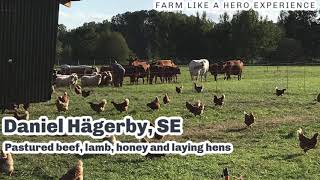
Daniel Hägerby runs Alves Naturbetter, a 300-hectare family farm in southern Sweden producing pastured eggs, grass-fed beef and lamb, and honey. He moved there in 1990 and shifted from part-time desk work to farming full-time, starting with three sheep around 2013 and adding a cow named Ines and beehives. Bark beetles and storms have damaged the spruce forestry that once supported the farm's income.
Chapters
Okay. Welcome to a new episode of Farm Like a Hero, folks. I'm Richard Perkins. Today I'm here with Daniel Hegeby who runs alves Naturbetter, a 300 hectare farm in southern Sweden with pastured eggs, grass fed beef, grass fed lamb, as well as honey production. Being mostly forest, the managed pasture comprises around 30 hectares. And now the original homestead kitchen garden is being scaled up in collaboration with the local grower to add a new dimension to the farm. Products are sold primarily to subscription customers and also at Rico rings. Daniel, thanks so much for taking the time to share with us today.
Thank you. Pleasure.
So tell us a bit. This is a family farm, right? Your father owns the farm, is that right?
Yeah, he bought it and we moved here in 1990, so 30 years ago. And he's. My father's been mainly focused on the forest and the woodlands and the plantings of that for all that time. So never had anything to do with the arable fields of the pasture that's been rented out to neighboring farmers ever since purchase up until about 2015 maybe, when Warhar sheep herd got big enough that we needed some pasture of our own. Yeah, yeah. So you basically have been in our.
Family longer than that and you've managed to sort of arrange free reign of the bits of land your father doesn't want.
Yeah, well, he's. He's an interesting man in many ways. He's. He's never. He never ever shows me that he's proud of what I do or that I do anything good. So he's always. I don't know what the words are, but seeming disappointed or upset or whatever. But when I sometimes hear him talk to others, it's a different story. So I think he is proud of what I'm doing. He's happy that I'm here with my family and living close to him and my mother now with children, so their grandchildren. But he would never tell me that.
Did he want you to be a lumberjack or.
Well, no. Yeah, I do help him out in the woods, especially during the winter, and I'm pretty sure he enjoys that. But I don't think there's any prestige that way. No.
Does that make it hard to work there? Like, are you living in close proximity?
We are living in close proximity and I think it's almost completely positive thing. We get a lot of help with taking care of the kids, tending to the kids, and we can lend each other maybe I lend his machinery and my parents helped me out with the chickens. They close at night, especially in the Height of summer, because getting up early and moving them and then closing up at night, it's a long day. So they do that, walk the dogs and they close for the chickens. It's an easy job, but it's got to be done. And it's really late, so I'm thankful for that. So I think say it's primarily or almost 100% positive as my dad doesn't affect the way I run things as long as I'm in the field.
So there's a nice natural balance because your focus is on the different parts.
Yeah. Yeah. So now if I were to take over the whole farm, then it would be a different story because then I would like maybe to do things different, differently in the woods. And then he would be opposed to almost everything. And then that even if I would be the formal owner of everything and I would. Would be completely within my rights to do what I want, it would be socially impossible.
Yeah.
Yeah. That's why I'm not interested in taking over the website anytime soon.
Is it something you've discussed in the longer term in terms we have just slightly.
And that's when I realized I'm not interested in forestry because anything that I want to do as opposed to what he wants to do, more or less.
Are you talking about sort of more natural forms of.
Yeah. Or at least I was thinking that way. But I'm starting maybe to change my mind a little bit because of the bark beetle situation. I don't know if you're familiar with it.
Yeah. And for listeners, maybe you could just give a snapshot what you're referring to. Yeah.
Anyone who heard Greta Thunberg's radio talk on Swedish radio. It was made in English as well for international audience. She was talking about the Canadian, North American bark beetle, something pine beetle or something. And we have a similar problem in Sweden. It's just not as big yet. But it maybe may become as big because winters are getting milder and the summers are getting hotter. So the beetles get a chance to reproduce more during the summer and they survive more during the winter. And that combined with the heat stress and the drought stress of the. Especially the spruce trees is not a good combination. And then add some storms to that and all of a sudden maybe the spruce plant things are not worth as much as they are on paper. Yeah. And if I do take over the farm, I would. Yeah. I would have to like pay for. Not upright. But still I have to.
Take on the finance of that forestry.
Yeah. At present value. And I think maybe it's not won't be in like in my lifetime, it will be reduced a lot in value. And maybe that's one of the reasons I don't want to take it on financially. And another is that if. Yeah, and I said I almost changed my mind. That is, if I do take it on, I have to clear cut a lot financially. I just have to. There's no other way or I'll have to work double jobs outside the farm and I'm not interested in that. So. But if it's gonna be eaten by beetles and been blown over anyway in a few years, then maybe I might as well clear cut it and then let whatever wants to come up come up.
Interesting tensions and dynamics, but maybe that's better.
Even if the economics of that are in conventional terms, very poor. I'm not so sure about the long run.
Yeah, it might be lower risk in the long run. That's an interesting dynamic to have looming around you. But you've been starting up then on the pasture with larger livestock and hens primarily for your income.
Yeah. So I've been working desk jobs outside the farm since we moved here on and off. And I'm doing that less and less. And now we're in a position I could quit completely if I wanted to. My desk job is very good in the sense that I never have to go to an office. I just carry the phone and I answer some calls and I write some emails and it pays fairly well and I can do it at the same time as I'm collecting eggs or whatever. So it's. I'm not quitting quite yet, but I could, I do want to. But you know, financially it's. I'm in a good position and I, I could stay here for six months or maybe a year more.
What is like, what got you into. So you brought up on the farm, but seeing like contractors or other farmers doing arable. What got you into farming? Like, what were some of the key influences that made you want to start enterprises there?
Well, I think it was probably started for me, started with Al Gore's film back in 2006 and then I started reading books on climate change and. And then that tipped over into like peak oil and resource limits. And then when you get old enough to start thinking about kids and these things get very real and I wanted to be able to support my family in the long run and also making sure that the farm, which is a real asset that won't be inflated away on some stock market to make that as valuable as possible, not for being sold but actually sustaining people in the future and with the increased challenges of climate change as well, and also resource depletion, I'm trying to restore the land and develop ways of producing food that are not as input intensive and not as fossil fuel dependent. So both in an altruistic like way, but also primarily, I think for myself and my family to be able to. Yeah, to write it right it out for the next few generations.
Yeah, sure. And so how did you go about. I mean, did you have any experience with livestock and.
Well, not really. I never handled any animals up until we moved here in 2012. And then maybe 2013, a neighbor gave us three sheep. Just they thought we should have some sheep. Now we live here. We've never had any like, need for meat really because there's so much game. It's a big farm. So we have a lot of wild boar primarily, but also. Rod you. Yeah, yeah. And elk. So we've never had the need for meat, but it's nice to be able to do it yourself anyway and have a bit of variation from the wild boar. And then that flock grew and it grew and then we got some beehives and they multiplied. And then 2015, I think it was all this time my focus was to reduce cost so we could work less. So reduce our living expenses so we could work the minimum. Because I was very uninterested in consumers contributing to the global fossil fuel economy. Really. So whatever you. Yeah, whatever you buy, even if it's a local tourist thing, it still contributes to the global fossil fuel economy in the long run if you follow down the money streams. It does. So I really wanted to reduce that a lot. And I looked at what we pay for and what costs a lot in our household and it was a lot of dairy. So I thought, yeah, maybe we should get our own cow. But that was the beginning. And it took me quite a while to be able to milk her at all. And then it took me some more time to be able to milk her in the pasture, but now we're mastering that and that's great. And then after doing your course in 2018, I bought another five cows with heifer calves, all heifer calves. So with the intention to both be able to graze a larger area and better, but also the option to start milking them. And I have tried a little bit, but they've never been milked. And the adult cows are just haven't been handled that way. And it's probably possible, but it's, it's too risky and it's Too much work. And I've given up on trying to milk those.
So they've turned into beef animals, essentially.
Yeah. Pretty poor beef animals, of course, but.
A lot of Swedish. I know they're doing dairy cows for beef specifically because of the quality of.
I know, I know. But unless the customer understands that, it's not that easy. But anyway. But they're calves, of course, they're used to me and they're grown up beside me and they've been watching me milk Inus, our family cow, for a long time and they're licking me when I'm doing it. So I'm thinking it'll be a lot easier to start milking them. So they'll be delivering their calves in the spring and I'll try to start milking more. So it'll be another few heifers I'll turn into cows that I can start milking. And we've tried because when we milk Ines twice a day, which I have done now, and when her calf is big enough to handle or eat only grass, we get too much more milk than we need. So we've been making some cheese, of course, but even though we don't want to make cheese every day, so. And we've been selling some milk as well, under the table, so to speak, and just to try out the demand, and it's huge. So even though we've not been an official, we haven't made much sound of barely told anyone, everyone's asking for it.
So this kind of really started as a way living into some of your ideals and trying to support your family and provide your needs. But at what point has it transitioned to making your living and coming full time? Like, what's happened there that made you want to develop it into like a full time livelihood, as it were?
More from Richard


A review of short and intensive season on a mixed farm and restaurant/event space in Sweden






Alskade Kyckling Exploring complexities of poultry production in Sweden and what we stand for


