FARM LIKE A HERO EXPERIENCE: Daniele Bucci, IT
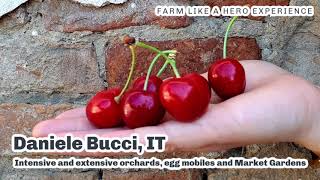
Interview on the Farm Like a Hero series with Richard Perkins and farmer Daniele Bucci (Podere Cimbalona). Covers Daniele's agricultural education (ag school, university in Bologna, master's in horticultural sciences), family farm history, conventional management and investments, financial pressures from cooperative commodity markets, and a gradual transition since 2015 toward organic and regenerative practices. Farm details: 6.5 ha total, vegetables on ~3,000 m^2, 1 ha vineyard, pastured eggs started in the interview year; customers can adopt their own vegetable garden for direct sale.
Chapters
Okay. Welcome to a new episode of Farm Like a Hero. I'm Richard Perkins. Today I'm here with Daniele Bucci, who runs Podere Cimbalona. It's a six and a half hectare farm in Italy. It's a certified organic farm producing different types of temperate stone fruit and apples, as well as a hectare vineyard vegetables produced on 3,000 square meters for direct sale at the farm shop. And pastured egg production began this year. And at the farm, customers can adopt their own vegetable garden, deciding what to grow and even give it a name. And then Daniela will manage it and diverse fresh vegetables once a week with a similar approach to the fruit trees. So, Daniela, thanks so much for taking the time to be with us today. Yeah, welcome and please tell us a bit about the background of the farm and. Yeah, your background, how you ended up where you are today.
Sure. Well, I grew up in a countryside where there's a lot of agriculture. And my father was a blacksmith, but both of my grandfather were farmers. And I think it's because of them that now I am farming. They really passed down to me this big passion about farming. And I was used to spend a lot of time with them when I was a kid. And as I grew up, I went to ag school when I was teenager. Then I went to agricultural university here in Bologna. And then I took a master in horticultural sciences. And then I worked for a couple of years as intern in a research group at the university. We were working on pair breeding new rootstock, dwarfing rootstock on cherry, peaches and trellis for apple orchards and so on and so forth, a lot of stuff. And. And I must say that during this period I was always working at the farm because my grandfather passed away when I was around 20 and my family and I decided to keep the farm. So during those years I was studying and working with my family, keeping running those, you know, keep running the farm. And now they quit. And since 2015, I quit every type of job and I was 100% into farming. So now I'm here.
Beautiful. And that. So it was, was it your grandfather that established the initial orchards and.
Well, it has a very old and long story. It was my grandfather, father, I believe the end of the 80s that came here the first time and start farming. And of course, the farm by that time was completely different than it is now. I mean, every farm here around was a mixed farm. Had animals, they had fruit trees, they had sugar beets, wheat, corn, whatever. And then from there, my grand grandfather, my grandfather, my father was a blacksmith so we jumped off a generation and now I'm a farmer again.
Is that what would have been the typical sort of size on your great grandfather's time? What would have been a typical sort of family mixed farm size?
Let's say about 5 hectares or 5 hectares. There were many, many people working, you know, at that size.
Yeah. So it's not so far away in cultural history, which is really nice. What was your experience of like, what did your father think of you going into farming? I mean, he must have seen your passion early on, but having skipped out of it himself, what did he think about you going into it?
Yeah, you know, I must tell you that when, you know, when I had these contract with the university and I was thinking of quitting it or I mean, stop working there and go into farming 100%, no one was really, was really happy about my decision. Everyone was saying, you are mad, just stay there, just find a good job, just keep on researching. Maybe you find career at university, don't go farming, it's hard. So no one. But you know, I'm here. So that was my choice.
You've got really nice Instagram if people want to see the structure of how it looks on the farm and on Facebook. But tell us a bit about like, I went to agricultural school, but certainly didn't go so far through the academic side as you have done. And my experience of that was pretty dismal. You could say I was very disillusioned with. It was mostly sons and daughters of much bigger farms that's highly industrial and they're learning essentially how to maintain big machines bought on debt and how to use chemicals. And so I left there feeling like I had more questions than answers. And I looked into alternative ag around the world and I noticed the pattern language that most of the farmers that have inspired me, or pretty much all of them never actually went to ag school. And so I've been advising people to sidestep that as far as possible because they just haven't seen it's necessary. But I think you probably have more insight and experience to share because you've been through a longer, more in depth pathway with that. So I'm curious to hear. Yeah. What you would reflect back about going through sort of academic route with that.
Well, you know, I believe that my, my what I learned at the university was worth it anyway because it's, it's a, it's the backbone of what now I am doing differently. But you know, the theory, you need to learn the theory. So the chemistry, the physics, the biology and microbiology, all that stuff. But yeah, I believe I share the same idea about university because it was a place where they teach how to farm. Really conventional. There was no course, there was no good word for farming other than conventional. So even organic was seen as something freak. But back then, I mean, it's almost 15 years ago now, but it was hard to find some different type of agriculture at the university. And as well, in those two years that I spent researching as a research group, we were working in highly productive and intensive orchards and we were mostly dealing with multinationals or very, very big farm. Not for sure with. With small farms. And. And I must say that I've been working with, on this farm, I've been managing this farm for about 10 years, conventionally, completely. I was completely sure of my idea because of course I was teenager, I was in my 20s, and in school they taught me how to run that farm in that way. And here around all the neighbor and friends were telling me this is how it's done, is how it should be done. So for me was that was the correct way of farming and organic farming or even other type of farming. Myself was, I was say, a bit critical about those type of farming at that day. But luckily enough, I found other people like you or like other good farmers around the world that are doing amazing job. And I had the strength to say, like to jump out of that downspiral that you often mentioned in your video, where I was going actually, because I must say that I learned it the hard way during those years. Farming was not easy, but luckily enough I jumped out. And now I use all of my background that I learned at the university with a different scope, with a different aim. And I'm learning a lot and I'm studying a lot about regenerative, for example, or other type of farming that I believe is the type of farming that most resemble the idea that I have about farming.
Could you maybe elaborate more on. You're talking about learning the hard way and that caused you to sort of investigate other ways to do things. But what did that entail? Was it financial problems or plant health, soil health, that sort of thing?
I believe it was a mix. It was a mix. I mean, you know, starting a farm from zero is hard. Starting a farm that was obsolete, I think it's even worse. So starting from is zero. Starting a farmer that was old, it's below zero because I had to renew everything. I had to invest a lot of money in machinery and new orchards and equipment to fulfill the regulation. And so I did a Lot of investment at the beginning of my farming career. And that brought me to of course, to willing to push the farm farther. So that means more fertilizer, more chemicals, more, you know, pushing the orchard, pushing the fruit trees to produce more and more and more. But that was not a solution because this farm was producing few crops at the beginning and we were taking all those products to a cooperative that was selling them. So we didn't get to decide the final price of our product. And we faced few years where there was a. I don't know what reason, the market was very bad and fruit price was as low as, you know, it couldn't even cover the cost production. So by that time we lost a lot of money. And so there, yeah, it was financial. First front was financial. And so I would say from the soil point of view, of course, when you want your soil to produce more, but you don't have the knowledge to do it, then you push it like, you know, so just with fertilizer, that's the wrong way.
What is it? I mean, is the co op sort of sales of fruit, it seems to be quite common in Spain, Italy. Is that the sort of standards way? So you're essentially combining produce of lots of small farms to sell into the commodity market. So you don't really have any say on much. I guess you're just happy someone can take your produce. And is that like, is that a very common standard way of doing things and how to. How are farmers feeling about that? Is it, is it good for the farmer or is it like selling into any commodity market really?
Yeah, it is exactly how you say. Most of the farm here around are focusing their energy into production and just that then they bring the stuff, the product to this big cooperative that is more than 10,000 members. So it's not small cooperative, it's a big cooperative that will sort, package and sell it to supermarkets mainly as commodity. As commodity. So with a very low price, we would say on market, that's the common farm year round. And those farms usually cultivate very few crops, two, three, four crops. And so they are getting bigger. They play on scale, of course, as big as they get, the lower is the cost of production. And yeah, that's. The average farmer here around is working like that.
Yeah. So what was what you spoke a little bit about, seeing things online, etc. But what was like the critical points where you decided to stop spraying, stop adding chemicals? Was it like from one year to the next you just suddenly changed or.
Well, no, it was not that. Like day to Night to change my mind. But it was more like path that brought me to definitely change my mind. But I believe it was hidden somewhere inside me even when I was at the university because, you know, back in those days I was thinking there might be something wrong. It can't be that way then. You know, reading books, meeting people, taking online courses and traveling around really helped me open the eyes and say, okay, there are people that are doing that and they're doing very well, so probably this is the right way. Then I started slowly. I mean, of course you can't get it from a day to another one because you have an organism that is in balance, not imbalance, which is managed conventionally and you can just stop doing that stuff and change it from day to another. It has to be gradual. So when I first turned my farm into organic, then I started to year after year decreasing the number of pesticides, decreasing the number of fertilizer, applying new techniques and new products that are more environment friendly and so on.
So it's really. It's like weaning off drugs essentially. I mean it's literally. That's what it is, right? I guess.
Yeah, yeah. It's a slow revolution, it's a slow path, but I'm glad I took it.
What was the response from neighbours and people? Because that must have been the sort of turning point or did you keep it a little bit quiet what you're up to?
Well, you know, I'm a white fly year round but I don't mind neighbor are smiling at me in a friendly way. Of course they are good people, they're good farmers. But yeah, they are smiling. A friend of mine, I caught some of them sometimes like pretending of counting aphids on my trees or. Complaining about the tall grass, but that's it. I mean it's no problem. I do what I want, they do what they want.
Yeah.
But yeah, I'm a wildfly, I'm surrounded by conventional farm.
It sounds like some part of that process has been to diversify further your product range. But maybe we can keep on trees for a while. I'm curious about how. Yeah, what. What's been. You've added other orchards species into the mix of what was there. It sounds like. And I'm curious, I think a lot of listeners would be super curious to hear about. Yeah. Your methods of tree care and soil prep and everything to do with planting new trees and transitioning and then maintaining those trees in an organic way and. Yeah. How you've gone about that and any details you can share about trees. We haven't had many tree growers on the tour, so it'd be super nice to dig deep into that well.
Yeah, sure. Well, you know, as I mentioned before, the management of this farm has been conventional for many years. So even the design of this farm is strictly conventional. So if you look at from above, it seems like no difference with my neighbor. So there are rows of concrete posts, hay nets, and so on. But also my challenge is somehow to try to apply regenerative techniques procedure in what was a conventional designed form.
More from Richard


A review of short and intensive season on a mixed farm and restaurant/event space in Sweden






Alskade Kyckling Exploring complexities of poultry production in Sweden and what we stand for


