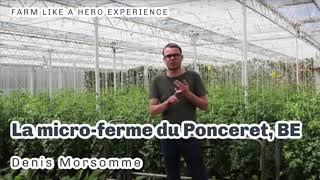
Interview with Denis Morsomme (Micro Ferme du Ponceret, Belgium) about starting and scaling a diversified vegetable and small-scale greenhouse farm. Farm began building in 2015 and started operations in 2016; motivations included local food and heating greenhouses with a biochar production machine (carbon-negative). The farm runs a retail shop and kitchen, employs 14 people year-round and up to 22 in summer (started with ~6 hires in year one), and has expanded into agroforestry and laying hens to integrate with outdoor vegetable rotations. Infrastructure described: 2,000 m2 heated greenhouse, 800 m2 tunnel, ~1 hectare outside production, plus additional plots of ~0.2–0.3 ha. The conversation focuses on technical choices (biochar heating), staffing/management challenges of a mid-sized operation, and plans to scale to gain operational resilience.
Questions this video answers
Built in 2015 and began operation in 2016.
14 people year-round; up to 22 in the summer.
2,000 square meters of heated greenhouse; 800 square meters of tunnel; about 1 hectare of outside production; additional ~0.2–0.3 hectare plots.
Chapters
Okay. Welcome to a new episode of Farm Like a Hero, folks. I'm Richard Perkins. Today I'm here with Dennis Mosson of Le Miqlo Femme de ponserrette. Started in 2016 in Belgium. It's got expensive glass houses, high tunnel and field production. And the farm also has a busy shop and kitchen. They employ 14 people year round and up to 22 in the summer. And they heat the greenhouse with a biochar production machine. Dennis joined us on our first online training back in 2018. And there's been recent additions on the farm of agroforestry and the introduction of laying hens to test out rotations with their outdoor vegetable production. I'm super interested to hear how that's all going and to explore, Dennis, the challenges and opportunities of scaling and working with a larger team than perhaps many of us are used to. So, Dennis, thanks so much for taking the time to be with us today.
Thank you for the invitation.
Awesome. Yeah, I'm super excited to hear all about what's going on there because it's definitely a different scale to most people would be familiar with. But maybe we can start, go back a step and hear how you came into farming in the first place.
I mean, first shock was when we had our first daughter. Then we started to focus on food and being more careful and so on. And since we are from we used to work in the retail business, we were thinking to have a organic shop or something like that. But more than organic, it was most more focused on local. And then I started to turn around to visit the farms and so on, but couldn't find much different type of product because here we are in a meat production area and there is definitely no vegetable production. And because we are, it's cold, we get four, five months frost free. We're like the coldest part of Belgium. And so I tried to learn about Dutch greenhouses, but obviously since I didn't want them to be problem for the climate, I was looking for a way to heat it properly. And then I found the biochar machine which can help to heat and produce biochar, which is carbon negative. And from that we had a retail side which we had an experience in. And we started to build in 2015 and operation in 2016. It's been a very rough journey the first year. I mean, I had no training at all in vegetable production or whatever. So we're just learning by doing, learning by doing. And well since 2019. So it's like one year or two. Things are getting stabilized and fine so that's better. But for like two, three years it's been like very, very complicated and I.
Guess we'll dig right into that to hear because you're operating with a really big team, which is a huge financial and psychological burden, I guess. But that is quite a brave move to jump straight into sort of high end production. Tell us a bit, just for reference, the scale of the farm, like how big is the indoor growing space and how much have you got going on outside?
We have 2,000 square meters of heated greenhouse, we have 800 square meters of tunnel, called tunnel and one hectare of outside production. A little more, little more. And then has hands that are turning on 0.2 or 0.3 hectares.
It's quite a big operation.
Well, it's really funny because I'm right between a Dutch guy who build greenhouses and they laugh at me when I say 0.2 hectare greenhouse because they have like 10 hectares. And on the other hand I have the local organic grower who are really on small scale, so I'm kind of hybrid. And we choose that from the beginning because we used to have a shop with my wife and we definitely wanted something on another scale just not to be just the two of us and having people around who you can share with. And so that's, that's better. I mean you're not alone. But of course managing people and paying them is a very big challenge. But that's something we choose from the beginning. The first year we hire, I think six people just to start things. And yeah, now we are up to 20, 22 in the summer. And I think from what I have learned is you need experienced people, you need so many skills to grow properly and skills in the greenhouse are different from the screen, from outside and so on, that you really need to be able to pay them year round if you want to keep those. Know how the knowledge and it's just not possible to do it on your own.
I mean.
And also I have an uncle who's been a farmer for all his life and he always been lonely. So I mean, I couldn't imagine farming like family style or just I always been clear that we would have a.
Team.
And for now that we have this, like we have the right people at the right place with the right skills to have quite a peace of mind. We think we should even go bigger because it's like I used to work in the retail business and in the franchise business and there you always have the same pattern where you have someone who got the skills and you have a backup on each place. So when someone goes away or go on holiday, that's no, no big deal because someone else can handle the job. Because right now, I mean, I'm kind of with my wife, we as a backup of everybody. And if someone go away, we have to quickly shift. And that's still keep intention. If we want to reach what we had in mind, something, I mean, nice, but also peaceful for us, we would even need to be bigger.
So scaling up slightly more to find that critical mass where you get the confidence and peace of mind to be able to step out to the degree that you would like as well as others being able to do that.
Yeah, exactly. That would be a comfort for us, but also for the other employee, because obviously, they know that if they go away, I mean, everybody is in the mask.