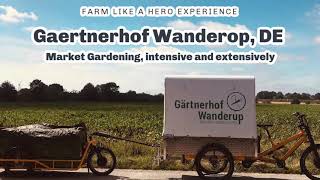
This is an interview (Farm Like a Hero series) with Judith and Henrik of Getten Hof Wanderup, a market garden near Flensburg, Germany. They started in 2016 on about 3.5 hectares (initially 5,000 m2) and built a CSA that grew to ~130 members; the discussion covers their pathway into farming, converting a horse pasture into vegetable production, financing (bank loan ~€60,000 plus ~€10,000 member credit), early infrastructure challenges (quack grass, sandy low-fertility soil, irrigation), equipment choices (BCS two-wheel tractor, later compact tractor, compost toiler), labour intensity (70-hour weeks early on) and community engagement (shop presence, member help).
Chapters
Okay. Welcome to a new episode of Farm Like a Hero, folks. I'm Mitchell Perkins and today I'm here with Judith and Hendrick who run Getten Hof Wanderup started in 2016. So Market Garden with 130 CSA members from a 3 1/2 hectare site in close to Flensburg in Germany, which they run along with four seasonal employees who work for different lengths of time throughout the season. They're running the garden with a BCS two wheeled tractor and interesting. They're also cutting and baling attachments to work with hay and mulching for their livestock. And recently they've started to make their own compost with a compact tractor and compost toiler in order to maintain super high quality nutrient and life inoculants to their production. And vegetables are sold locally and to also alongside the CSA members to local shops and transported by bike and bike trailer, which also seems to perform many other functions the farm. So super curious to hear about that. Judith and Henrik, thanks so much for joining us and to be with us today. And please tell us a bit about your pathway into farming, how you folks both came into contact with farming and how you met, etc.
Yeah, my farming journey started like 10 years ago. I made in education at Biodynamic Farms and a few Biodynamic Farms and Judith.
I'm a landscape ecologist actually and we first met at CSA public presentation where people from Flensburg, the place where we live, they organized it and they wanted to have a CSA and. And that's where Henrik and I first met.
And yeah, also we started pretty soon after we met in 2016. We started with 5,000m2 market garden and with I think was at the beginning 35 members and we had a business plan where everything was in it and we also get after half a year we get credit from a bank. So we were able to financial everything and we bought polytunnels and everything and all the tools. We started actually with a small tractor and with a tiller behind it and a lot of hand work like we used because there's the hook on our logo and we use this hook for.
The.
Cultivation of the beds because the soil was full of quack grass I think, and also some other perennial weeds and was a lot of soil where.
It can spread everywhere.
Yeah, and it's a. Yeah. The farm is located really close to Flensburg. It's 15 kilometers far from Flensburg and Flensburg is the northest city in Germany, so it's near the border to Denmark and it's A sandy soil.
And low in fertility.
Low in fertility, but very easy to cultivate. And yeah, we started like really it was a tough start because we just started producing vegetables and had no infrastructure. We lived in this time we lived in Flensburg and just traveled every day to the farm by bike also. And yeah, at the beginning it was like the.
It was a horse pasture actually.
Yeah, it was a horse pasture with nothing else than a small shed. Small shed. It's now our tool shed. And yeah, this is maybe very interesting because we transformed the horse pasture into a small market gardening and after the years getting more and more farm. Like a biodynamic farm.
Yeah.
And 2000.
Can I. Can I just ask, is that were they offering the land? Like do you own the land or were they offering that as part of the setting up the csa, as it were?
No, we just rented the land, rent the land and it's. We only own one small house in front of the garden, so the rest is just rented land. And yeah, it works. And I'm not. It's not interesting for the. For bigger farms here, really small and yeah, for corn or something like that. It's absolutely.
So it let you start up at pretty low cost.
Yeah, we started, but then we get also like €60,000 from the. From the bank. And I think it's for a market garden. It's not so less.
It's quite a lot, I think quite a lot for a market garden.
And also we get. This was the first. We get some credit from CSA members, like €10,000. And we bought a BCS with this money and the first year was just producing and bring the farm on to roll was tough work because we only were together and we have to take care of everything and.
And quite a big garden at the same time.
Yeah, yeah. There was no rain water irrigation system. There was no holy tunnel. There was nothing.
So how. Just in that first year, how did you. How did you get by? Did you rely on rain and.
Yeah, we were pretty fast that we just put some. We drill a pump drill a spring.
Well.
Well. And then after. Yeah, I think after two months we had some irrigation and this year it was not so, so difficult. And then we. We had an irrigation and we just need to set up every time we need. We plant it or we seed it, we need to set up a new tube. And it was like really slowly. We just covered the whole.
Built everything out.
Also had a lot of help from friends and from the CSA members. Yeah, a lot of community work.
How did you get the Customers involved in the first year then was that part of that whole meeting process that you've gone through? There was already a bit of a buzz around it.
And yeah, there were also, I think a pretty nice thing we made at the beginning was that we rent a small shop in Flensburg. It's more like. It's not a shop where we sell stuff. We only bring the vegetables for our CSA members. And now there are two different projects into in this shop. But it's pretty central in the city. And so there we had a lot of people, we came there and just saw that what we are doing there. And they asked, oh, you're selling vegetables? And so we're getting pretty fast more members. That was, I think, one really good thing we did.
But a lot of people who helped us were in this first public presentation about csa. So there was already a group of people who was interested and then they came to help and to be members. So it was there before actually we didn't have to do so much about it.
Awesome. So quite a smooth start for like as you jumped into something quite large scale. It sounds like it went really as smoothly as it could have in some ways.
Yeah, but for me it was also I learned on different biodynamic farms and this market gardening style where we have now in Germany and Switzerland, everywhere. And there it was like the beginning, I think. And for me I had a. More like a vision from a bigger farm and not this small, tiny farm. And so yeah, we just jumped in and had the idea of like bigger farming, like more mechanized.
With the compact tractor.
Yeah, the compact tractor was not there before. We did everything by hand. Also the compost and bringing compost on the field and all that stuff.
Wheelbarrows and it was a lot of hand labor.
Yeah. So we were working 70 hours a week, no weekends. And also we had the problem that we didn't have a good. How do you call it?
The budget in the first year was not so.
So it was very low because we wanted to get people and not to be. Have not that many people. So we thought that if we have a low price, then a lot of people will join. But the price was so low that we could only afford two employees. So me and Henrik. But we needed a lot more.
Actually there was a big, big mistake in the beginning that we thought, okay, maybe we just make the. The price for the share just low. And so we also. The first two years were really hard because we just went after a while we had one guy, one friend of mine who worked for 15 hours a week, and he was a good worker, but it was not enough. So we had, in the second year, we get also 2,000 square meters more for the storage crops. And that was like, okay, how we do this, but it worked. But the quality of the crops and some crops were also not so nice because we just were not able to weed them. And that was pretty hard in the beginning.