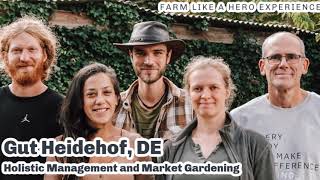
This is a transcript of a Farm Like a Hero episode (YouTube) in which Richard Perkins interviews the Gut (Gut) Heidehof team in Germany about their regenerative farm project. The episode includes an aerial tour describing buildings, pastures ("Pig Field", "Forest Field"), garden and infrastructure; a short history (estate founded 1904, formerly ~400 ha, now ~20 ha farmed); the group's formation and negotiation with the landowners (team members Stefan, Astrid, Alva, later Bork and Hannes); operational notes (dual-purpose cattle and poultry, no-dig market garden, sheep mobile grazing, farm shop) and governance/learning (holistic management training, accredited as a German Savory hub, ecological monitoring training). It also notes infrastructure scale (approx. 5,000 m² roofed building space) and that the team began active farming there in early 2019.
Chapters
Okay, welcome to a new episode of Farm Like a Hero, folks. I'm Richard Perkins. Today I'm here with the team at Good Heidehof in Germany. Started in early 2019, acting as a savory hub in Germany. And the farm raises dual purpose cattle as well as dual purpose poultry and the no dig market garden. Three of the five person team have spent time with us at Ridgedale as either interns or farm managers and another as a guest. So I'm really excited to hear about their collaboration and the development of the project today. Folks, thanks so much for taking the time to be with.
Thanks for having us.
Okay, let's start the flight over the farm with the building area. We have to the left the big main building, old cow stables to the right the big riding hall and then a small riding hole now in the center and a couple of stable buildings which are mostly storage units. At the moment we have our little farm shop in the center and big barn just below us. Before we turn now to the garden. Bio antenna, extensive no dig compost mulch systems, experimenting with different mulches. But Albert will tell you more about that in the interview. We have our sheep in the mobile grass mower to the left and fly now over to our smaller house pasture. It's Goosefield because wild geese like to mist here while they travel. This little pond, you see the main access road for cars, this alley just below us. Now we fly over to the big pasture called Pig Field. There was wild boar damage when we came to the farm. We used that ecological disturbance to reseed a little bit. That's the main pasture which we graze. We can very nicely see the different parcels. And now we come over to Forest Field. This is nicely ingrained. Bordering the forest, the orchard of a neighbor. And then flying over back to the garden. Once again, the alley just below us and side view the nursery now in the center. Behind that the sheep and the mobile lawn, hut and flyover of the garden. Electric ATV standing there. And now we come to the total views. Once again we have the garden and we see the chicken in the very left and the chicken hoops. And this is the view of potential future resource bases. Plus the farm in the center. Just behind is the land of the city of Hamburg. Same next to our pig field pasture. There's a big pasture in the back which is rented out to a conventional colleague. And that's it.
Tell us a bit the story of the place because as far as I understand this is. Is it like an estate as part of a bigger sort of Conservation area in Germany.
Yeah, you could say so. So Budheidehof was founded or found 1904 and the original intent was to be an agricultural production site for the west of the city of Hamburg. Back in the day they had like a rather big area of over 400 hectares which were farmed. It became mainly a milking enterprise you could say. So they had cattle and milking cows and own feed production for these. But then over the world wars, obviously the people milking them were still manually back in the day and they got drawn to war and then the milking capacity went down and it slowly turned into like a riding estate. So agriculture was rather set back and it became of. Yeah, a baroque riding estate for the well known writers of hamburg. And now since 20002019 we've been picking up on the original idea and started producing food again for us and the communities around us. And it's about 20 hectares which remain now out of the previously 400 which we farm now they are all connected to the farm. So we are in a very nice situation there. It's very uncommon for Germany. Normally land is scattered in little pieces, but we have it all in one bunch and it's mainly pastures and a little bit of arable land.
Tell us a bit about how, like how did the vision come together? Was it Astrid, was that you and Stefan originally or was it with the UALBA as well? Like tell us about the sort of formation and the visioning and how that process all worked and how did you find the land as it were?
Yeah, so it came to happen through a common acquaintance of Stefan's and the owners of this place. And we, the three of us, Stefan, Alva and I were quite sure we wanted to work together and farm together and had a lot of ideas about what we wanted to be doing, starting on the regenerative projects. And there was this family owning this place that were looking for people to do this exact thing. So it seemed like quite a good match right from the start. And there some incredibly sympathetic people that are always enormously supportive even though it's a long process for them also to. To understand the depth of what we actually are trying to achieve here. Okay, they are really in it.
What did that take to establish is that sitting down, countless sort of conversations and explaining a vision and hearing their needs. And was it a sort of process like that over the winter?
So it came about.
We.
We spent some months in the autumn before starting up preparing proposals for what this should be looking like according to our ideas and what it would Cost. How long would it take to become profitable and what would this look like? And we also spent some time aligning our holistic context in the. In the lines of ballistic management, being sure that we were all on the same page.
You mean with the owners of the.
Land as well, Both for ourselves and with the owners.
Interesting, because I know you went off to America, didn't you, to do holistic management training with the Savoury home.
Yes. We became accredited last year as German savory hub. Yeah.
Awesome.
And are at the moment also involved in some EOV training, which is ecological monitoring of the property. So we can see where we're going and actually document this.
Yeah, awesome. Tell us a bit about that processing because it's quite clunky, writing the context for yourself. And it's harder to do that with partner or family. Like how is that to do that as a group with these people that you essentially moving on to their land to do your thing. How was that process?
Actually, it happened before we agreed to come here. Was Steffen doing it with them? We weren't really ready to jump in it without knowing what was their idea. So Steffen spent the whole weekend with all of the owners and Stefan is accredited as a teacher for holistic management. So it was just like a workshop with them. And then he came to us and shared with us what came out of that. And that was what helped us to make the decision of, okay, we're going for it. And then we made it together, the three of us, because we started only Stefan, Astrid and me. And then again when Bork and Hannes came this year.
Yeah.
And it's also distrust with the owners. It's been like a slow evolution of giving and taking. And it's. Yeah, it's just. It just keeps going.
Yeah.
It's like the extended family, it's like they start to understand more and more the more they come and share. But we have all decision making power of what happens here.
Yeah.
And all the support.
So.
We'Ll sit down this winter again to like reassess, like where have we moved in the last 18 months since starting out and where do we see. There are quite a few administrative hurdles which we had to tackle in the first years of starting out at this place. So we hope to have that all wrapped up by winter so that we can start the planning process for the next, hopefully decades to come.
Yeah.
Okay. I want to come back to that then, please. But the. So just tell us a bit about the setup. You've got the lands mostly, Pastor, all in one block but you've got access to buildings that you can live on the farm and you have a shop there and some barns and stuff like.
That Infrastructure Yeah when you fly over the estate you see there is quite a little bit of building area we have just on roofed area we have 5,000 square meters building space and there are like double stories in many of them and it's a rather big proportion of building towards land base so what's the deal?
There are those buildings you have access to?
Yeah so we lease them we have a long term lease contract for the.
Whole estate does that mean you must maintain them also?
No there's a deal that the like the way it's set up there's the family they have a company owning the place and then there is the operative company which which we are and that's the long term lease and they will bring buildings as the ownership facility and the lease and certain usages of the building will refinance that.