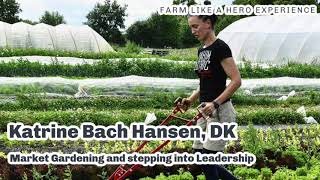
Katrine Berk Hansen started a market garden in Southern Fuen, Denmark in 2018 after permaculture training and volunteer work. She and Anders built the operation from bare soil on one rented hectare, expanding to six 840 m² beds with polytunnels before taking it over and scaling back after storm damage.
Chapters
Okay. Welcome to a new episode of Farm Like a Hero, folks. Today I'm here with Katrine Berk Hansen, who runs Ohau in Denmark. I filmed a startup of the market garden on YouTube back in September in 2018. But lots changed over there. And no longer in a relationship with Anders, Katrine's decided to take over the business and stay on to run the production. So thanks for taking time out, Katrina sharing with us today.
Thank you.
So tell us a bit about the. Your background, like your journey into all this. Like, how did you end up there in Denmark growing vegetables.
Interesting. That's a long time ago. I think it was when I was. Me and Anders was traveling in Indonesia and actually we were just. We were trying to like, get to know all the local people there and trying to learn the language. And the way we got into that was through permaculture and I was working as a photographer and Anos was an office guy. Yeah. And then there was just like the way through. We just met some inspiring people, work with permaculture. And then after that we just traveled around Europe and worked in different farms. And I think the place where I just. Where it like tricked for me and I got very inspirational, inspired was at your place, actually at ridgeddale.
So Anders had come as a intern and then he stayed on and you came as an intern, didn't you?
Yeah, I was there for three months, I think, and Anos was there six months. I just. Yeah, the whole like all the different enterprises and the whole like the farm life, the permaculture was more like small causes and small beds and like, it was just very crazy to get at a real farm and work there. And I think that whole farm life was very inspiring me the whole way to live also, not only the farm, but the way that like you eat your own food and you're just there and it's all integrated. Yeah. And then me and Anna started shoot of the with Miklo in 2017. And that was the first year of trying to make your own business after Ridgedale. And that was an amazing year. And Anas and Mikkel were just super cool to work with and very inspirational.
Pretty epic. I think that's one of the most popular, popular videos on our YouTube channel. I think most people listening will be familiar with that already.
Yeah, yeah, yeah. It was a very, very fun year. We had a very great time, the three of us. Very good dynamics and. Yeah, super, super awesome. Yeah. And then me and Anna moved to Southern Fuen and started our own Marget garden business in 2018. So I think it just evolved like from permaculture. I think that's general way. And then into farm and then slowly like getting to know soil and what soil is and all that kind of. Yeah, just the ecosystems and the big picture and the farm scale. Yeah.
And so that you guys are set up on, it's like a bigger organic farm, isn't it? And you rented lands and basically had to start from a flat bit of ground and build up roads and tunnels and maybe you could just remind listeners like what's the sort of scale under cultivation and greenhouses.
Yeah, so we rented. There was a guy with 300 hectares of organic farmed land and he was open to rent some land to young farmers. And then we were renting one hectare of land and yeah, it was 2018, so it's three years ago and we just started everything at once on a bare soil. Yeah, just build polytunnels and beds and fence and water.
And you had to build a road just to get your vehicle in, didn't you?
Yeah, exactly, A road. And everything was super wet that fall. And actually the potatoes, the farmer from. The farmer didn't harvest his potatoes because it was so wet. So we have had like potato, wheat, first year all over the place. It was so crazy. Yeah. But we did everything at once. It was just like ransom like. Yeah, just buy everything, build everything, get customers, sell vegetables before you even have grown one and just crazy. Crazy. Yeah, yeah. But I think we could do it because we just did it the year before at the. At Switzeruf, this at Mickl's place. So we just like. We already tried it once. So I guess that gave us some. Some. Yeah. Momentum or something. Yeah, yeah, yeah, yeah. And then we. Yeah. So it's. Yeah. Then we did the business for two years and then we split up and. Then I have been cutting down on the land a little bit. So the first year we were having like six gardens of 840 square meters each garden, one tunnel on 250 square meters. And then when I took over the farm, there was a storm. Like I took over the farm in March this year and everything was just like. Have just been standing over the winter and I decided to take over and then there was a storm and the pond tunnel was crashed. So I started to like rebuild the tunnel. So I've shortened it a little bit, so now it's only 200 square meters. But yeah, and then I have cut two gardens, so I only have four gardens now, but still on 840 square meters each. So that's like 3,000.
3,000. Oh, yeah, no, sorry, I misquoted. So, yeah, yeah, it was like 6,000 square meters before, so an acre. So pretty big garden. But now it's still pretty big garden.
It's just still a pretty big garden. Yeah.
Yeah.
But. Yeah.
Wow. So that's like some pretty major life changes. That's obviously, you know, changed a lot of things. I know you guys have been together a very long time, but it's also thrown you into a very. Well, suddenly you're in a leadership position that you. Reflecting back that you haven't been in before.
Yeah, it's pretty. I've been in it before, but always like with. On my side.
Yeah.
Yeah, sorry. The connection was just a little bit. Yeah. So I've been leadering the team before, but with Anas on my side. So always some. Somebody to talk to when you go, come home and reflect on the day. So now I'm just me in this position and nobody in my. Like, nobody that I can reflect with. Except if I call other farmers. Yeah, I can reflect. Yeah. But that's. That has been pretty like kind of both fun and crazy and a bit lonely also to be alone on the top because it's so. I don't know where to start, but I'd love to have you. Maybe I should start to say that I have me and then I have one employee part time, three days a week. And then I've had some volunteers. Only one at the time. I only take one at a time. Yeah, but it's a. I've been very, very, very. What do you call it? Aware of, like making expectations. What do you call it? Talking to people beforehand that they come to the farm. Like, what. What do you expect? What do I expect from this? And I don't give any food or place to sleep. And people have to take care of themselves and their transport. So they have to find out, like some kind of motivation that's not about money or food or sleeping, that they want to come and work for free. It is challenging to be a leader, to be like, people come with all different kind of expectations to the place and to me and what they should learn. And then often it's a whole nother story. And then often I feel like, yeah, it's just very important to get the expectations whom to fall, getting people on your farm.