FARM LIKE A HERO EXPERIENCE: Helle Bauer, DE
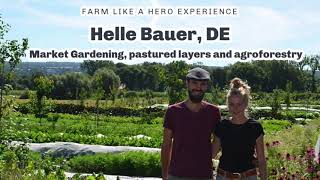
Jasper De Witt took over a German farm with asparagus production and stopped it in 2020 due to labor demands. He now runs a market garden with 1,500 m² of beds, 250 laying hens, and a small asparagus plot, needing just 3 peak workers instead of 20-28. COVID accelerated his CSA sales and he's converting a stone barn into a farm shop and event space.
Questions this video answers
First season was 2018 (interview indicates they are in the third season as of 2020).
Approximately 1,500 square meters of bed space.
Two tunnels totaling about 300 square meters (roughly 150 m² each).
About 2 hectares of pasture.
Approximately 250 layers.
Chapters
Okay. Welcome to a new episode of Farm Like a Hero, folks. I'm Richard Perkins. Today I'm here with Jasper De Witt who runs Hellebau in Germany with his fiance Anna. It's a field scale, asparagus pasture, poultry and market garden operation along with some agroforestry right in the heart of their small town. Jasper was an intern with us at Ridgedale that you might remember from the first time we featured him on YouTube back in April 2018. So super excited to catch up. Jasper, thanks so much for joining us.
Thanks, Richard. Exactly. So we have a small farm here in Germany in Gudelheim. But you were saying about asparagus. Asparagus, we're not doing that anymore. So we stopped that this year. We're in our third year now. We started first season was in 2018. We're now in our third season and like I said, no more asparagus. So we just have the market garden and plastered hens and a bit of agroforestry. Exactly, yeah.
Now people will have seen that video, a lot of them. And you've obviously got a lot of building projects and epic work going on around the outside. But you had tell us about it when you took over the properties, totally run down, as people will see in that video. And it came with asparagus fields, quite extensive fields that you started running but knew you wanted to get rid of because it's pretty intensive labor and inputs, isn't it?
Sort of like that. It was a wee bit different. So my girlfriend or fiance's family or dad and mom bought the house together or the farm with the house and all the other buildings. And so basically I came back from Ridgeddale 2017 and I came back with my plan and my business plan and everyone and I said to Cardine, that's Anna's father, I want to do this and I want a piece of land and can you help me have a look for a piece of land? And he was like, okay, that's all right, we'll have a look for a piece of land. And this farm was in their village. And he was like, should we go and have a look at it, take it out? I was like, why not? So we went down there together. I think Anna was there too. And I mean we fell in love with it straight away. It was absolutely doing farmhouse or not small. It's a huge farmhouse, but old timber frame and just absolutely perfect. But it was, we both seen that it was a hell of a lot of work. Like I would never ever have took that project down by myself. And so, so then we came to. He wasn't 100% convinced because he's been working for bigger agricultural companies, Fernandses and Norwegian companies on ploughs and all the rest of it. So he was obviously 100% convinced of normal agriculture and wasn't too convinced about my little garden, that I could live from that. So he said to me, okay, we'll do this, we'll do this project together. But also that asparagus farm was looking for somebody that's also in our small village, that's a family friend of theirs who was renting it out. Her husband died. And he says, okay, you do your garden, I'll do the renovation work, plus we'll do the asparagus together. Because then you have a proper company that you can live from. And I was like, well, it's pretty much everything that I want. I'm gonna have to do the asparagus. So I said, I'll try it, I'll give it a go and see how it goes. And we've done that. We tried it for two years. And I realized pretty quickly it wasn't really what I wanted to do. I mean, it was a great gate opener. I got a lot of customers through that. There's a lot of people. There's random established shop on the farm. Not on this farm, on the asparagus farm. So I could use that customer base to start selling my eggs, start selling the vegetables from the start. Coming that was good, but it just didn't fit my contacts or contact at all.
This is very much heavy tillage based and it's the widespergers, right? So it's mounded plastic, loads of labor force. Because you had something like 28 employees the first season whilst you're trying to build up your own stuff, right?
Something like that went from being jobless down like 20, 25 employees. So there's the farm shop that was open every day. Then you had to have people in sales. You had to have people peeling the asparagus, people sorting it. There was the start, I think about 10 people or not more than 10 people on the field harvesting every day. It was a lot of work and a lot of organization for sure.
It's very time sensitive, isn't it? So you've got that window where. And it's a famous sort of area there, isn't it, that people travel quite a long way to get asparagus. So it really was a great way to just instantly have a customer base for your other products.
It was Good. It was good customer base. And I mean with asparagus there was a lot of money coming in, but the result is going out again on wages. I mean it's so crazy work intensive to get that stuff out of the ground. Every single one spear has to be taken out. And I think it was eight times. Every spear is handled before it's sold to the customers. Every single asparagus spears, older sandals. Eight times. That's crazy. And yeah, like you said, it's pretty much. I think it's as far away from regenerative as you can do. Like usually the amount of soil being moved to make them dams every year and cover them in plastic, that's ridiculous.
But a great catalyst and that. So this is the first year without that. And reflecting back on like with the COVID situation, it would have been very hard to do that anyway. Right.
That would have been. Probably would have broke our necks this year. If we didn't make that decision last year, I wouldn't have been able to get any harvest helpers. Covid just came right at the exact point where asparagus harvest would have started. So yeah, that would have been really not easy at all. But as it went, we didn't have any asparagus. And the COVID situation helped us a lot. I mean business wise. A lot of. Lot of new customers. Loads of new customers. We were a bit late. We were planning everything this year. We had a holiday and we were doing a few things and we're just falling behind a bit in the planning for the CSA and stuff, for example. And we just really started getting into that and then Covid came. So I think when the lockdown came, that was the same week we released our TSA subscriptions and they're all within a week. 90 boxes we've done this year or we're doing this year. And farm sales took twice a week. Farm sales, that's amazing. That where they exploded. That was good.
How's that been in terms of workload? Have you had to do more to achieve that extra customer base or is it still on the same foot space as it were.
At the same area? I've got a new tunnel this year which is good. So doubled my tunnel space. I just got the exact same one again.
Tell everyone maybe quickly just the area under cultivation and the hens just for people need a.
Market garden. There's 1500 square meters bed space and two tunnels.
They're what, like 150 square meters each?
Thing like that would be about 300 square meters in the tunnels. And then a little bit of spa asparagus. I planted a little bit of green asparagus this year. It's not in production yet. A few rows of strawberries, bit of potatoes and what do you call them in English? Can't remember the heck of the German name. Pumpkins. That's the one that's on the side away from the market garden.
How often do you speak English now, Jasper?
Too little, to be honest. Too many Germans around me.
Yeah.
And then I've got. I've got just about two hectares of pasture where I'm running this year. 250 layers exactly. And those two hectares are being planted out. Have been planted out. Some of them with agroforestry, apple, etc.
So that's really. Is that kind of the level you want the garden to be at? Are you still in the process of scaling up slowly? Does that feel manageable with your workload?
That's the question I'm asking myself a lot at the moment, to be honest. I mean, customer wise, I could double it probably next year. But that's the thing. Do I want to do I want that stress? Do I want that what's bringing me. I'm trying to play around with it at the minute in my head. How much do I want to do?
So we're.
I started the season by myself this year. So I settled the whole gardens by myself. That was tight. I was actually somebody supposed to be coming. But then Covid situation meant some old. And then during the summer, May and June, there's two people came, two interns, one the middle of May, one at the start of June, there away at the minute. But we'll be staying until the end of September. And I mean the real heavy time in the middle of the summer where you're just harvesting flat out. I think three people is a must in the garden next year. I'm thinking one employee maybe one free space for somebody who wants to intern or something. Yeah. But I don't know. I'm not sure if I want to get back here yet. I'm still thinking about it. Yeah.
You've also got a lot of projects on the side. Like your downtime in winter is converting some of the building space still and.
Exactly. Whoever's seen the videos probably seen most of the buildings that's on the farm. And so this year, obviously through the whole year, there's one big project. Like I said, my future father in law is responsible for most of the building work. He's taking care of that. And there's one Big old, really, really beautiful stone. What do you call it? A barn.
It's a type of barn, isn't it? It was the old pig, a big.
Old sandstone barn that used to be cow shed and after that it was pigs. And so basically we cleared, took out everything, completely emptied it out, put a new floor, took the plaster off the walls and sorted out all the woodwork, put in the new ceiling and it's beautiful. Now another side of it, we're putting in a farm shop, hoping to get it finished within the next maybe three, four weeks. There's a new cooler, there's a egggery and then there's toilets for if we want to rent out the big hall next door. So there's been a lot of building work back there and on top of that I want to put in a yoga studio. So there's a lot to do. That's why I'm not sure how much more I want to do.
This is the building. If people go back to that video on YouTube, it's. It was. One end of the building was just totally ripped off. Right. It was just open and a lot of old hay in the loft with rotten beams and so it's looking. Can people see that on your Instagram or anywhere? Like how it looks now?
Not yet.
When it's done.
I'll take a few pictures of it and I'll put it up.
So you've got like basically a banquet hall and a farm shop where you can do farm to table stuff because you've done little events with chefs in the local area, haven't you that were super successful and brought a lot of people to the farm and.
Yeah, exactly, yeah. That's one other thing. We haven't started work on it yet but we've left one area for like a kitchen, industry kitchen. So we can do stuff like that. Cater amazing. Lots of, lots of plans, still a lot to be built but.
It'S a good decade long project really to do all those buildings.
Don't.
More from Richard


A review of short and intensive season on a mixed farm and restaurant/event space in Sweden






Alskade Kyckling Exploring complexities of poultry production in Sweden and what we stand for


