FARM LIKE A HERO EXPERIENCE: Iside Farm, Italy
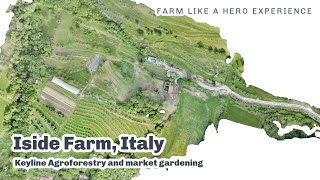
Matteo and Paola built a 6-hectare farm in Italy combining keyline pastures, agroforestry, and perennials with sheep and donkeys. They grow 250 olive trees, some yielding 120-130 kg each, and run a market garden for cash flow while their longer-term systems mature. Early funding challenges forced costly structural choices and a family loan to buy the land.
Chapters
Okay. Welcome to a new episode of Farm Like a Hero. Folks. I'm Richard Perkins. Today I'm here with Matteo and Paola who run Easy Day Farm in Italy. It's a 6 hectare farm started in 2016 and is based around a keyline silver pasture system producing nuts, olives, fruits, berries, with sheep and donkey herds moving in between, as well as a market garden focused on biointensive productions that really fosters soil building through cover crops and soil preparations, etc. And I know this couple have a great passion for experimenting with innovative methods and farm ready technologies. So I'm super excited for the conversation. Folks, thanks so much for joining us today.
Thank you.
Thank you.
So you folks have. You've been there six years, building up a beautiful farm, having kids, managing kids and business and family. Tell us a bit, what led you to setting up the farm? How's your journey's been into this? How did you get where you are today?
I start. Okay. I met Matteo while I was thinking to easy death, which was a dream very. Probably very different from what it is now. Sorry for my English, but yeah, let's say I turn in farming because. Okay, I study as a agronomist, but then I did the mountain living until I broke my knee and I came back to my first dream, which was.
Farming, which is much better for the knees.
Not really, but my knees went pretty well while I joined to my real dream. While leading mountain was something I like to do, but for me there is a huge difference between what you like to do and what you want to do. When I realized that I couldn't go on leading people on the mountains, I just watched my refrigerator, fridge. There was. Yeah, there was hanging there since probably 10 years draw and it seems to be a permaculture draw. And I still didn't know what permaculture was. I realized it was something close to permaculture. When I really watch it, like, okay, that was my dream, I can come back to it. I have to change a life. And then I start to follow permaculture course and I met Matteo. So this is one of the case in which life brings to you things that works together. When you. Yeah, when you get the. The right flow of the life. And then also I went to bank to ask for money, but money came before the bank entered the dream. So I can't say many things happened that conspired together. Yeah, the choice was the right choice. And so since now we didn't have real depth. Okay. Which is I think a good thing. Compared with our colleagues. And yeah, Matteo has the experience I didn't have and that's it. And then he came and he can tell the rest of the story. He made me pregnant so I couldn't really join the farming. No, I'm joking. But yes, I would say he drived the easy the idea more than oh, we drive it together. I mean. But yeah, he has experience, so I didn't really said something against what he said, what to do. I mean, and now we. Yeah, we started with market gardening because it allows us to connect with locals, with people, with customers. And now we probably are going back to what we really like, which is more connected with animal and stuff like that.
So really creating gardens to cash flow things, while the perennials, obviously they take longer time and time to set up. And yeah, Matteo, how was your journey into all this? Like where did your interest begin and what was the pathway before you met?
It was around six years old. Six, seven years old. Probably in the bathroom where we had. My father used to keep John Seymour's book on self sufficiency. I was just looking at the pictures all the time and I really also didn't like much the school system, anything that felt like an institution. Then I studied agricultural. High school was a very good one with a big farm, with all sorts of things. It was conventional, but there was rice, cereal, like silviculture, orchards, gardens. We have the second best soil lab of the region. So it was a very good school. And then I just. But I always loved the whole. The whole thing about agriculture, about permaculture and organic. And then two days after the last exam I just left with bike. And then for many years I've been traveling and working in different places, Europe, Australia and Mexico, just going to courses, going to farms, following those ones that brought the books that I was reading about. So always keeping on starting doing courses, but also putting into practice. Then I came back, I started a farm with some of the friends on another lake and there we started a market garden and broilers and egg. Egg production. But then I met Paola and I started again. So that's basically my story.
Super nice. And so what were key like keylines been a big thing for you, right? And agroforestry, like is that things that you picked up in other countries when you were traveling?
Yeah, I mean all the elements, they just came here and there by visiting, by working to farms or following courses. So the key line, in reality I'm not an extreme expert, but in the farm we just have a. A Small part which is. Which is a key lane system. Agroforestry. We are trying to implement it quite a lot all over the farm, even in the market garden area, where normally everybody keeps more or less the whole land free from trees. So we are pushing a little bit hard. We know that many times we will not harvest what we should harvest. But still, as I told you, we are we. For us it's very important to experiment in order to create some systems that could be used also by other farmers.
Yeah, yeah. So what was the. At the starting point, what was on the land already? Like, it seems like some of the trees systems were maybe established.
Yeah.
Could you describe like what did you have to start with six years ago?
Like it was olive trees quite a lot, like 250. And some olive trees are very big. They can reach 120, 130 kilos per tree of olives. So these we found they were a bit abandoned. So little by little we had to reform them, reshape them. And I think in the next years we will increase more and more the production. And then there were abandoned raspberries and currants. And apart from that, Yeah, I would say few fruit trees, old fruit trees here and there.
Yeah.
All the rest we started.
So then how has that been for you, Paolo, to see? Like did you sort of talk about ideas you were going to do or did you lay them out on mapping and paper? And did you sort of see your dream coming alive in that?
I would say both we grow something on map, but actually we also follow. Help from government that push up as to do before, for example the fruit trees, orchards. And probably we would have done things different without this money help fundings.
But that limits. Do they put limits on what you have to do?
Yeah. No. Okay. It was a quite free system of funding. But to get in the farms we had to rush with something like culture. And so probably we left. We are related with structure, for example, which are a very huge part. And I see now that probably it has been. Okay, let's see. Mistake. But wasn't a mistake in. I mean we are experience. We didn't have experience. Okay. Now we would have structures. Probably things will be much easier without. Probably, let's say our balance doesn't really. It's not really in a good position right now because we have a lot expensive expenses that are not in the production system, but are like.
Affitted rentals, rentals, house rentals.
When we will have. Now we have the permission to build and we still have something left about the budget. So we are in a good way to resolve our problem, but to solve our problem. But probably our hugest problem problem now is the house and all the other structures that we need to be competitive. So we spent a lot of money to bring things to be. To. Start transform our first production. So we go very far to. And we will do it in our farm in the future. And for example, we have expensive rent. We have. I don't know, we don't have where to put things. The right place for everything will be very easier for us to have a place for everything.
Is it that the whole farm is rented or like. I didn't understand your story before, how you happened on that place actually.
Okay, we build, we bought the land. It's our property, just agricultural land. I see it's boat. That's why we can plant fruit trees and so on. Sorry, do you think it's a problem with children like this?
That's how my life looks most of the time. So it's fine.
Yeah. We could buy the land because of my uncle, which is American and he helped us before the bank. Let's say I was looking for. Before this land. I was looking for a very close land, but smaller, was about 2 hectares. But the owner at the end didn't want to sell it. And that's why we joined this new hugest project, which was much bigger with another friend of mine that she didn't join at the end, but I could, because my uncle. I mean, my uncle.
I was looking at the aerial photo that people I guess will see on the thumbnail.
So.
So there's no. Is it like ruins that are there? Yeah, yeah. Okay.
Our property yet?
More from Richard


A review of short and intensive season on a mixed farm and restaurant/event space in Sweden






Alskade Kyckling Exploring complexities of poultry production in Sweden and what we stand for


