FARM LIKE A HERO EXPERIENCE: James & Rosa from Tap O' Noth, Scotland
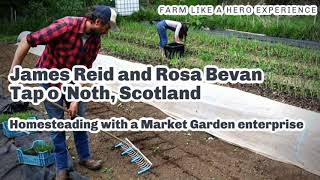
Richard Perkins visits James Reid and Rosa Bevan at their farm in Aberdeenshire, Scotland to discuss how they practice permaculture and sustainable farming. They cover the farm's history, daily operations, and the specific challenges they face running Tapper Noth Farm.
Chapters
Okay, welcome to a new episode of Farm Like a Hero, folks. I'm Richard Perkins. Today I'm here with James Reid and Rosa Bevan of Tapper Noth Farm in Aberdeenshire in Scotland. Started in 2012, this rural farm is about 3 hectares and is built primarily around a market garden which runs as a CSA 20 weeks of the year. They also grow a lot of perennial crops and raise free range chickens, ducks, geese and also goats for their home dairy needs. Super excited to hear about this project in quite rural Scotland. So thanks you two for taking the time to be with us today.
That's fine. Good to see you.
Awesome. Tell us a bit how I know, James, you arrived at that site a few years before Rosie, you joined. And tell us a bit how you ended up there. You're in quite a rural setting. Right.
So, I mean, first off, really, it's a family property, so. So owned by my mum. My mum lives next door. They were lucky to have two houses on the site and we'd always wanted to sort of have a family small holding, I guess. So we came here as a family and set the place up in 2012. We picked the farm because really on things like prices, the land was a lot cheaper in this part of Scotland than it was in others and more available because a lot of the land is locked up in estates, so sometimes it's very difficult to even get the land. But the project, the idea was to set up a family small holding, obviously from my background is within permaculture, so the kind of idea of following that prime directive of taking responsibility of your own needs was what originally got me going. And over the years that changed to wanting to focus on an enterprise and actually see what we could do with these ecological principles and prove that we can, you know, add to the local economy and grow food. Because there's the one thing I'd always heard was that we, you know, you can't make money from farming was true. So that's what got me here.
And then how did Rosa appear?
I actually came as a volunteer. So I arrived in 2017 and I've been working kind of in urban farms down south and I just moved to Glasgow and I knew that I wanted to start something up in Scotland, I thought, or I was actually looking into studying some kind of anthropology of food and food history, but I wanted to learn more about csa. So I basically came here and then didn't leave. Kind of running the co, Running the farm and market garden together ever since. Yeah, yeah.
Awesome. And what's the like, tell Us a bit about like how you got into farming. Was that, James, for you and your family, was that something that you grew up with a bit in your childhood?
I grew up with very keen gardeners. My grandparents lived and worked in what was Ceylon, now Sri Lanka, as state workers and things. So they had a small holding over there. But no, I've got. Neither of us have any official agricultural backgrounds. But it was permaculture really that got me hooked on everything to do with this. So I did. I completed a PDC in 2003 with Robin Francis at Jambone Gardens in New South Wales, where I was living. I was living in Australia at the time. Never really heard it. Well, in that area of Australia you hear this P word floating around a lot and the designs caught my attention in the manual and that really got me hooked on learning how to design. So. So completed the pdc, came back to Britain and yeah, it's kind of been well since 2003, working up to try to find somewhere in Scotland. Had a year in Portugal, learning, working on a farm there. So a little bit of insight into different climates, but mostly our climate here. So yeah, no, permaculture design really was what propelled me to here. Whereas you've got more of a. Yeah.
I studied zoology and kind of went in a conservation direction and farming was not something that I'd always, always had an interest in food, but farming itself was something I really had a very basic knowledge of. You know, I grew up in London so I didn't have farms around me and I really just visualized, you know, monocultural systems and something that I didn't really see as anything very natural. So. So it was only when I went and I started working in conservation, I was living in Central America and that was when I kind of first started to see more sustainable forms of agriculture and places that look like the rainforest, but actually loads of food was growing in them. And I started to hear about permaculture and really it just grew from there and I just thought I need to learn about farming in this way, you know, that basically as a form of conservation. But it seemed a lot more hands on than the kind of conservation that I'd been in where I felt like it was all quite kind of closing people out as the solution. So I saw it as quite promising and exciting. So I went down and kind of worked on urban farms and community gardens in London, but kind of still felt the draw to be maybe more rural. Yeah. And that's how I kind of found my way here.
You went ultra Rural.
A lot of people question if it's just. Well, it is very different to London, but it's good. I like it.
I wish I'd had more of a chance to maybe like, you know. You did an internship with.
Yeah, I started at a place called Keats Community Organics, which is in. There's not as many. It doesn't seem urban farms in south London, but it was a kind of. In southeast London. They're really cool. And yeah, I did an internship and then got a job with them.
So.
And that was all restaurants and salads and very much like, you know, small crops and quick growing crops. So here it was the first time, you know, I saw big cabbages.
Yeah.
Broccoli and things like that that I hadn't actually grown before. So it's quite a learning curve.
Yeah, I think I would have enjoyed doing an internship or I haven't really even gone woofing, you know, I've been in a lucky position, you know, especially working with family. There's quite often when we take volunteers here, they ask. Ask us for advice on how to get a piece of land because that's the sort of dream for a lot of people and we can give them advice on different avenues to take and different ideas and things. But for me personally, you know, obviously I quite a lot of. Yeah. Had some luck with the fact that I had a family who wanted to work with this kind of WhatsApp.
But I mean that's quite traditional in some. Traditional and untraditional because often people. It's a family farm and then they end up, you know, farming there. So obviously it wasn't a family farm before but, you know, kind of being able to generations to work together with that.
What is the relative sort of land price there? Obviously it's cheaper and Scotland and further south in the uk, but what. How does it. You're saying it's cheaper than other parts.
Of Scotland also, you know, which area of Scotland we're in. So we're in Aberdeenshire. I mean, obviously Aberdeen is or maybe was the oil capital, one of the oil capitals of Europe. I'm not sure anymore whether it's got that claim problems of oil. But. So things can get quite pricey as you get towards the city. We're an hour from Aberdeen city itself. Whereas when you go up further north, up in above Inverness, it starts getting a lot cheaper but maybe tougher land. It's a lot, you know, a lot more bog. Peaty soils and things. Whereas we're pretty lucky here. We're right on the edge of quite fertile farming. I mean, Aberdeenshire is incredibly well known for its farming for beef and so a good, very good grass growing area.
We're surrounded by a huge farm as well.
Yeah, we really are in barley and a little bit of wheat, but not much barley, oats, wheat, completely surrounded by a farm. So that's kind of the landscape and the farming. But yeah, our little eight acres is kind of just on the edge before it starts going up onto the hill ground behind us which is covered in heather and a lot more acidic soils. So that was maybe, you know, again, I've learned so much over the last nearly, nearly 10 years of living here. I mean, when we looked around the site, it took maybe only 20 to 30 minutes before we knew this was the site for us. But I've certainly, if I could look at property now, I think I would have. There would be a lot more things I'd be looking out for.
Tell us about that. There's a few key, key features you wish you'd hear.
I mean, the housing. The housing really lets us down from a design point of view. If we're looking at, you know, if our goal is to try and create a design that's going to look after itself or be as cheap to run as possible, or efficient and abundant. The housing, unfortunately, because it's a very old house, 1886, the cottage that we're in right now, and you know, it's lath and plaster walls. So of course we could try and do something, we could try and retrofit, but it would take a very long time and a lot of money to do that. So the house, yes, is probably the most expensive thing that we have to look after with regards to heating. We're still on oil central heating in the house. We looked into changing that when we first arrived, but it was a relatively new boiler. So, you know, we thought, why just work with what we've got? What else would we change?
We'd maybe have a little bit more kind of outbuilding, infrastructure for storage, any kind of, well, much dry space at all. So when it comes to kind of the animal side of it, it's a bit difficult because, you know, storing lots of hay or making hay and then, you know.
Difficult.
So yeah, some infrastructure we've had to.
Pretty much make any, any sheds or barns we've, we've made ourselves and we're working on quite a limited budget.
More from Richard


A review of short and intensive season on a mixed farm and restaurant/event space in Sweden






Alskade Kyckling Exploring complexities of poultry production in Sweden and what we stand for


