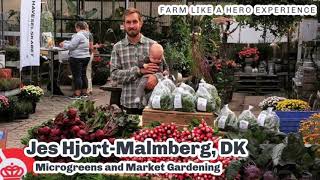
Jes Hjort-Malmberg left a lucrative insurance job in Denmark to start Okertopen, a microfarm producing year-round vegetables and microgreens. Microgreens now make up half the revenue, sold at local markets and restaurants. The shift meant financial sacrifice but gave him more time with family and real satisfaction.
Chapters
Okay. Welcome to a new episode of Farm Like a Hero, folks. I'm Richard Perkins. Today I'm here with Jes Malmberg of Okertopen in Denmark. It's a micro farm started in 2018 after Jes quit his job in the city. At the same time is having his third child and now produces vegetables and microgreens year round with the aid of a passive solar greenhouse that's for sale through two local markets and through restaurants. So just like so much for taking the time to join us today.
Thank you for having me.
Awesome. So you had quite a well paid job that you sacked in to become a veg farmer. Tell us a bit about your journey into all this.
Yeah, well, it was a bit of a journey. Like as many people reach some point in their life where they just need to make a change or for me, it was definitely the children. After we had our second child, I was really starting to how to say it, like think about or be aware of what I was doing. And I was always being into eating healthy and all the vegetables and stuff. And you know that Richard, when you have a child, you think about stuff you never thought you would think about. So it started as this way of growing your food for your family and that need. And I felt like a really joy doing it. And I've always been very like optimistic. So I've pretty much done what I wanted to do my entire life. And when I was an insurance and finance broker previous to the farm job and I thought I was doing something in sales and that was my calling or my thing. But it turns out it's just, I'm actually not a good salesman. I'm just good with people and relation and all that. And I never thought that farming was the way for me to keep on doing that, connecting with people and in that way. But yeah, to take you from the start. Like in 2017, I quit my job without having like a plan. That sounds like a good start. No, but I was aware enough. I've done a ton of research on the Internet, watched all the videos on YouTube and read the classic books about market gardening and all that. So I was pretty well informed. But I needed the experience and the practice because I have zero experience with growing vegetables. I haven't done any. I haven't. My, my parents not have not had a farm or I haven't had any education in it. So it's pretty much hands on and just learning down the road. But like my greens was the, the, the gateway drug, if you can say that for me. The. Yeah, the other job alongside the other job I had, I was testing and trying to grow, grow the microgreens and eventually got good at it enough for me to sell it. And then I realized this is like, if you put all your energy into it, I might end up doing it full time. And as I said before, I'm very optimistic. So I believe that with patience and optimism, I can do pretty much whatever I want to do. So. So yeah, that's, that's the, That's. That was the start of it. So I started 2018 full time. Well, I went full time even, like, I had a salary. Like I had a Tesla and all that money and stuff, but, like, I hadn't saved any money because I was just spending them. So it was like, I have the same amount of money now when I had as I had back then. So it's just. I started basically with nothing. But it was like it was a switch for my wife and our kids. Like, we turned our life upside down. We sold our house, moved in where we live now with exactly where I was born with my parents. It's a big house. So we, we have now reconstructed the house. So. So we live like two families in the same house, but like separated. So with our own access and own driveway and all that. Because that was the way that was the. Like, the farm is here. And that was another wish I had that I wanted to be more with the kids and more at home instead of just driving around and meetings and all that. So it was a step back, like a big step back financially. But also, we made a lot of sacrifices in order for us to get where we are now. But we were totally on board with it and it has rewarded us so much in so many other ways than the financial. Yeah, yeah.
Enriching. That's awesome. And by the looks of it, I mean, just looking through your social media and things that, like, you'd never know that you didn't have experience two years ago. It looks like the productions are going sweet now.
Yeah, well, it's. Well, of course not all of it is going sweet. You know that. It's, It's. But yeah, you learn so fast when you do it, like when you devote all your time to do it. And I knew that if I wanted to get good at it and make a living of it, I couldn't find, like, I couldn't put my 50% of my energy in the vegetable and 50% in the insurance job. It would simply wouldn't work. So I went like 120% on the vegetables from all the microgreens from the get go and really just wanted it to make it happen.
It looks like you're producing quite some micros. Like what's your markets reach? Like what's the sort of customer base you're able to sell to?
Well, I think I sell 50% is probably microbeams of the total revenue on the farm.
Okay.
And. Well, I started with the microgreens because it was. I quit my job in November 17, so not a lot of vegetables grow well in, in. In Denmark in November. So But I was like I had success with the microgreens, growing them indoors. So that's why I like I started that and cast kind of known for it in my little area in Denmark and people started to realize that this is. It was. Well, people knew about pea shoots and stuff, but it has always been something you ate at a fancy restaurant and stuff. But then I made some salad mixes with the microgreens and then people saw it as a sell, not just a fancy topping for. I'm located nearby the fifth biggest city in Denmark. And it's not that big I would say probably compared to some of the viewers. Denmark is a small country. The city I live nearby have around 80,000 people living in it. It's a decent size for a small country like Denmark. But it's. Well in my view and a little bit still. There's not a lot of. It's not like if you go to Copenhagen or who's in or the bigger city in Denmark. There's a. There's a trend going on with more food culture. Yeah, exactly. It's not like that at all in Espionage where I'm at. But it turns out that when you just start to. When you show people like I grow this organic microgreens, locally grown, fresh, tasty vegetables, people just like they appeared out of nowhere. It was funny to see how there actually were a lot of customers who wanted that. But it's obvious if you don't. If they don't have the choice, if they don't have the option of buying stuff like this, well, you never find. You'll never find out if there's a market. Yeah.