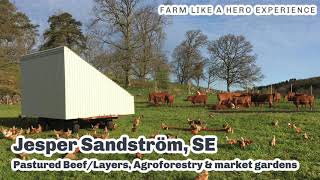
Jesper Sandström left polymer chemistry to run a 30-hectare organic farm in Sweden. After buying the land in 2015, he shifted toward permaculture methods, ditched tillage, removed pigs and sheep, and added layers while expanding his market garden and fruit trees.
Questions this video answers
2011
2003
2015
30 hectares
7,000 square meters
Chapters
Okay. Welcome to another episode of Farm Like a Hero folks. I'm Richard Perkins. Today I'm here with Jesper Sandstrom of Kirkby Gourds in Sweden. And Jesper is actually a participant on our first online training. And he runs a really nice diverse 30 hectare farm. Pasture based farm with beef cows and a Ridgedale style eggmobile running amidst agroforestry systems. I think he's into planting nut trees too. So we'll talk about that. As well as running a no dig market garden. And Jesper also collaborates with three other farms and a micro dairy to run a collaborative farm shop. One of them is Molly, who will actually speak to in the next episode, who is a former intern here at Richdale. So I'm super excited to hear how things have been developing. Jesper, thanks so much for taking the time out to be with us today.
Okay. Hello.
So tell us a bit, Jesper. What's your background? Because your land's been under organic certification for quite a long time now. And how did you. Were you brought up in farming and what's your journey been like to get to where you are today?
No, I haven't been brought up in farming. I studied chemistry at university and started working with rubber development of rubber materials. But I was now after 25 years I understood that I really never liked that. So I actually quit my job 2011 to be able to take care more care of my family and my children. And I was thinking about what to do next. I was thinking about starting up a lime seed paint production. With my background in polymer chemistry, I thought maybe I could do this better. I had some ideas and maybe not the best ideas. So yeah, it's good. That never happened. That's good. In 2015 we moved here to where I live in Slatvokra in South Sweden. We moved here 2003. So that's 17 years ago. And yeah, we moved here since we wanted a big garden and we have, we have a 7,000 square meter garden here which is, it's a big garden and I was. So I've been growing vegetables for many, many years. And now when we got this big garden I could increase that interest and start. Could start to plant fruit trees. Fruit trees has always been an interest. So that was happened. We planted trees and we planted. Yeah, growing vegetables and this 7,000m2 garden became too small. So I started to think what should we. I got very interested in permaculture. So how could, how could I plant a fruit. Fruit forest? That was a thing I started to think about. And yeah, suddenly 2015, a friend of mine, the closest farm here, said, my farm is for sale. And this, this. This was a cattle farm, 30 hectares. And it has been organic certified for. It was organic certified for 16 years at that time. So now we have continued with that. So now it's been certified for more than 20 years, which is fantastic.
Yeah.
So I started to think, okay, so.
Just to clarify, Jesper, you bought a family house in the village because there's a house on the farm, isn't there? But that's rented out.
Yeah.
Because you already had a house when you bought the farm.
Yeah, yeah. We live beside the farm. So still. And since we have a nice house here, and I haven't had the possibility to convince my family to move to a farm yet. But we'll see. We'll see. So. No, but I was thinking, okay, the nearby farm is for sale. It's not very expensive. It has been certified for 16 years. It has a very good possibility for a fruit forest. How often will that happen? And then, as always, I thought, oh, no, this is too early. If it could come in three years, then it's better. But not now. But okay, I realized that this was the opportunity. So. And after. Yeah, it's a long history, but we were able to buy this farm. Yeah. First someone else wanted to buy it, but then they quit. And yeah, suddenly we had a possibility, so we took it. That's how it is. That's how it started.
So what was your vision at that point? You just wanted to plant a great big mother of a food forest?
Yeah, actually more or less it was. And. And yeah, we had 20 hectares of arable land and I thought I could grow some high quality grains on those lands. I was interested in that. Like healthier grains. That was my idea, but nothing more than that. And I asked a friend in the village here if she were interested to participate in this project, because I realized that this will be quite difficult. And she was that kind of person that loves animals. A horse lady, if you want to say that. And she said, yes, I want to participate. I want cows. Okay. So we ended up. We ended up. It ended up that we bought 10 heifers, 10 lambs, nine lambs, four pigs, 20 turkeys, and started up and started to grow vegetables, traditional, organic way, till the land crops in rows, livestock in three hectare paddocks. Yeah. And we did that for like three years. So that was how it started. And I saw from the beginning that this land is not feared. This is not good. This land we have no flowers. I have beehives here in my garden in the village and I have beehives at the farm. Still have it. And there were no flowers at the farm so we didn't get any honey.
But you did in your garden.
Yeah, yeah, exactly. So. And so I thought about that. I was thinking about that. But I realized that when I looking around at the fields, all fields are green. There are no flowers here. We cutting. We asked the neighbors. We are cutting down the grass exactly when the flower starts to come. Yeah, so. So I didn't like that. So we planted some, some insects. Insects. Planting just flowers. But I felt like it was, it was, it wasn't. I mean most of the land was organic but it didn't have a high diversity.
Yeah.
So. Yeah. So I was continuously thinking about this fruit forest and I was starting to study. Mark Shepard was my first contact with other way agriculture because I was interested in planting trees. So I really liked his ideas with keyline design and. Yeah. And all that. Yeah. And then I visit you. I don't know if you remember, I was at one of the market garden courses. Yeah, the first one. And so Mark Shepard made me interested in another way of grazing and at that time you made me interested in another way of grazing. And then I joined your. This online course, the first one when we were a group and that was very good because then I really understood that I. I need to stop tilling. I need to graze in another way and need to. Yeah, I need to get rid of the pigs and get rid of the sheep and start with. So you did that start with layers. So a lot of things happened then. 2008.
Yeah, you, you got rid of the sheep and pigs. Do you. Is that. Was that a good move? Looking.