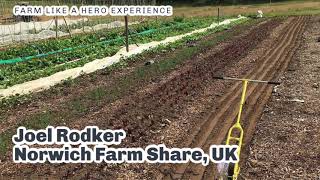
Interview episode of 'Farm Like a Hero' (YouTube) in which Richard Perkins interviews Joel Rodker about Norwich Farmshare, a community-supported agriculture (CSA) in Norwich. The conversation covers: the CSA structure and governance (community benefit society), scale (about 130 members; started 2018), and operational constraints; Joel’s personal farming journey (childhood exposure to smallholding and rare-breed animals, university allotment, degree in environmental science, WWOOFing across Europe, nine years teaching geography and setting up a school garden, a year trying to grow in Dordogne, France, difficult market-garden start near Peterborough in 2018, then joining Norwich Farmshare with colleague Jack in early 2019). The episode explores motivations, practical challenges, and community food-resilience themes.
Chapters
Okay. Welcome to a new episode of Farm Like a Hero, folks. I'm Richard Perkins. Today I'm here with Joel Rodger of Norwich Farm share. That's a CSA vegetable and herb production with 130 members started in 2018. Norwich Farm share is a community benefit society and Joel and his colleague Jack are the primary growers there. Legally, it's a structure that requires a board made up of voluntary people from the community that covers things like legal, finances, communications, etc. Which brings some interesting opportunities as well as constraints for the growers with regards to their decision making. It's an interesting model grown out of community discussions back in 2010 from the transition town movement. So I'm really excited to hear more about how this community is dealing with its food resilience and the pros and cons of this approach. So, Joel, thanks so much for taking the time to join us today.
Yeah, it's a privilege to be part of the tour.
Hmm. Welcome. And, yeah, I wonder if we can just start with your beginnings, like, how did your journey with farming begin?
So, I was brought up in South London. My parents have a garden, so I was always in the garden, but my mum's parents bought a small holding in Sussex in the 50s or 60s and they had rare breed pigs. And my grandfather, who was an actor, had an organic vegetable garden. I guess before organic was. Was kind of a thing. And they used to enter the animals in shows all around the country, rare breed pigs and chickens. So I used to go down with my mum every weekend and collect the eggs and feed the chickens and help in the veggie garden and take the pig for a walk in the forest. So, yeah, it gets a bit unusual for a Londoner that I had this exposure to the kind of farm life. But there's a big contrast with what I'm trying to do now in the sense that they were never doing that for money. My grandmother used to sell a few eggs to neighbors, but it was very much a small holding. But, yeah, I loved it. It was great. And that exposure to animal. I used to spend hours sitting in the pen with the piglets and just loved it. So that was a very positive experience for me. Then I went to university in Norwich and got an allotment straight away, which I've still got 25 years later or something. So I just. Yeah, I guess somewhere inside me there was a desire to grow, but I never really had the time to do the allotment properly. So I would sow stuff and I wouldn't be there to water or harvest. But I love going up there and just playing around. And then, yeah, then I was at uni. I did a degree in environmental science, so that was much more academic. But yeah, my interest was in environmental politics and how that impacted on the ground. But I suppose I wasn't really doing anything apart from the allotment. Growing wise. Then I worked in a vegetarian restaurant that was run as a co operative for three years. Then I cycled around Europe for two years and I joined lots of WOOF organizations. So I did WOOF in Romania and Poland and Italy, Spain and Portugal and that was really interesting and the cycling and meeting people was amazing. But I never really worked on a farm where they were not like the farms that I'm kind of in contact with now. People were doing tourism or it was like a sort of hobby. So I never really had the experience of people running a really profitable ecological small scale farm, which is interesting. Yeah, I don't know what, what the reason was, maybe I just didn't find the right farm, but I wasn't really looking for that specifically. I was just looking for nice places to go. But I loved it. Yeah, I worked on sheep farms and organic veg gardens, etc. Then I came back to England and I was a teacher for nine years teaching geography. But I set up a school garden with a pond and tried to get kids involved growing food, which had a lot of challenges. But you know, there were some kids that loved it. And it was interesting for me because so many of them didn't have the body strength or the, or the knowledge. You know, they could hardly put a spade in the ground or they didn't know what crops were. And I showed them what they could eat and they loved it. So for me it's always been important, kind of sharing that knowledge and enthusiasm. But again, it wasn't, you know, so hard to run a garden in the school when you're trying to teach GCSEs and A levels and that just isn't the time. And then the summer, there's nobody there. So then my grandmother died and I was left a bit of money and I started thinking, you know, maybe I can just put the teaching on hold for a bit and try and do something that to do with growing. I wasn't really sure what. My grandparents had bought a house in France in the 50s or 60s and it was a ruin and they sort of redid it and it had about three acres of land, beautiful part of the Dordogne in southwest France. So we used to go out There every summer. That was my holiday for most of my childhood. And I used to spend where we all spent the holiday, basically weeding and strimming and kind of getting the garden looking nice. And then that would be the end of the holiday. We'd come back. Not everybody's idea of a holiday, but I guess again, it was a part of the farming and the being outside. So then I left my teaching job and went to live in the cottage in France for a year to see if I could get into growing there. I was really interested in walnuts because it's a big walnut growing area. I was trying to find out about that and maybe keeping goats. So I spent about a year there and grew a lot of veg, but realized that unless I committed to it full time and had, I think the minimum would have been about 20 hectares of walnuts to make it work. And obviously the time to get to a profitable place. You know, I wasn't there for long enough and then my mum got ill, so I had to come back to England. She died in 2016. Since then, I've been kind of looking after my dad, who's pretty elderly. And then I got There was an opportunity to go to somewhere near Peterborough. Some farmers had some land. They were opening a farm shop. They wanted someone to sell market garden. So I went there in 2018 and started setting that up and that, you know, I learned a lot. But I was sleeping in a tent on their farm until December, and then I moved into a caravan with no heating and no water. So it was pretty tough. And then it was just difficult with the sales and the traveling back and forth. And eventually it just. It didn't work out. So I came back to Norwich and, you know, I guess in those three or four years since I left teaching, I discovered Jean Martin Fortier and Curtis Stone and then you and Elliot Coleman. And that sort of. It made me feel like it was possible to make a living from farming because having that experience of my grandparents in Sussex, I kind of. And being in France, it just seemed very hard to make a living growing vegetables. But these models seem to show that it was possible. So I guess I had that in the back of my mind and I was starting to experiment with those techniques. Came back to Norwich. Jack, who I work with now, was a sort of a friend, but I didn't know him very well, and he said that Norwich. He'd been working for Norwich Farmershare for about a year. But in December 2018, they've got an email from the person doing the finances, saying they didn't have any money left. They're basically bankrupt. The other grower basically left. She was just really pissed off and said that this is a joke and left. So Jack was on his own doing a day, a week over the winter. We got talking at the beginning of 2019 and just had a discussion about whether we could kind of ramp up production, get lots more members and have enough money to pay ourselves to do two days a week each. And that's what we did, basically. And yeah, I've been there ever since. So that was the beginning of sort of February, March 2019.
So you've always had this in your blood from. And even eking out of you when you're meant to be teaching geography.
It's always been there. But I guess what I've learned over the last couple of years is that if. If you can't, well, you can obviously do it in your back garden, but if you can't make a living from it, then it's not. It's not viable. And it's. Yeah, for me, learning all of that business stuff and the marketing, that's been a big eye opener. But I love it and it didn't come naturally to me. But that's a sort of new side of it which I've been learning about. Don't.