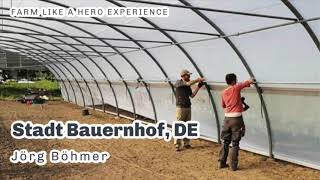
Jorg Bohmer runs Stadt Bauernhof, a solidarity agriculture farm in Sauerbrücken, Germany, where members pay to support production and volunteer together. The 1.7-hectare farm started with 60 member shares and now serves about 100 households year-round, plus restaurants and seasonal members.
Chapters
All right. Welcome to a new episode of Farm Like a Hero. I'm Richard Perkins. Today I'm here with Jorg Boerme from Stadt Barenhof, that Siddi farm in Sauerbucken, Germany. Solidarity Based Agriculture, or Solawi as they call it, offers interested people the opportunity to regularly get food directly from the city farm. They grow vegetables along with orchard crops, bees and laying hens. And they also specialize in some edible flower production delivered straight to different restaurants, including a Michelin starred establishment. The chefs also don't pay for their products directly. Instead they also sign up for the budget for the csa which runs year round. And it's an interesting farm that I'm dying to hear more about, including the Solidarity agriculture elements. So, Joerg, thanks for taking the time to join us at your schedule and welcome to the Farm Like a Hero experience.
Yeah, thank you.
Maybe we can jump right into that and tell us a bit like, what is Solidarity Agriculture? Because that's part of a bigger network that's going on in Germany, right?
Yeah, mainly I think it's very similar what's called CSA in other countries. But I just heard from some international people telling me that there are some differences and probably it's from what I learned on the Internet is CSA is more like people picking boxes and paying for them regularly. For our farm and for many other solar farms in Germany, it's a little bit different that people are probably more involved in production. It's not that people have to work obligatory in our farm, but we're very strongly linked with our members and people are involved in helping, weeding and planting and whatsoever is to do. And we have a lot of community events also taking part. Not this year probably, or not this, in this Corona period now. But yeah, general.
So it's really a way to invite people from the city into the farm, see how their foods produce. But it means, I guess that you spend a lot of your time mixing the production with managing people, right?
Yeah, this is true. And I know growers who say that it's probably not really helpful to have so many helpers because in some it doesn't give you any extra time. But I think it depends a lot on how you manage this. And I have to admit that we've not been good in this from the start, but yeah, we're getting better every time in organizing things. So we have things like after work weeding and yeah, we have a lot of events that are properly planned and then you can do a lot of things if you have 15, 10, 15 helpers.
Sure, let's come back to that then. But just for the reference, for the listener, tell us like the scale of the operation and in terms of like the square meterage under cultivation, etc. And then tell us a bit about how those work groups look like. How many people do you have coming to such events?
Yeah, so when I break it down, the whole farm with all the buildings and all the areas, 1.7 hectares. This is the place where we. What we run and there's about. So there's a restaurant here also and we have an association, a non profit organization, I'm a member. And also head off. And we rented this whole place from the owner. So there's a private owner, landlord. And we have this 3,000 square meters of buildings and so on. And we have some. Apart from this association, we have two private enterprises. This is the restaurant and the solawi. So it's three bodies kind of working here. And it's 1.4 hectares of green area, you can say. And this is. We have like 550 square meters now of greenhouses. And only if you really put it down to the net bed area where we really cultivate. This is 2,3000 square meters, depending on what we calculate. So yeah, there's a lot of pathways and walkways and public areas. So we have places where people can come together and have barbecue and playground for children and all this stuff. And we have some extra area, of course covered. This is intended to be fruit production, fruit orchards with laying hands. But this is still a project. So we already planted a lot of trees. But the laying hands are very small amount of just now.
So how does that work with the. Like it's got similarities to a csa, like how many members are you serving from there and how many of them interact with the sites regularly, they're coming through, et cetera.
Yeah, so we started with 60 harvest shares in the first year and now we have like 100 normal harvest shares equals 100 households of different sizes roundabout. And we have on top of that we have three restaurants as customers. More requests coming in. Just today I got a phone call for another restaurant is interested in our products. And we have on top for the summer season, we have summer harvest chairs, which is a very nice idea of a good friend of mine, because always we have this peak in summer. I mean, we try to do winter gardening and things like that also to flatten the curve in terms of vegetable loads. But we have a summer peak and therefore we have something kind of opportunity for new people to get to know, Stadtbauer and Hoven the products here. And therefore we have the main month like July, August, September, we give have some extra harvest shares. We started with 20 last year, this year it's only 15.
But yeah, that's a great way to get rid of those excesses. That saves you work of trying to store, preserve anything, etc.
Yeah, and it's quite easy with regard to organizing an extra marketing opportunity like going to the market or so. Doesn't really makes sense with our amounts of vegetables we have then extra.