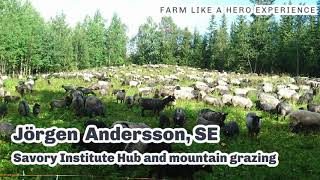
This is an interview from the "Farm Like a Hero" series (host Richard Perkins) with farmer and entrepreneur Jorgen Andersson (Fjellbetter, Nordic Savory Hub). The guest recounts his upbringing in conventional Swedish farming, his move to Jämtland/Åre, and a gradual, sometimes painful shift toward regenerative agriculture and holistic management after recognizing harms from conventional practices. The conversation emphasizes regional cultural dynamics (Åre as a ski resort with wealthy visitors, local independence), generational pride in farming practices, and psychological barriers to admitting past mistakes.
Chapters
Welcome to a new episode of Farm Like a Hero, folks. I'm Richard Perkins. Today I'm here with Jorgen Anderson, who runs Fjellbetter in Oren, Sweden, and is also the founder of the Nordic Savory Hub. And we posted a video with Jorgen on YouTube back in July 2019 where he presented a distillation of some of his wise thoughts and perspectives, which you may like to check out if you haven't already. And they're grazing sheep in the mountain pastures. And Jorgen's really run an innovative pilot project where local businesses and private customers have invested into the company, creating a direct link between the producer and the consumers. So in today's episode, we'll be talking about farming, but also holistic management and a sort of more global perspective as well. So I'm really excited for today's episode. Jurgen, thanks so much for taking the time out to join us today.
Yeah, thanks. This would be. This would be great.
So maybe we can start back, right, like into your past, like what was your journey into farming and how did you end up where you are today?
Okay, so I grew up in the. In the south of Sweden or same, same Stockholm level of stock of Sweden in a very conventional farming culture. So I'm very much from this farming culture back generations and all that. On the farm there where the dairy cows went away in the late 60s, so I could experience how those clay soils really got harder and harder to work with the tractors as the cows had been removed. I didn't. It was sort of puzzling at the time, but I could never connect why that was happening. And then later in life I took this leap and moved to Jamplan, to what is considered the north of Sweden, which is actually the center of it. So I live in. Yeah, it's halfway up. So I've been living for half my life, more than half of my life now in this place in Jamplan, which is a very different culture in many ways. Yeah, farm wise and entrepreneur. The way. The way people look at entrepreneurial things is different. It's a different culture here. So it's been a lot of dynamics. And Water Valley has been a super dynamic place where the most wealthy elite of Stockholm has been playing around for 100 years and where the local farming has been really the toughest conditions for farming anywhere. But there has been this dynamic between the meeting between this wealthy people and their ideas and the local, local countryside of this area. So that kind of dynamic is still here. And I really got sort of amazed by that as I moved here. I didn't know about that before I came here.
Just for reference for international listeners. Ora is a famous ski resort, isn't it? So that's what's drawing people up for the holidays.
Yeah. So it's been a big, big, big thing in skiing. But if 100 years ago it was more like people want to be healthy and breathe fresh air and look for flowers. And so it has been different things. But since the 50s, the skiing has been a big thing, a big attraction to come here. So yes, it has got a long history and also has a history of like, what do you call that? An English separatist. So the people of this area, they find they think they have their own republic, not really a part of Sweden. And that has got to do something to do with this local economy mentality, which is important as well. So I found. Find this place, interesting place to be where the future might not be what the past have been, where we're going into something hopefully more sustainable, different. Yeah.
So was there any key? I mean, you really, as a very humble man, I think it's. It's something you've talked about in the YouTube video that we put out before. But for folks that haven't seen that, like, were there any critical insights or moments in your journey from sort of conventional farming to regenerative ag? Like, were there any sort of light bulb moments or was it a progression over time?
Well, I mean, I feel I've been very privileged in many ways. I got to work for the. I was employed by the Swedish Federation of Farmers in this county of Jantan in this project in the 90s. So I had the privilege of dig in deeper into what is this about sustainable development and how can the farming community benefit from people becoming more interested in environmental topics? And later on came the climate things. So trying to figure that out and trying to figure out what is likely to happen when we are hitting the limits of physical resources as a civilization, et cetera, and then very painfully becoming aware of that. That what, what I've. I've been taking a lot of pride in being a good farmer, being able to sort of produce all that good food and all those things, and then suddenly coming to realization that what I've been doing is to prevent, you know, prevent photosynthesis, prevent diversity, prevent actual production of the land, producing the kind of food that people don't really need, creating unhealthy food and just feeding an industry instead. Those kind of very painful realizations. So that has been. I don't know if you call them a light bulb moment, but it's more like a slow, slow, painful process of daring to say that what I have been good at is to prevent nature, you know. Prevent nature to do what? If I would allow nature to do what it wants to do, it would be better. I'm using all my diesel and all my power to prevent it. So that's, that's. That's painful. Yeah.
That like. Do you agree with that idea of like pride and arrogance is quite strong in farming families of. We do it like this because grandfather did it like this. That seems to me to be one of the toughest nuts to crack, as it were.
Yeah. Yeah. And looking at it from the perspective of the farming community in Sweden, in particular in Sweden, I mean we have been saying that every 10th year the half of us are gone. And it's been like that for a long time. So this in order to try to stay on. It's like we are not wanted. You know, you are. So it has really been a long several generations of, Of. Of an environment that is really feeding bitterness. So it's easy to become a grumpy old man in this business that is sort of fighting. Fighting the world of feeling that the world are against you in every way, whatever happens. So that is that kind of general bitterness. Yeah. Yeah. So sure, victim is victimization.
Yeah.
Being victims. But that it is a bad path to choose to be a victim. But even though you have all the reasons, it doesn't make it a better path. Just makes you a grumpy old man. So yes, that has very much been the case in the. In the community where I come from. So then finding this whole new world of what we now call regenerative agriculture and holistic management is such a breath of fresh air. And the big thing is that it is providing hope for everyone. Hope for the future generation of farmers and for the. For the people and for everybody. But even that will become a may. May seem provocative for the. For the existing community. For the remaining community of farming farmers.
Yes. I mean it's threatening the very. The sort of ingrained habits and conditioning. You talked about the pain of your realizations and it's. That's why everyone would avoid it, I guess, is confronting their own mistakes.
Yeah, it is. I guess it's very natural. Of course it is. And to. Whatever you learned seems to so painfully often it seems to be like 180 degrees wrong. Not even close. Yeah. It's like nothing that you thought of your knowledge that was of value, you thought were valuable proves to be more like the opposite. So it is a. Yeah, it's a natural thing that it has to be painful and it should be. Let's. Let's respect each other for having such a journey. Yeah, yeah.
It's interesting. Something that's been on my mind a lot is this sort of. This deeper psychology behind these processes and change across the board. Not just in farming, but that's definitely a topic that's been. Been increasingly important to me. But that leads me to thinking the way you described the Empland is. It seems like they have a sort of somewhat of a fierce independence and the solidarity there. Is that the feeling you have when you arrive there?
Yeah, definitely. So there is definitely such a history of it. So there are historical reasons. This was an area. If you go between the period of 1750 and 1850, the. The. The public, the farming community would be more would be better off here than anywhere else in Europe when it comes to capacity of. To be able to read and write whatever you call that in English, being child newborns, surviving or any kind of those measurements of people being read, doing well. So they were doing better here than anywhere else. And that was due to a capacity or some lack and some capacity to hold on to the local economies and to have this ruminant based economy going in a way that was functioning, was doing really good for this area. So that is a memory that people were doing well here and that still remains some kind of a pride in people. And that comes together with a really tough. I mean this dairy based agriculture, agriculture community or culture went through hard times in the 50s and 60s and 70s.