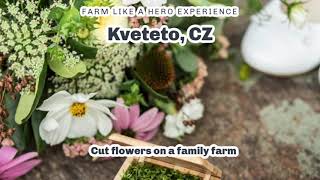
A Farm Like a Hero episode (YouTube) featuring Richard Perkins visiting Pawel and Anna’s Kveteto farm near Prague. They run a ~3-hectare property (orchard, tunnels, vegetables) focused primarily on cut flowers sold to weddings, farmers markets and florists; they began buying land in 2015, moved in 2016 and have grown to nearly one hectare of planted beds. The interview covers their background, learning sources, local market gaps (heavy imports of cut flowers), Czech small-scale/regenerative farming status, and land-price pressures near Prague.
Questions this video answers
Just under 3 hectares
About 65 km from Prague
Bought land in 2015; moved in 2016
Started in 2016
Almost one hectare of planted beds
Chapters
Okay. Welcome to a new episode of Farm Like a Hero. Folks. I'm Richard Perkins. Today I'm here with Pawel and Anna who run quite in Czech Republic. It's a farm just under 3 hectares, about 65 km from Prague. And they sell primarily cut flowers to weddings and farmers markets, florists, etc. Started in 2016, the farm also has got orchards and they've also started growing vegetables.
Welcome to our property. We will quickly show you what we grow and what we have. So we got about one big tunnel house here and more pretty grow flowers and tomatoes. At the moment. We've got other two tunnel houses up there. One it's for seedlings, one is for power extensions. And then if we look in the back, we've got the orchard in the back and some other places where we will grow in the future. At the moment we put green manure and we have got some potatoes back there.
We will go here.
This is our main plot. We grow flowers in here. Always irrigated by drip irrigation or connected to the main pipeline. First season of vegetable. So we learning. We also grow perennials, flowers which are here. We will slowly go to our processing places. The floor fruit lot where we started 10 more plots in the 2015. We are still in some working process. We're building a new workshop. So it's why we have a lot of this stuff around. This is our main processing place where we store and process flowers and vegetables. Also now it's also putting lots of working things here.
Flower production is a field that I'm excited for but don't know so much about. So thank you so much for joining us today, folks.
Hi, nice to be here.
Thank you. Yeah. Tell us a bit your backstory. Can you like, how did you end up where you are today? What's been your journey into farming and meeting and starting this operation?
We both went to universities and after the university we kind of were a little bit lost with jobs and then we decided to go for a year to New Zealand and we went to a place near Christchurch on the south island and we then started work in like a. What do you call it? Horticulture garden.
Yeah, yeah, like a garden center. And it was like a wholesale.
It was conventional. Yeah. And then we. We like the job. Sorry about it. So we basically forger for a full year. We stay with one lady, but because of the earthquake, her house was repaired for two months. So we didn't have to move to a different farm. It used to be a vegetable farm and actually when we arrived there, the man just gave us the book from John about the market garden. It was I think 2014 in the end of the year and we, we read it and we say, yeah, that's cool, that we should try in Czech Republic when we go back. But we kind of were more interested in other things like maybe we can try the flowers because there was no local flowers at that moment in Prague and around. So we started that and we started slowly. So we bought some land in 2015 and we moved in 2016 and also our son and second son was born. So it kind of complicated a little bit, but slowly we, you know, have a few beds in 2016, then doubled it. Yeah. And now we almost have one hectare of beds. So. And it's not like it kind of not grow sequently on one bed. We mostly do only one crop and we cover it or we put some green manure. So we don't. Because we have a lot of land we can use. So you don't have to kind of.
Yeah, we don't have to turn more crops on one bank.
Yeah, yeah. How common is this stuff in Czech Republic like regenerative ag and market gardening, flower growing and some of the other enterprises. Is it touched down there or are you sort of out there on the limb as pioneers, would you say?
I would say that we are a bit in a bubble like you know, with Facebook and Instagram. It's just. We think it's here, but it's not. It's not really small scale farm like with the vegetables or the flowers is beginning. There are few, few of them. And with the flowers we are trying to do like something like association or some organization to support it. So we really know each other. We do some meetings and so but yeah, so with the vegetables there are farmers, there are smaller farmers, but there are conventional. And really no regenerative agriculture. Not at all.
Okay. So you take on that extra work too. Hey, not nap time for you. You wanted to be on the show.
Yeah.
So that. How did that influence you? Like did you have to draw knowledge from the Internet and books and like you didn't really have peers around to support you at home there?
No, we kind of. Yeah. Lots of our knowledge is from books. Yeah. Have some knowledge from the, from the New Zealand. From the garden center.
So we know the basics.
The basics? Yeah, like more like the technical stuff as I was working more like I was supporting some technic on there. So about the education about some houses, how to build it and that stuff. So that actually come very helpful.
Mainly. Mainly books and YouTube.
Is there much out there for flower growing? I'm curious, like what resources you found useful?
Most of it is from usa, something from uk, but that's it. And there is not much, but you can find, you know, pieces of information and put it together. Hard thing for me because I'm mostly the one who like plants the flowers or plants where to plant everything. The hard thing for me is that when I find some information, I'm not sure if it's usable here in our climate with, you know, the organic approach. Because a lot of the farmers are conventional and do heat their hoop houses or the glass houses or whatever they have and put additional light and stuff.
So yeah, so you've had to translate all that to your time and circumstance. But what, I'm curious, what led you to start with flowers? Like what was the sort of driving force there?
You know, we are not sure. Everybody is asking us, but we actually. We are not sure. Probably it was just we were thinking that the flowers are really not here. You know, there was a big tradition in Czech Republic, like the growing cut flowers, but it totally disappeared because of probably our background like the historic communism, etc.
And also I think because of the import, most of them like 99% it's from. From Netherland and it's raw. Neither means it's from Africa or South America. So.
Yeah.
And. And the vegetable, I don't know. Probably it seems also harder for us or. I don't know, we are not sure what the turning point.
That's pretty brave thing to do.
I think we were also more thinking about something which is missing on the market in Prague and the flowers were one of the things we thought it's more missing than the vegetable because there is some ecological farm or beer farm for vegetable in Prague.
So organic.
Organic, yeah. What is the.
I'm curious a bit what the land price is there? Like when you're sort of deciding to purchase land and start up a business, like what does it look like in terms of land prices and the economy.
Now.
It'S quite hard to find like a house with a big, big field or something just next to the house and that. That's what we were looking for. And that's hard. And we were really lucky that we found this. We found it like it was listed like a cottage or something. Something different, not a farm. Because also because of the historic communism, when you find a house in a village, the field would be 1 km from the. From the house. Yeah, because they divided it somehow and some. So we were really lucky to buy it here, and it wasn't so expensive, like, when you compare it with housing in Prague or something like this.
Yeah, but we were kind of lucky because we bought it in 2015, and the prices actually came quite high now in Braak and Surroundings area. So at the moment, I think the price, like the common price for one hectare if somebody is selling, because that's not very normal. At the moment, it's about €12,000 for one hectare.
Okay. So pretty expensive.
Yeah.
Even compared to other European countries, it's pretty pricey.
And it's kind of like in here, so. But in more fertile land, like, like north of Prague, it would be like, maybe almost double. So it could be like 20 and, like, more.