FARM LIKE A HERO EXPERIENCE: Lubuskie Angus, PL
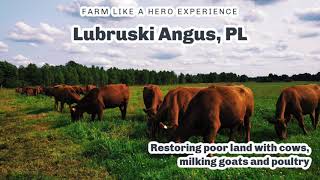
A filmed interview on Richard Perkins' 'Farm Like a Hero' series featuring Thomas Jackil of Lubuskie Angus, Poland. Thomas describes leaving a telecommunications career to buy degraded land and build a regenerative mixed farm from scratch to supply healthier food locally. He learned from holistic/regenerative authors (Joel Salatin, Gabe Brown, Richard Perkins) and is translating key books into Polish. Operational details include a pedigree Angus herd, a small dairy-goat operation for cheese, seasonal broilers, solar-powered infrastructure, and family-managed, low-equipment systems. He reports specific timelines and counts (see Answers) and ongoing construction and translation projects.
Questions this video answers
29 cows.
About 15 goats total; 8 are milked.
Approximately 4.5 kilometers of perimeter fence.
The house arrived on 28 June 2015 and they moved in on 15 September 2015.
They expected the first translated book (You Can Farm) around June of the next year (relative to interview).
Chapters
Okay.
Welcome to a new episode of Farm Like a Hero, folks. I'm Richard Perkins. Today I'm here with Thomas Jackil who runs Labuski Angus in Poland. He was recently on regenerative agriculture design training. I'm wearing his T shirts and starting out with Angus beef and milking goats and poultry. Thomas actually bought us a whole host of incredible goats cheeses and preserved meats that we enjoy together here. And super nice mixed farm. And Thomas has got a great story. So Thomas, thanks so much for taking the time to be with us today.
Thank you very much, Richard. I'm very delighted to be with you today.
Nice. Can you.
Thank you for the T shirt.
You also bought. You bought so many gifts. It's incredibly generous. Thank you for that. But maybe you can tell us a bit of. I've already seen around your farm and heard a lot of the story. But tell me, tell us a bit of your history, like how did you come into farming in the first place?
Okay. So I am the city boy. I have no agriculture background. I am telecommunication engineer working across the countries to serve my experience and knowledge with the telecommunication. And a few years back I tried to find my niche to. To do something different as a telecommunication engineer. I earned some bag of money and I wanted to invest this money. And I noticed that the quality of the food and availability of the good food, it's difficult those days. We have the nice shelf in the shops showing us it's organic food. But the question arises in my brain, what's the other? What's the other food? If this is organic and there is very healthy, what's the rest of the food? So I found this as a niche and decided to invest my money in the farm. And my goal is to provide the healthiest and the best food I can provide to my local community. So that was kind of the goal. Obviously it was difficult to do it from the beginning. We were thinking to buy the ready organized farm and start from there. But then we realized that it's so difficult to find a place we will be happy with, especially with the land structure, the size of the land and some infrastructure. So we decided to buy just the land in the middle of nowhere, really in the middle of nowhere and build everything from the scratches. The advantage of that was that we could decide how we can design the farm, what we can do, how we can do, etc. We obviously we had no background. So I have to spend a lot of, a lot of time to learn how to do the farming. The first attempt was just, just to do as ordinary people in Poland. So tillage, farm, heavy farm equipment, tractors, et cetera, et cetera. But then I realized that when I came across holistic management movement, I found that there are different ways. Then fortunately, I started to read the. Read the books like Joel Salatin, Richard Perkins, or Gabe Brown. And then I realized, oh, that's the way I want to do it. It's a niche not only for the quality of the food, but it's a niche of processes that are described in these books. Because I thought that. And I found that in Poland, this type of. The farming wasn't available. The people were not going with this kind of farming. Permaculture. Permaculture kind of view was there, but with a very small, small scale. Nobody show in Poland earlier that the bigger animals and the farm can be organized in the totally different way. And that that kind of. I try to merge together farming with education for the other people in Poland as well, to show them. Because. Because I. I have available to read and understand English and German. So it was much easier to me to kind of, kind of take this knowledge, translate to Polish and implement in Poland. That was the goal for it.
And you've been. I mean, you're in the process of translating Joel Salatin's you Can farm, right?
Yeah, we are working together with the group. We have a professional English translator with us. My role will be more as a marketing and promotion of this book. But we are in the process of translating you can Farm because there are not so many books available in Polish language to the Polish farmers at this time. All this knowledge is available in English. No problems. But very rarely, farmers can speak and read English language in Poland. Yeah, that's a big gap. And that's the reason we want to fill in this gap with the Joel's, Richard's books as well.
When is it you'll be. When do you expect that to be done?
The first book you can farm, we expected around June next year.
Perfect. That's gonna be amazing.
Yeah. So that's the plan. We. We are working at the moment to have the. A small bit translated, presented to the people, because you can talk to the people about the book, but if they don't get it, what's there they wouldn't buy? So we want to present few. Few parts of the book for free just to people to allow them to realize how important such knowledge is on those. On those books.
Yeah.
So that's the goal.
Awesome. Hey, and I know a little bit of your backstory. Are you sitting in. You Built your house in 10 weeks, right?
Yeah, yeah, yeah. So that's the log house. We live in the log house. We built this in the 2015 and I was basically the house was bought and prepared by. By professional factory, but it was assembled and finished by myself, my brother and my father and the professional crew. They showed us for the five days how to start, how to start it, how to do it, and then we continued ourselves. So the home arrived on the 28th of June and we started to leave on the 15th of September. Quick action.
Yeah. And so that's separated from the farm, isn't it? But you plan to build up another house at the farm, right?
Actually, we are starting this today.
Okay.
Today is the day we started the building New farm. New farm. Close to the farm we didn't want to buy. We didn't want to build this at the farm because our farm is placed around 800 meters away from the village and it will be difficult to get the electricity, like a grid electricity to the farm. So we decided to buy a land a little closer to get the electricity, but will be with the walking distance to the farm. So we bought this like three years ago. We started all the process to gain the building permission. We got this three weeks ago. And actually today it's the day we.
Start to build it. Thanks for taking the time to speak with us instead.
Oh yeah, yeah. All is exciting, but I don't know, I wouldn't, I couldn't. I have to be with you.
How long will it take to build this house then?
Oh, it'll be much longer process at the moment. I'm thinking to be completed by the end of 2022. We have no rush at the moment. We have place to live and we will be building this house along with this farm infrastructure. There will be a separate building for the small slaughtery for the broilers. There will be a special room for the cheese making and chiller. And what else is there? And for the special, the chiller, there will be two cheetahs. Actually, one will be for the broilers and the second will be for the beef because we are planning to mature beef and sell this to the local market.
Wow. Ambitious. And I know you're good at getting things done, so it's super exciting.
That's the plan. Yeah, yeah.
And so this is really symbolizing what you started with, right? You brought Angus to start an Angus herd and then you've got milking goats and poultry and you already build up a lot of experience with that from scratch, right?
Yes, yes. So we had no farming experience whatsoever. My wife, she's a nurse and I am the telecommunication engineer and I still work with the Telecommunication because it's obviously it's difficult to get the funds to build everything. We would have really farm from scratches. There was the naked farm, naked land, very destroyed land. And we had to renovate it. We had to build around four and a half kilometers of perimeter fence. That. That was a big achievement for us. And we had to build all the infrastructure on farms. So we have a sheds, we have the well for the. For the water, everything and all the farm is based on the solar power because we don't have the electricity there. And we were able to manage all our animals with no heavy equipment. We still don't have. We don't own even the tractor as you. We have a quad bike, we have the trailer. So we move everything with a quad bike or navara if it's needed for more power. And we have three peel fillers, three foundations of our farm. That's the Angus. We have the pedigree type Angus herd. We breed them and we kind of the calf cow operation. So we have that at the Moment we have 29 cows. We breed them, we keep the calves to the age of 6, 7 months and then we sell them to the different farmers for keeping them longer. At the moment we have quite good reputation in Poland. So our calves, especially male they go as reproductors to the other farms. Usually they buy us from us. And also because we invested in with the professional eye for Williams trailer. So we are independent. We can take our animals and travel across the Poland with no problems. That's a very big advantage. And the other pillar is the goats. We keep a small kind of. We don't have many 15 goats at the moment. We milk only eight at this moment. So we milk the goats to produce our own goat cheese. At the moment we mainly produce for our own consumption and to give for the friends as a gift from time to time. But mainly my own family like this goat type of the cheese.
So it's awesome every day.
So every day, Every day on goat cheese we don't drink milk much. My family kind of doesn't like the taste. They got used to to the cow milk. So. But the cheese, it's wonderful, you know that we eat this all the time. And the third there are broilers and hands broilers, of course, for the season only when it's warm we kind of keep them with the kind of similar Joel Saladin type of the chicken tractors. But because I work as a telecommunication engineer abroad, mainly abroad on the various communication companies. I had to build my farm as a woman proof because I have.
You mean. So just for clarifying for the listeners. So like your wife and children, right? Helping with movement of the animals.
I was. I was kind of gifted with the three daughters. So I have three daughters. And when I work abroad, usually my system of working was 20 days abroad and 10 days in Poland. So I had to prepare my farm for 20 days to be managed and operated by my family, which is my wife and three daughters. So everything is built as a woman proof. So we have the chicken tractors, but they have those wheels from the trailers on the each of the corners. So we can leave this with the wheel and on the wheels and we can just push it. And it's easy to manage and very light. So the strength is not required for such kind of the movement. So it's easy to operate. We have four of them. Normally we use three at the season and the fourth is as the backup because we don't have the brooder. And usually we buy three weeks old chicks and we put them to our chicken tractors. But sometimes the delivery overlays. So we have the spare ones just to take the small ones and keep them for the. For the time when we process the restaurant. So that's the reason I say that our farm is woman proof. And we trained our animals like algus. As somebody would say they are dangerous because they are just beef cattle, they are big. But we trained the cattle to be operated by the. By the woman with no problem. We use the border collie to help us with managing the animals. They got used to each other. We trained the border collie ourselves to manage with the cattle. So it helps. It helps a lot. Of course, sometimes the grass is greener on the other side of the fence. And that's the problem, especially with the goats. But as a family we can very often deals with the problem. And very often, when I was abroad, I got the call. The cops are there, you have to go, you have to help me. How high? How, What I have to do. So there are a lot of costs. But fortunately with those years, we manage and we learn how to manage the animals.
More from Richard


A review of short and intensive season on a mixed farm and restaurant/event space in Sweden






Alskade Kyckling Exploring complexities of poultry production in Sweden and what we stand for


