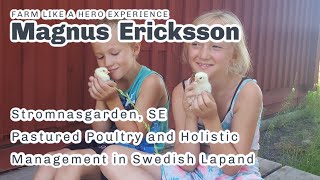
Magnus Ericksson started Strömnäsgården, a 20-hectare farm in Swedish Lapland at 66°N, after learning from holistic management practitioners like Alan Savory and Joel Salatin. He moved from town jobs into pasture-based beef and lamb, tested 100 broilers in 2018, and added on-farm slaughter to improve cash flow.
Questions this video answers
June 22, 2020.
20 hectares.
About 66° north (Swedish Lapland).
Samuel and Felicia.
100 chickens.
Chapters
Okay. Welcome to a new episode of Farm Like a Hero, folks. I'm Richard Perkins. Today I'm here with Magnus Erickson from Stromness Garden. And that's a farm up in 66 degrees north up in Swedish Lapland. And having no previous farming experience, Magnus and his wife also had read a lot of books and watched a bunch of YouTubes before buying a 20 hectare farm and starting up with holistically managed beef and lamb. And they're both working off farm jobs to pay for infrastructure development, as well as raising both their children, Samuel and Felicia. And the family also decided on top of all that, to create what's perhaps the northernmost fasted broiler enterprise on the planet, along with an on farm slaughter facility, primarily to help with cash flow and building up the customer base. Magnus attended Pastry Poultry Masterclass here at Ridgedale with us before embarking on that journey and also features in our book. I'm super curious to delve into how things have got going since then and to hear the perspective of a young family coming into farming and managing life in the far north. So I'm super excited for the episode. Magnus, thank you so much for taking the time to be with us today.
No problem. It's my pleasure.
Awesome.
Yeah.
Great to have you with us. And maybe you could really start at the beginning then. Like, who were the people that you read or watched that got you into this journey in the first place?
Oh, my. Beginning in this journey started with a deep interest in health and nutrition. Really? What are we humans supposed to eat? That developed to an interest in, okay, how is food produced and how can we produce it in a sensible way so that we don't wreck the ecosystems that we all depend on? And that set me on a course to all these books and YouTube videos. And I think Alan Savory was the first I encountered, and Joel Saladin was pretty early. And they inspired me a lot. They made me think in different ways about food production. And then, of course, I found out about you and your farm. Darren Doherty was one that I found pretty early also. And there's a lot of names I could name drop forever pretty much. But the biggest influencers was for sure, Holistic Management by Alan Savory and those things. And Joel Salatin is always entertaining to listen to when he speaks. And the complete package that you deliver was very impressive in my mind. So I kind of found one source to go to for everything when I found your channel and what you were doing in Vanland. So that was really my. The people that inspired me the most in the beginning for sure. And then it took off. I read books, listened to a lot of YouTube videos, lectures, whatever, for years, until we eventually decided to give it a go. And what we first did was really backwards because we got the most expensive animals first. That takes the longest to get a return on, completely backwards. But hey, that's life, right? You make mistakes and you learn from them. So we did that. And we never really had the intention of becoming full time farmers. When we started, we had our town jobs and we're quite happy with them. And we thought just produce food for ourselves, good, nutritious, healthy food, pasture based things like that. But as we got started, we fell in love with it. This, you know, farm experience just grew on us. It became something of a passion, more of a passion than it was when we started. So in the spring of 2018, my wife also said that she wanted to be full time farmer farming. So I fell in love with her even more when she said that. And so we actually had a test run of 100 chicken that summer. And it was also the summer when I came to your place for the poultry course. But we had a test run to see can we do this and do we want to do this? Because we are a small farm, we immediately knew that we're too small to have cows and sheep as our main income source, that we're just too small for that. Yeah, it is impossible to do pretty much. And I had heard about from Joel Salatin and people like that about this pastured poultry thing, you know, having chicken outside on pasture and chicken tractors and moving them around. And so I pretty quickly thought that that might be our ticket to full time farming. This is doable here. We can do this here. We have the infrastructure or can get the infrastructure to do it here without too much work, too much invested, you know, it's doable. So we did.
That's awesome. I want to just pick up on that then. So it was your wife who first put forward working full time on the farm. Maybe you can tell us a bit like what is your work outside of this? And do you feel like the vision was equally both of yours at the beginning?
Yeah, it was my idea to get a farm and start producing our own food. And also was not on board at all. She accepted the move to this place, but barely, you know. But as we got our animals, she fell in love with them and fell in love with the kind of the lifestyle of being here, taking care of the animals and doing all the things that needed to be done. So she fairly quickly changed her mind and wanted to be on board and wanted to participate. I never wanted to be full time when we started, but also quickly realized that, yes, I do actually want to do this full time. But she was the first one to really say that, yeah, I want to do this for real. And that was an amazing day for me. She works as a teacher and yeah, mainly as a teacher. And I work as a personal assistant for an autistic boy or man, so I take care of him. That's our off farm work. Also works full time and I work part time. And when I work I work 24 hour shifts. I don't do many shifts per month, which is awesome for this kind of lifestyle. So I'm home a lot. But I can tell you that when we made the decision to buy this place and get animals and start farming, the circle of friends and family we have around us couldn't believe it. Because I'm a city boy, grew up in the city, I have both my thumbs in the middle of my palms. Very not good at practical stuff at all. Never had any practice. But when the dream is big enough, I guess the obstacles get smaller. So we just went for it and haven't looked back since. Now we were still in the beginning, so there's not much to look back at, but. But we made the decision and now we're moving in that direction.