FARM LIKE A HERO EXPERIENCE: Märta Jansdotter, SE
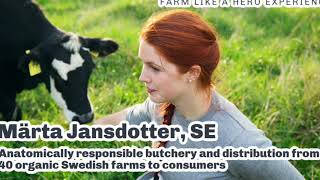
Märta Jansdotter runs Korunegarde, a Swedish distributor of grass-fed organic meat founded by her father in 2001. The company works with 40 farms, processes 250 tons annually, and supplies 12 to 14 municipalities alongside direct consumers. She grew up on an early organic farm and returned to lead the business after studying.
Questions this video answers
1985
2001
About 10 full-time employees
About 40 farms: ~30 beef farms, ~8 sheep/lamb farms, 1 pig farmer; plus chicken sourced via a separate company/farm network
Roughly 250 tons per year (approximate)
Chapters
Okay. Welcome to a new episode of Farm Like a Hero, folks. I'm Richard Perkins. Today I'm here with Marte Janstotter, the CEO of Korunegarde, that's a Swedish butchery and distributor of grass fed pastured meats, pork and chicken, from farms in the west of Sweden, with a strong focus on anatomical responsibility that is educating customers to eat responsibly across whole animals, not just eating prime cats. Growing up on her father's beef farm, Art is very engaged with holistic management, is the board member for the bee farm and is involved with the grazing planning and also is running a business that's creating a way for larger scale farmers to sell wholesale while still maintaining personal connection between the consumer and the farm and the food. So, Marlo, thanks so much for taking the time to be with us today.
Thank you. And thank you for that very nice presentation.
So could you tell us a bit about the sort of the history of the company? Your father, I believe, started that along with some other farmers. But you grew up on the family farm. Could you tell us a bit about your background and the background of the company?
Yeah, sure. I was born in 985, which was when the whole kind of organic movement started in Sweden, where the KRAV association for Certification was started. So when I was four years old, this farm that I'm brought up on was certified organic. So it was one of the first farmers farms in Sweden or the first movers of the organic certified farms. And we were a very small farm at that point. We had maybe like 30, 40 cows and some. Some pig production. And yeah, it was a small farm, which is the area I'm brought up in. It's very, it's, it's small, but it kind of grew during the 90s and it was both the beef operation and the pork operation kind of grew. So we had, I think the end of the 90s, we had about, I think 3% of the Swedish organic pig production came from this farm. It was a small amount of organic pigs in Sweden at that point. So maybe not so impressive, but yeah, and we kind of, it was a 90s of being really a bit mocked from the industry because they just thought that organic beef and pork, it was just some idiot in Stockholm who wanted to have that. And it was just, yeah, not appreciated. But we saw a demand in our local community because dad has had a pretty large legal distribution of meat from the farm from our seller. So he saw that selling directly to the consumer actually worked and it was just not some odd person in Stockholm who wanted it. It was people in our local community. But I mean, the problem with doing things illegally is that they're illegal. So from that kind of. That was the energy from which Grenada was founded, of doing it by the books and paying taxes and having all the certifications and inspections so on that you should have, when you work with food, to have safety. So Granagorda was founded in 2001 by him and two other farms that just saw, I think, for the sustainability of their farms to create a way to the market that is not dependent on the big grocery chains or like the big food system in Sweden, but to have this direct connection in order to get the value created on the farm and to get a better profitability. So that was 20 years back, and it's been a very interesting journey. When the company was founded, I was a vegetarian. I. I don't really remember why. I wish I did, but I think it was like I was studying theater and like everybody was vegetarians back then. Or I think that was the first wave of vegetarianism, I don't know. But I kind of stopped doing that because it didn't agree with me. And that's where I kind of also more understood the value of both meat as a food, but also the animals out in the landscape and the important job they do for building, of fertility and all these kind of things. So I got pretty passionate about it. But I went to Gothenburg. I worked. I didn't want anything to do with the farm. I was kind of, you know, breaking free. And I studied business for three and a half years in Gothenburg and got a master's or meister degree there. And when I was finished with that, I was feeling that I didn't want to work for a consultancy firm or just like the man. But I wanted to do something that had a heart and a passion. And that's where dad and the other guy who started the company has kind of split ways. And the company didn't have any manager or leadership. So I kind of. I was 24 years old. I did not know how to run a company, but I kind of went into it and I was, I don't think, not particularly good at it in the beginning, but that's how you learn. So it's. It's 10 years now and counting, and I feel like I'm starting to figure out what it's like to run a company and what it's like to build a company. And I'm still very proud over what it is that we do. This relationship we have with Our farmers and supply the products we sell and the way we can sell it directly to consumer. And the most important or most awesome thing is that I feel like people are really starting to wake up when 10 years ago people were just like. It was like talking to a wall. We were like, we're selling grass fed beef. And they were just like, doesn't every cow eat grass? Like no, they don't. But now it's really like people are asking for it. People have another will to pay for good quality and they just. It's just a very different market now than it was 10 years ago. And I think we can see it on the explosion of the rijbourin too. It's like, I don't think that that would have happened 10 years ago.
Sure.
Or it didn't happen 10 years ago, obviously. But it's just a difference. So that's my story. That's where I am now.
Awesome. Did you go into the business studies with any kind of intention of taking on the business or did that develop as you were coming to the end of those studies?
Oh, no, not at all. I was really like, I didn't want anything. I promised myself not to become a farmer. It's like I just didn't see any. You say you were say I shouldn't do anything. That's when you end up doing it. But I know I really didn't want anything to do with it. I didn't see that it was sustainable. I just saw how dad was working his ass off and didn't, you know, no profit. Just very, very hard work. Because it is hard work. But I think dad didn't really share the passion as much with as kids that I think he could have probably done. And I think that there's something farmers in Sweden generally do like. They only talk about what is not good and what is hard. But they don't share the reason why it's worth it. You working with nature and animals and like it's a really amazing job. But they don't talk about that. They just talk about the negative side, which I think is sad because it's a lot of benefits too.
Sure. So that's that coming home, as it were, to apply your training to the business. Is that. Was it your idea or did you feel like the needs that no one else could step into? Or were they looking for you to come back? Like, how did it come about? Because it's quite a big responsibility you took on a pretty young age when most people are not taking so many responsibilities on it seems I think I.
Felt like I had to. It was more like, I gotta do this. I don't really think that I was ready for it and I didn't really have any good support. I think I would have really benefited from a mentor or someone who had a more seniority in running business because, I mean, I figured it out. But I think that the stress level was a little bit too high and I could have probably made better decisions that would have been better for the company and also the people who work in the company. Because that's something I really find a challenge with a smaller company, is that you don't have all these great structures for having a good work environment all the time for the people who are working with you. Yeah. And you expect them to be the way you work. You know, it's like an entrepreneur. You can't really expect that for someone who is employed.
Sure. Could you maybe just give us a rough scale of the business, like how many people work for the company and what's the sort of volume of meets that you're dealing with? Just to give perspective to listeners.
Yeah. So we are about 10 employees full time and it's about five people who work with production, with butchering and packing. And then we have five people who do sales and administration and business development and so on. And we have about 40 farms. So it's about 30 beef farms and about, I think, eight who do sheep and lambs. And then we have one pig farmer and then we do this whole sale of chicken. So that's like a company that we sell, we get the chicken from. And they are, I think, five chicken farmers or something. So that's, that's. That's total. And we're. We're about. Roughly, I think about 250 tons of meat yearly or something. We process. So it's a very. From even a Swedish perspective, it's small, but it's not tiny.
Yeah, no, it's quite.
We're in the middle there. Yeah, almost.
And what's the. In terms of the logistics of the company? Where do you have like a central butchery facility and then you're shipping out boxes all over Sweden or are you. Where do you sell to?
Well, we do. We have our. In Udavala. That's where we ended up, in an old sanitary slaughterhouse, actually. So. So that's where we have all the butchering and we do all the slaughtering around that area. Because there are some good slaughterhouses there. But customer wise, our main customers is in Stockholm and Gothenburg, of course, because it's the big cities and we're starting to get a bigger customer base in Malma too. So that's the south of Sweden and that's basically home delivery or to delivery to pick up points. And our E Commerce is about 40% of our. What did you say? Revenue, right?
Yeah.
And then we also do we have like, what do you say, like municipalities and schools that. But that is here in this. In the west coast of Sweden because it's shorter, shorter delivery times. And then we have some restaurants and also a lot of grocery stores. So. But the main amount of grocery stores in the west of Sweden and some in Stockholm too. So it's yeah, kind of based around Stockholm and Gothenburg I would say, but quite split up.
What's the tell us about the municipalities? Like that's surprising to me that schools etc are buying, you know, high quality, high priced food compared to what they get typically in most countries. Like is that a new thing or is that something that's been pushed in Sweden because there's higher economy here? Obviously.
I think it's due a lot to political decisions that they wanted to have more organic in the public sector and also more locally produced food. So I think that they have a little bit of a budget for it. But I think it's also these. Usually a portion is on average I think 10 kroners or 12 kroners per portion. So they kind of spread that out with serving pea soup one day, which is really cheap, which is just a couple of kroners and then they can have a little bit more expensive food. But basically.
So just for reference, that's like €1, €1 20 for people that don't.
Ah yes. I'm going to convert it. But I think what we've been really lucky is that these region Westergartlands, which is the west of Sweden, has had a very, had a very good food strategy for the last almost 20 years where they have wanted to push local and organic food. So that strategy has kind of pushed the municipalities to make good decisions and really look at how they purchase food. So I think the first kind of procurement we got was in 2006. So we deliver to all the hospitals in the regions and now we have I think about 12 or 14 municipalities that we are allowed to deliver to and they also buy. And it's amazing. I mean we have a lot of up in your area in Sevle and all the Dawsons coming in and they're amazing, they're so happy, amazing people, customers to just talk to actually. And I think they Just want to support Swedish farming and make a difference. And it's just. It's amazing. I'm really, really grateful for that political purchasing power that has come up in Sweden. And it's looking at, I think, Sweden in general. There is a lot of locally produced food and a lot of organic food purchased in the public sector because of political decisions, basically. And that has really stimulated actually farming and local production. So it's been really good.
When do you think that. Have you noticed any shifts in that? I know, like, I've seen SLU have put out some pretty controversial papers like Damning Organics and, you know, it's very mixed feelings when I speak to. We're surrounded by more elderly community here and very skeptical of good food and, you know, some very affluent people who will go out of their way to find the cheapest food possible, which I guess is a typical pattern. But, like, has that shifted at some points politically? Was there, like a defining moment for that? I'm not so familiar with Swedish politics, so that's why I'm asking.
I think it's still a lot focused on price and the lowest price when it comes to procurement, but it's starting to. They actually have made some legal changes, both from the eu, because the EU procurement laws also applies to the Swedish procurement laws. But they have made some changes in this law just like two, three years back, where you could actually start. You could put rules in the procurement, which allows you to buy more local and to place demands of, like, no antibiotics used or like, organic and these kind of things to make it easier to actually buy locally produced food, which is, of course a sensitive subject in the eu because they want to have this free movement of goods. But there has been a drive towards that politically, I think, the past maybe 10, 15 years and a lot of political will. And I also feel like there's a shift in people's mindset around the price of food. If you take, like, the older generations there are, like, really. It should be really, really cheap. And they don't really care about what it is. But I think the younger generation is much more quality and, you know, a lot of different values that matter. And I think that even the older generation is starting to kind of wake up to see that it's not so easy just to look at the price and have that as a determining factor. And I think that is also due to the cheap food, as it's really gotten in many areas, pretty shitty. I mean, if you look at, like, America, where everything is much more, is so much more Contrast, you have much more better food and much more worse food. It almost becomes easier when you have this polarity. And in Sweden, it's been a lot like Lagom and kind of everything is in a middle way.
And I think that middle way, everything's mediocre.
Yeah. Then it's like, well, it doesn't really matter because it's the same thing. But I think it's starting to get more diverse. Makes it easier to understand.
I was definitely shocked when I moved to Sweden. The access to good food. Maybe in Stockholm, one of the big cities, it's probably easy to get hold of anything. But certainly in the rural areas, it's surprisingly different to most countries in Europe. It's very poor access to good food. So it's really nice to hear you saying that. I wonder, Marta, what the. Like, how was the company when you sort of stepped into that role and how much have you been able to put your passion and interests into what you do? Has there been room for you to sort of maneuver in that way?
Well, I would say yes. I mean, it's used to be my father that was a sole owner, and five years ago I took over the majority ownership. But I think that maybe I have not been good at really sitting down and taking the time and thinking about really where the company should go, because it's always a company keeps you really busy if you don't watch it. So I think it's been. I have not made a priority enough to sit down and really talk about our why and our strategy and our core, our being or our context. So that's something I've been doing the last years. But I still have a work to do there. But I think since day one, I had a lot of deciding power. I was given a lot of freedom. But the hard thing, I think, being so young and inexperienced, is that you don't really know what to do without freedom. The good thing is that I think I listened a lot to the people who worked in the company, and I know that our butchers, for example, have a lot more to say than a normal butcher has in terms of how we develop our. The way we cut the animals and the way we work with meat quality and all these kind of things is that we really. Every animal that comes into us, we give a kind of a grade on how good it is. And then we also give our farmers a little bit extra money for better meat quality, because that's how we see that we give them incentives to actually turn the production towards higher quality and not like faster growth or more muscle meat, which usually is not good quality. So. And I don't really think that that would have happened if I didn't really listen to the people I work with and kind of heard what they thought was good. And, I mean, the butchers do the selection of the meat to the different customers all by themselves, because they are the ones who know and they are the one who have to do that, too.
More from Richard


A review of short and intensive season on a mixed farm and restaurant/event space in Sweden






Alskade Kyckling Exploring complexities of poultry production in Sweden and what we stand for


