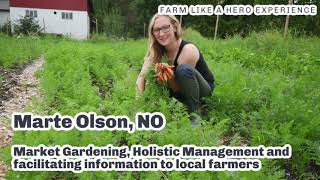
Interview episode of the Farm Like a Hero series (host Richard Perkins) featuring Marte Olson, a market gardener in Dokka, Norway. Marte describes her background in ecology (master's with a specialty in botany), early experience working on a small-scale vegetable farm in Wales, and her decision to buy a three-hectare farm near Dokka. Current production area is around 2,000 m²; she purchased the property for 1,750,000 NOK (approx. €200,000). The conversation introduces local market changes in Norway (more market gardens starting due to startup funding) and notes Marte's interest in holistic management and strategic niche/value-added development.
Questions this video answers
Around 2,000 square meters.
Three hectares.
1,750,000 Norwegian kroner (≈€200,000).
Master's degree in ecology with a specialty in botany.
Worked for several months on a small-scale vegetable farm in Wales.
Chapters
All right. Welcome to a new episode of Farm Like a Hero, folks. I'm Richard Perkins. Today I'm here with Marta Olsson, who owns a market garden in Docker over in neighbouring Norway. Starting up small whilst working off the farm and developing the farm over the past few years. The production is now around 2,000 meters squared. And in the last couple of years, Marta's informed me that a lot of market gardens have been starting up in Norway because of the possibility to get startup money from the stone. And that's created a sudden increase in the amount of vegetables in the market. And whilst perhaps not saturated, it does mean that strategic business development will be much more important in the future in terms of finding specific niches and possibly adding value to produce. Marta is thinking a lot about these topics and is informed by holistic management in her planning. So I'm super excited to talk about that. Marta, thanks so much for taking the time to join us today.
It's very nice to be here.
Awesome. Maybe you could start right at the beginning. Like, what's your background and how did you get into this in the first place?
I think that it's been a long process, but it started actually out when I was 12 years old and I was so sure that I was going to be a farmer. But then I stepped into another field, which is biology and ecology. And I studied ecology outside Oslo in a place called Oz and took a master's degree there, where I have a specialty in botanics. And while I was doing this, I lived in a farm outside Oslo. So I got. I rented a very small farm in the forest in Oslo and lived there while I was studying. And this interest for botanics, it's developed at the same time as I was getting more interested in edible plants and really trying to figure out how to grow stuff. So I started to grow a lot of vegetables for myself. And I think that while I was studying this, I got more aware of how bad everything is around with the planet and ecosystems. And I got a bit like, I really wanted to know more how. What I could do to. To help the environment. And so while I was in this food politics organization, I got a bit into gardening. We were learning a little bit about holistic management. And this was the first time that I heard of Anne Kopsta, which is. I later had. I have a very close relationship with now and who is also my mentor here. And I tried to figure out in what way I could, me as a person could really help the environment and the way that I think that we will always need to produce food and that would always be, always be necessary. So it was. If I was to do anything, it was. It seemed natural to me to start with food production. And I also learned that it was very little local or small scale vegetable production in Norway. So I kind of tried to learn a bit more about this. And at this time I was working as a. After I finished my master's degree in ecology, I started. I started working as a nature mapper where I actually go out in the forest trying to find important types of nature endangered species and stuff. And didn't really feel that I could use my ecology knowledge in a good way. I was just like following a system and the system, I don't think it can be used for any good. So it felt so meaningless going out there. And I was really thinking, okay, there, there has to be something more. I can't, I'm not gonna do this the rest of my life. So that's when I thought of buying a farm and starting farming myself. But before that I went on a tour to or some months to Wales where I worked at the farm a vegeta small scale vegetable producer.
Why Wales?
No, it was. I don't know why, I've never been there. It was. Seemed nice and I talked to this farmer and I could work there for some months and so I did. But I think what I actually learned from there was how to not farm because it was, it was very chaotic and it was. He had like one piece of my packs that fitted only one bed and then there was another piece that only fitted there. And he was the only one that had really like knowledge of where stuff would go. And it was. We were a few people that were working there and it was just. It was such chaotic and there was so much weeds. We actually spent two whole days digging with a spade by hand, a whole polytunnel. And it was like, why are we doing this at this time? I also been like looking into the no dig way and I think that going to Wales and experiencing all these weeds, it was really like the point where I decided that I'm not gonna do this. No, that is not. I'm not gonna spend my whole time doing this and doing all this. What I really felt was unnecessary tasks. And that is something that really. I think it's demotivating. So I, yeah. So I got back to Norway and I quickly after this I bought my own farm in Dhaka. That was like. There are many people who have asked me why Dhaka? Because Dhaka is a pretty small place like between famous Places like Valdres and Gibran Stalon, which is probably more. More people would probably move there. But I knew some people here and I also were able to get a job as a biologist here. So that was kind of. I decided and got this. Bought this farm for. It's a three hectare farm on the west side of Ramsburn. So it's not like the most ideal conditions for growing. There are much better like growing conditions on the east side. But since I'm alone, I had like a bit. I haven't. Didn't have that much money to buy a farm from.
So I ended up like for people listening in other parts of the world, like, what's the sort of property prices there for context?
Oh, I paid 1,750,000 Norwegian kroners, which is probably something like €200,000. Yeah, something like that.
A house and like it's land with.
A house and a house and a barn and two hectares of fields that mainly have been used as grasslands or not even pastures. It's just been like used or farmed conventionally grass farming for the last 30 years by the. My neighboring cow or milk farmer. I bought this in the spring of 2019 and I. I don't know, maybe a person that would be a more planner sort of type would have waited one year until they started. But I thought, why not just try and start even though it's almost June.