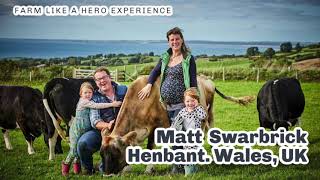
This is a recorded interview (YouTube) in which Richard Perkins speaks with Matt Swarbrick about his transition from a career in marine ecology and TV production (including work at the BBC) to running Henband, a 30-hectare farm in Wales. The conversation covers motivations for leaving urban life, interim steps (running a solar company, experimenting with a smallholding), the challenges of buying and renovating a derelict farmhouse, early living conditions in a static caravan without electricity, and the farm's development into diversified enterprises (market garden, eggmobile, agroforestry, small beef herd).
Questions this video answers
30 hectares
2012
August 7, 2020
Wales, UK
£200 (purchase) and £600 to move it
Chapters
Okay. Welcome to a new episode of Farm Like a Hero, folks. I'm Richard Perkins. Today I'm here with Matt Swarbrick who runs Henband with his family in Wales in the uk. After a career in award winning TV production at the BBC working with the likes of David Attenborough, Matt left the urban environment with his family for a simpler life in the country. He joined us last year for the regenerative design course. And I'm excited to hear about Matt's journey into showing that you can buy a farm and on a mortgage and make that work. The farm is 30 hectares and was born in 2012 with the early years involving renovating a derelict house and raising three young children. And it's grown to include tourism, a no dick market garden, a new ridged style eggmobile, agroforestry and a small beef herd. So Matt, thanks so much for taking the time out of your busy schedule to join us today to thank you.
Richard. It's really exciting to be, it's really exciting to be talking to you and doing this. It's really good.
I want to just hear a bit about the journey into farming for you and for your family. Like, how did that all come to be? Obviously you were living in the city, working in pretty intensive jobs. How did that all come about?
Yeah, I think when I was really little I fell in love with ecology, like really madly in love with ecology. And I jumped from that. I did like a, I studied that and then I did a PhD in, well, in marine ecology. And then from that that was kind of this like one thing for a long time studying one unique ecosystem. And then I, I worked for the BBC, which was amazing because I spent like, I spent like eight years or whatever it was, just, just sat on beaches just watching one little bit of ecology for like six weeks, you know, just sat there. It was amazing. But with that came a lot of travel and with that came a big recognition that we were always painting the world in a perfect way. And actually there's lots of things that, that need to be done. And so farming seemed like the main, it's like the most important job in the world, you know. And so a combination of wanting to farm in what felt like the right way and also like I just wanted to like have babies and build a nest, you know, and have our own food and just know an ecosystem and have like a little ecosystem I can play with. So having that ecosystem and being able to farm with it is, was what I wanted. Yeah.
So you built the capital up in your work to be able to. Because land obviously is very expensive in the uk. Obviously, Wales is slightly cheaper, but it's still astronomical in modern terms. But you, you ended up with a derelict house. So what was that like turning up from living in the city to move into a Welsh family?
It was pretty good, really. I kind of missed out a little bit in that biography, which was that between finishing the BBC and coming here, we also ran a solar company for. For like two years. And when I did that, I basically come out of spending 10 months a year in the Arctic to work in an office in Bristol. And I went a little bit bonkers, I guess, doing that. And so we put a little shout out, I mean, found the derelict farm just outside Bristol and someone, like, lent us a caravan and we basically, we were like kind of guard dogs, I guess, for this, for this farming family. And we. So we started. We started having pigs and chicken, all sorts. We just created this little smallholding. We kind of pretended that it was ours. And now I look back, it was bonkers because we were. We got pigs and got loads of stuff and we were sharing. We ran the office in the same building as Bristol Council Environmental Health Department. And what I didn't realize is we were just like packing the sausages and all the communal roof, the freezers in all the communal kitchens with our produce and all these, like, environmental health officers were all like, buying our sausages and putting the money in a pound jar, you know, and like, I, I can't imagine doing that now. But, yeah, so we had a little bit of that. So we, when we came here, we, like, you know, there was me and Jenny in the car and there was just this menagerie of, like, ducks underneath the stuff. And so we, we kind of came pretty running, I guess, slightly.
But how did you live when you got there? Did you have just a mobile, like, caravan?
We bought a static caravan. So we got a static caravan far too cheaply. I didn't realize when we came actually, that you can get a static caravan. They're basically free. So we got one for like 200 quid, but you pay £600 to move it. And actually, in hindsight, we'd have been much better off spending a thousand pounds and carrying one with double glazing. And, you know, you can get that price difference on that low end is like, massively different. But now we got that we were about six months without electric and, you know, all that stuff, and we realized we had to go and, you know, we were, we were like pooing in different Corners of field. And we started off just pooing in different. The same place with a shovel each day. And we realized you need to go to different corners of the field. Like, this is my corner. This is Jenny's corner. And then. But anyway, we did that for a long time. And then we had the baby in the March of that year, and so we just had to get into the house. And so we moved into the house pretty prematurely. But, like, we just put a massive stove in and it was fine.
What was it? Not totally run down, but just. No, sort of.
No, we came in. We actually. We realized quite early on. We realized quite early on that no one knows when you buy the farm, so all the locals, the only people who know are, like, two solicitors that live, like, you know, 200 miles away. And so what we realized was we could just kind of get on with it because they were really messing around. So in the August of that year, we came and we just. We just ripped the old roof. I mean, there was kind of half a roof, you know, so we. We took that off and we started building the roof. And I shouldn't say this. This is not a good example for anyone, but, yeah, we just. We just kind of really laid into it. And I remember my mum was like, climbing. My mum hates heights. Like, she won't, like, walk near the sea on the wall. Sea wall kind of thing, you know? And she was like, clinging onto the chimney with this. With this, like, bucket of lime going, my baby. This baby needs a roof. You know? And like. Yeah, so everyone kind of p.