FARM LIKE A HERO EXPERIENCE: Matthew Livingston, UK
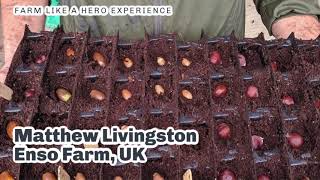
Matthew Livingston left a London software job to study sustainability and permaculture, then spent a year at a Costa Rican farm learning natural building and agroforestry. He returned to the UK and set up ENSO Farm on his family's 20 acres in Oxfordshire, building a no-dig market garden, polytunnels, and orchard now in its first full production year.
Chapters
Okay, welcome to a new episode of Farm Like a Hero, folks. I'm Richard Perkins. Today I'm here with Matthew Livingston from ENSO Farm in Oxfordshire in the uk. Matthew attended a farm scale PDC with us during his Master's degree and then traveled to Costa Rica for a year whilst his family searched for a property in the UK and upon his return they had found a property. He designed a land plan and has been busy setting up a no dig market garden and tunnel along with planting up a fruit and nut orchard. It's now in its second season, but the first real year of production. So I think it's a great chance to reflect on the startup process, design process, building up customer base and implementing land plans. So Matthew, thanks so much for taking the time to be with us.
Absolutely. Good to be here. Thanks for having me.
Yeah, welcome. And yeah, maybe we can go back to the time that you were doing your thesis and you were formulating where you wanted to go. Tell us a bit how that journey went for you and how you ended up getting into farming in that way.
Yeah. So winding back a bit further, I was working in software in London for three years and sort of became dissatisfied with the general trajectory of that industry as a whole and the company I was working for and so decided it was time for a shift in direction and becoming more aware of sort of issues we're facing in the world and so decided I needed to re educate myself and that's why I ended up doing a Master's in environment sustainability. And obviously that led me to. Well, I didn't want to focus just on issues, so I was trying to look for solutions at the same time. And that led me to first permaculture and then regenerative agriculture and of course you. And so during my dissertation where I was sort of comparing and contrasting permaculture and transition, town and sustainability transitions, I find an excuse to come to the PDC for 10, 14 days and that blew my mind. It was awesome. And started to see it as sort of an option for me in something that's more aligned with direct action and a good life and living healthy. And so that's how I ended up there and how I decided to sort of try to give this a crack and make it a lifestyle.
So what, what then led you to Costa Rica? Because obviously that's a very different climate zone, but you were working with natural building and cropping over there a bit, no?
Yeah. So Rancho Mustetal is a permaculture training center and they do a bit of Everything natural building, fermentation, tropical agroforestry. There's a zone one, Zone one gardens as well. So I was co lead of the zone one section and obviously totally different climactic zone but I just thought that would be really good for me coming from, you know, digital background, no farming. No farming background, no real practical experience. Just to sort of dive in and get a lot of practical skills. Woodworking as well, which has been obviously super useful now just like learning how to use a drill driver. Just basic simple things that if you didn't grow up building and doing those things, you don't have those skills. And so actually that despite it being in completely different climate was ended up being really, really useful. Yeah.
And did you. I guess there's a lot of group processes there and that's probably useful for like communication and workflows and processes like that, right?
Yeah, it's community living and so they base a lot of their decision making on holacracy and social sociocracy. So group decision based making is really interesting to see all those processes and I haven't quite applied that on a family scale level yet, but maybe if we scale up or have more people living on the farm in the future that'd be good. Yeah. But learning how to do things in larger groups and. Yeah, useful practical experience.
Yeah. That's great. I've got to ask you, did you meet our friend Benito when you were there?
Yes, I did meet Benito. Benito's a badass.
Yeah.
I didn't know you knew him.
Well, I met him in Thailand over a decade ago and he's an exceptionally talented plasterer and taught me a lot about plastering.
Oh yeah. Not just plastering, but just working with his hands. The whole Steen family. We met his brother also as well. Bear. Bear also Steen, I think his full name is. They're an awesome family.
Yeah. For listeners. The Steens were kind of responsible of bringing straw bale building to the States and their son was kind of raised unable to read or write coherently because plaster like nobody I've ever seen. So amazing. And he's got a great YouTube channel too, hasn't he?
I'm a follower.
Yeah.
Does some really, really great videography. I think his brother helps film him. While I was there we actually had a team out from Japan, Kyle Holtz Houte, he has a permaculture center called Permaculture Center Kamimomi in Japan. They do some amazing work and he's also a natural builder. So we had a Japanese natural plasters course, which is incredible. As well as a Japanese food and fermentation course, which is super inspiring as I'm also obviously a fan of Japanese culture.
Yeah. Some of the master plasterers from Japan and I believe that's who trained the Steens as well with their plastering. But hey, that sounds awesome. I want to know then, because you're in an unusual circumstance, perhaps you've bought land and a farm as. As a family. Right. But that means with your parents and siblings, is that right?
Well, so my parents own the farm and it is a. We. We all live here now, but usually it's just me and my mom and dad. It's obviously everyone's home for the current situation, but yeah, it's. It's in South Oxfordshire, where in our context is that we. My dad still needed access to London and my younger brother is still in boarding school. 45 minutes away, yet we're still half an hour to Oxford. So we're still good proximity to cities and to markets, but we're like, pretty much as remote as you could be probably in this part of the country. We're in a small, tiny village down a long stone track and then a dirt track. So it's. It's really nice. It's a really nice spot.
It's hard to get remote in the.
Uk, but that's hard to get remote. Sorry. And it's. It's hard to find what. What we ended up finding, which is, you know, small family house with 20 acres. There's really not a lot available. We search for about five years or something like this, as opposed to a house with the, you know, three, four acre garden.
That's awesome. So how did that all come about? Did your. Do your folks have any interest in the land and farming?
So not as much as I do, but we've always wanted to live more remotely and my mom is super into design and gardening and growing. So they were sort of. As I sort of moved away from technology towards thinking about this being my career and. And life path, I sort of brought them along on that vision and we made a decision as a family to go this route as opposed to, you know, buying something in the city or in central Oxford or something with less land. So we were all kind of on board with it. Yeah.
Well, you said you lived in South Africa before. Is that. Have your family moved around together?
Yeah, we're originally South African, so my parents are both born. Bred in Durban and they left when they're about 18 to come to the UK to get away from what was going on there at the time, and then we actually ended up in the States for a while, where I was born, and then back to the UK and then to Singapore and then back to the uk. So we've been all over, it's been a bit mental, but now we're finally put down roots and, yeah, feeling a lot more stable and we're here for. For good, for a long.
Time.
More from Richard


A review of short and intensive season on a mixed farm and restaurant/event space in Sweden






Alskade Kyckling Exploring complexities of poultry production in Sweden and what we stand for


