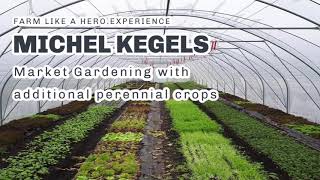
A Farm Like a Hero episode (host Richard Perkins) interviewing Michel Kegels of Groenhartig, a small-scale intensive vegetable farm in Amsterdam started in 2017. Michel describes founding the farm (started 2017 on 1,000 m², expanded to ~2,000 m²), adding a greenhouse in year two, and diversifying crops (salads, cherry tomatoes, herbs, edible flowers, baby leeks, baby carrots, beets, radicchios) originally sold mainly to restaurants. The interview context includes how COVID-19 forced a pivot from restaurant-focused sales toward consumer marketing.
Chapters
Okay. Welcome to a new episode of Farm Like a Hero, folks. I'm Richard Perkins. Today I'm here with Michael Kriegels from Gruen Hartig. I don't know if I've said that correctly. That's a small scale intensive vegetable farm in Amsterdam in the Netherlands, established in 2017 and originally marketing solely to restaurants. With the coronavirus outbreak, Michael's had to quickly pivot his sales strategy, something that I think a lot of producers have been going through this season. So I'm super excited for this episode and to hear about the farm's development as well as the changes in strategies now in this challenging time. So, Miko, thanks so much for taking the time to be with us today.
Yeah, thanks for having me.
Maybe you can just start by telling us quickly how big the farm is and the crops that you produce there.
Yeah, I have about 2000 square meters originally. The first year I started on 1000 and I started it as a part time side project to see how it would work. And then it quickly established into something more into a full time project, which it is now. Yeah, started in 2017 and I grew. Initially I tried to focus on lots of salads mainly, and then I quickly built a greenhouse in the second year, started growing some cherry tomatoes and then branching off into lots of niche products. Edible flowers, herbs. It's quite a diverse farm at the moment. This year I included even things like baby leeks and baby carrots and beets, radicchios, lots of niche crops. Basically adjusting to the demand of the chefs I work with. Salads are still a big part or were a big part of what I was selling to the restaurants. And now I'm adjusting that obviously because I'm marketing to consumers now.
Just jumping back a step. Like tell us a bit, how did you actually get into farming in the first place?
Well, basically I started doing. I started getting interested in permaculture. That was my entry point, really. Idealistic young guy trying to discovering something new about farming. I didn't really have any gardening experience, so I started doing that. And then at some point I was inspired by all the market gardeners, especially in the US and later I saw your videos as well, but I think it was already farming or he got started with that. But basically I got inspired. There was an opening somewhere. Somebody asked like, okay, could you do a herb garden for us? And then the wheel started turning and I basically wrote a business plan, tried to put that somewhere on the ground, and then I landed here. And then, yeah, I just grew and.
Grew so you came into it without even a business background or had you run your own business before?
Nothing, no. My background is in restaurants. I used to work in the service. I did hotel management school. I didn't really like that. So I became a snowboarding structure for about seven, seven seasons working odd jobs. And then I got in touch with permaculture. I quit the snowboarding thing because it was very superficial culture and I. Something was lacking. And then this happened. So it was either this or I would go heavy into psychology or something like that because that's my other interest. But it turned out to be this and I'm really happy with it.
That's interesting journey. And would you say that that you know, exposure to the food industry helps in the way that you've then approached restaurants? Maybe you could talk a bit about like why did you choose to market exclusively to restaurants in the first place?
Yeah, mainly I started or my idea was to do restaurants because there's not many small farmers that actually do anything with restaurants. Most of them are CSAs and they market to consumers. Most of them are even self harvest gardens. There's one or two now that are doing veg boxes as well. But the reason I focus on restaurants because in the Netherlands you had a movement of the forgotten vegetables. I think it's probably everywhere in Europe, but especially in the 90s, there was a big movement of forgotten vegetables of like parsnips and scorzonera. They were really banished to the poor people food. So nobody actually wanted to eat them anymore because in the second World War everybody had that association with we don't want to eat that anymore because that's all we ate in the war. But there was the restaurant, the quality restaurants and the Michelin star restaurants. A couple in the Netherlands basically brought them back into culinary existence. Restaurants have this innovative aspect or at least a niche part of them. And because I was very interested in food forests and permaculture in general. And I think there's a lot of perennial crops like the popo. Well, you probably know them all. Nobody actually knows them, nobody works with them. But I think the restaurants, they're the gateway for these type of crops that can be grown very sustainably.