FARM LIKE A HERO EXPERIENCE: Molly Rygg, SE
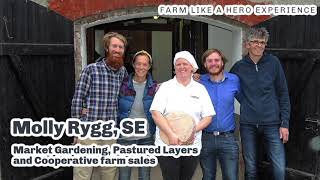
Interview (published Sep 9, 2020) with Molly Rygg about moving to southern Sweden, her Ridgedale internship (2016), and purchasing a small farm with partner Jonas in 2017. They started commercial production (market garden and pastured layers) and — with three other local producers (Jesper, his sister Linda, and Andreas) — opened a cooperative farm shop in May (year implied as the spring following setup). The conversation covers motivations (transition from chef work), practicalities of buying affordable, run-down farmland, local geography (west-coast fertile strip, river valley), and how collaborative sales helped them connect with customers and expand product range (eggs, honey, meat, cheese, vegetables).
Chapters
Okay. Welcome to a new episode of Farm Like a Hero, folks. Today I'm here with Molly Rigg, who runs Leah Gord in southern Sweden. And Molly was an intern with us at Ridgedale in 2016 and went on to purchase a farm with her partner Jonas in 2017 to get established with the market garden and pastured layers, whilst also having a young baby and really starting up commercially in 2019. Molly is really into collaborative farming and cooperative sales and is working with Jesper, who we spoke to in the previous episode, and two other farmers to run a cooperative farm shop. And so I'd love to hear more about that. Molly, thanks so much for taking the time to be with us today.
Thank you.
It's super nice to. I was just reflecting, speaking with Jesper about just the unreal chances of you finding lot of cool people in a small town.
Yeah.
Maybe you can tell us a bit about where you're situated in the population there and how all that sort of came about.
Yeah, we live in a tiny little town called Slatokere, which I'm probably pronouncing wrong, and it's about 20 minutes from Homestead, which is the biggest city in Holland. And we moved. We had. Yeah, my husband bought the farm. We had no idea. We didn't know anyone who lived here. Jonas is from Jotoborg, so we had no connection here. We just. We just moved to this town. Yeah, we just have a church and a preschool. That's the only thing in the town. And we found out about six months after living here that there was another farmer. And I just looked at his website and said he's into regenerative agriculture. And I thought, that sounds interesting. So I. I contacted him and we went to his farm and he said he had just done the online course with you. And I said, oh, yeah, I spent the summer at Ridgedale and we realized our farming goals were very similar, although his farm is 22 hectares minus 6. And then I was kind of like, ooh, can this. Can this town support two competing smaller farms? And it was like, we don't work together. We're going to be competitors. And I don't think that either of us would benefit from that. So I asked him if he wanted to work together and I think he was a little skeptical at first because he didn't know me and it's just like. But then he said yes. And we decided to open a farm shop because Jesper had tried to do a farm shop, but his farm is a little hidden off the road and our farm is right Next to. It's a kind of a busy road. It's like a shortcut between two places. So it's quite a bit of traffic here compared to where we are. And we decided to open a farm shop here. And Jesper's sister was actually thinking of opening her own farm shop, but she felt overwhelmed at the concept. And she makes cheese. She's been making cheese for about three years. And, yeah, we all decided to do the farm shop together. And then there's another farmer, Andreas Mottgord, who's nearby, and he was selling all of his meat wholesale, and he wanted to sell some of it retail and make a little more profit. So we just all came together and last May, we opened the farm shop.
That's amazing.
Yeah, it's like for Jonas and I, moving to a new place where we don't know anyone. And just by doing the farm shop with Jesper, his sister, and Linda and Andreas, we connected to their customer base. So for Jonas and I, it was like, suddenly all these people know about us. And Linda and Jesper, they had both been doing their business, like, three years, and they already had, like, really loyal customers. And, like, they got the advantage of. We did the farm shop for them. Like, Jonas and his dad built the whole thing, so they got to just, like, plug into it. So I think, like, everyone really benefited from it.
Yeah. Yeah. What are the chances?
Yeah, what are the chances? And, I mean, I just think of, like. I mean, we're 20 minutes from Homestead, so it's not that far. But if it was just Jonas and I with just vegetables, I don't think people would make the drive. Yeah, but, like, for example, Linda's cheese. People definitely drive from Homestead for that, but they also know that we have eggs, we have honey, we have meat, we have vegetables. So it's like, okay, I'm gonna drive for that amazing drive. 20 minutes for carrots and lettuce? Probably not.
Yeah. I really want to dig deeper into this, but then I'd love to go back a step, Molly, because you don't sound Swedish. Maybe you can tell listeners a bit of the backstory, like, how did you end up to be there? Like, where did your interest in food come from? I know you were working as a chef. And how did you meet Jonas? How did you get here?
Yeah, I was working as a chef in kitchens my whole life and just was kind of getting disillusioned with. With working in a luxury hotel company. And you don't really get to decide always what kind of food you're Serving and serving unsustainable food because that's what the customer wants. And I always had kitchen gardens. And. Yeah, just realizing that my favorite time of the week was when I was not working in the kitchen. I was taking kitchen garden because it was, like, so just de stressing. And it felt so good to be growing my own food.
It's kind of the opposite of being a chef, I guess.
Yeah, exactly. And I really wanted to have a child. And working in the kitchen, you just. It's. You can do it, but it's very hard. I met Jonas when I was working in Cambodia and decided to leave my job. And randomly, I thought, okay, I'm going to spend the summer wolfing in Sweden, since that's where Jonas was from. And I had not really been to Sweden and just see, can I live there? What is it? Like, I had really no idea. And just a random friend was like, oh, instead of woofing, you should go to this place called Ridgedale. And I was like, that fits in perfectly with my time to do the internship. And like, wow, that sounds really cool. And so I decided to spend the summer with you in Ridgedale. And. And that really opened my eyes to the possibilities of Sweden, because I didn't know that you could buy a farm. It actually is possible. If you're willing to live in a little remote place and buy a rundown house that no one else wants to live in, then it is possible.
You mean economically, the purchasing power? Yeah.
Yeah. I mean, our farm, I would say, was very affordable. I mean, it's not the ideal farm for most farmers. It's six hectares. I don't think would consider it a farm. And our house, a lot of people think it's abandoned because it really needs to be painted. But if you're willing to put up with those things, like, I think you can get a really nice opportunity here. And I learned that at Richdale. Learned what you could do. So we decided to move here, and then I got pregnant much, much sooner than I thought I was going to. Like, we had the idea to move here first, get settled in, and then have a baby, but it happened before that happens.
Yeah, but hang on, I want to pause you there, Molly, because you. So Jonas is a sailor, Right. That's his trait. But he bought the farm when you weren't even in the country.
Right.
So how did that come about?
Yeah, I think Jonas got nervous that we didn't have any place to live and we had a baby. So I was waiting for my visa, so I couldn't Travel to the US or couldn't travel to Sweden until I got my visa. So yeah, he. He bought the farm and he showed me the pictures and it looked really nice. But you know, at the time I was just like thinking about my. My baby. I wasn't really. But you know, it's. I think he did a really good job. I really. I think it's a really nice place. I think there's something really special about Holland where we live. Of course, I'm not pronouncing it right, but because we have the ocean, then there's like a strip of fertile, very fertile soil and then we have the forest. And it's not many places in Sweden that you have all three. We're halfway between Jotoborg and Malmo and we are like actually really close to. Our farm is like the last place that this west coast Vikings lived. So people have been farming our farm for over a thousand years. And like people find artifacts all over here.
Super cool.
Yeah. And our place, Leah, like, yeah, you can look at the history of farming. There's records of it and we have really good black soil and we live in a river valley. And I think it's. It's just a really cool place. It has really cool culture and people here are very friendly. Yeah. Even our small town, we are like a thousand people. There's people from all over the world living there.
So I think it makes it comfier for you moving in.
Yeah, we're not. We're definitely not the only. Or I'm definitely not the only foreigner. There's plenty of. Of foreigners here.
What. Did Jonas have an equal sort of interest in farming or is he. I know he still actively sails. Right. So was it more your thing to have a farm?
Yeah, it's more my thing and Jonas has been helping me. But yes, starting next year he won't. He really loves like the. He likes the lifestyle, but the actual farming is not. He likes to sail so he can do farming sometime. But he's. He has that itch urge to get to sea. Yeah. Yeah. And that's. That's one of the reasons why we picked this farm because it is near the coast. It's like 10 minutes drive to the coast. But he really. He likes building stuff and he's been like last year and this year he's really helps me with these big infrastructure projects like building, renovating the barn, building the egg mobile. He built the polytunnel. Like he's doing all those projects that I'm not really into. So he's yeah. And then, like, next year, you know, those big projects will be more or less set up, so I don't really need as much help with those things. So day to day right now, he doesn't do the vegetables or anything. That's just me. If. If I really need his help, I can help him, but he's. He's working on basically building projects.
More from Richard


A review of short and intensive season on a mixed farm and restaurant/event space in Sweden






Alskade Kyckling Exploring complexities of poultry production in Sweden and what we stand for


