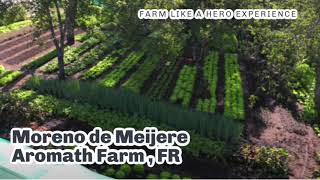
Interview from the "Farm Like a Hero" YouTube series where Richard Perkins interviews Moreno (Moreno de Meijere) of Aromath Farm. Moreno describes his pathway into farming—starting hands-on work while traveling (first notable experience in 2013 in New Zealand), learning about permaculture and organic methods, then moving with his partner to France because land access in the Netherlands was difficult. They began Aromath Farm on rented land in 2018, starting a market garden on about one-third of an acre (~1,300 m²) and documented the project on YouTube. The chunk covers motivations, formative farm work (monoculture picking jobs), the influence of permaculture, and the practical choice to rent land within a ~50 km radius of their target market.
Questions this video answers
2018
About one-third of an acre (~1,300 square meters)
July 10, 2020
Chapters
Okay, welcome back to another episode of Farm Like a Hero folks with me, Richard Perkins. Today I'm here with Marino, the Dutch farmer of Aromath farm in eastern France. Started in 2018 on rented land Marino Market Gardens on about a third of an acre, that's about 1300 square meters. And he's documenting his journey over on YouTube where you can find some really excellently laid out, well explained videos there. It's another great low cost startup in the market garden space and I'm excited to hear how they run their operation on the rented bid land. So Marina, really excited to have you join us and thank you for taking the time to be with us.
Thank you. It's a pleasure.
Super nice. So you, you're on rented land there, but maybe we can jump back a step. Like tell us a bit how you got into farming. Like what's the journey been for you?
Well, we got to go back all the way to, well, well before, like 2010, I believe. 10 years ago about. I was working in a roofing company in the roofing industry really for a couple of years. And ultimately I didn't want to keep going in that industry because I didn't see myself doing that for the rest of my life. I mean, don't get me wrong, I truly enjoyed the time that I was spending there. I really think that the skills that I've learned in that business are super, incredibly important to have. But in order to do that for the rest of my life, it was just not for me. So I decided to quit my job at the time, saved up some money first and decided to go and do traveling. And in order to sustain my travels financially, I had to do some kind of work. And it happened that most of the work for overseas travelers was in farms. And for me it was, it sounds a bit cliche or whatever, but it was really like love, love at first sight. It was just being able to be outside working when it was raining or not, that didn't really matter. Just being able to work with fruits, with vegetables, with plants. It was the whole harmony, the whole, the whole feeling, the ambience. It was just exactly something that I was looking for without knowing it really. So that's really how I got into farming. So that was in 2013 in New Zealand on the Mandarin farm, which was monoculture, so not really what we stand for nowadays. But that's where I really got my first introduction to farming, if you will.
And you worked on a bunch of other people's farms before starting up your own. Is there any key farms that really influenced your thinking there?
Well, the more I was working on the farm, so I was going really following the seasons initially. The first year that was really monoculture seasonal picking work. So it was just picking, picking, picking fruits was mainly fruits initially was Mandarin, kiwis, apples, whatsoever. And the more I was going into farming and the more people I met, because we were always with a large crew of both national and international people. And many people were actually also interested in a more sustainable way of growing. Although we were working in what we call pesticide ridden agriculture, we were really. There were many people that were interested in the thing organic. I didn't even know what it was back then. Shame on me. But didn't even know what it was organic then permaculture. And it actually went bit by bit for me. So the more I went into farming, the more people I met, the more I actually got introduced with permaculture and organic. And it actually caught my interest. And that's how I actually. That's how the ball started rolling for me, really, because then I started really looking into this. And for me it was like all the work that I was doing on those farm was actually like, I started realizing that everything we were doing was really wrong. And it was super interesting. It was like a really light bulb moment for me. And at that moment I just decided, okay, I want to do this as something for the rest of my life, but I want to do it in a way that I think that that resonates with me, that I think that is good not only for ourselves, but also for others. And that got the ball rolling, really.
And you started with rented land with your wife and young child. Tell us a bit about how you got to that place. And obviously you're not French originally, so how did you end up where you are now?
Well, we needed to start somewhere. And it was either gonna be in Holland, where I. Where I come from, or in France. Well, it was not a possibility in Holland. There's just the access to land is extremely difficult. And my wife didn't really enjoy Holland neither. Me neither, to be honest. At that time we didn't have a child yet. And so we decided, okay. It's actually quite a funny story that you asked because we were on the edge of, okay, do we get started or do we continue to learn from others first? And this is a story that actually not many people know, but we actually started going. We started a bicycle journey. We wanted to go through Europe by bicycle, visiting all sorts of permaculture farms and regenerative agricultural farms. And the moment we arrived in Sweden, this was in 2000, what was it, 16 or 17? We actually found you online and we wanted to call you up to actually work on your farm, but it was just you. You just got full with interns and it was. It was not possible at that moment anymore. And, okay, so we continued to do bicycling. A little while after that, I got actually an injury on my knee, so we couldn't continue the cycling trip. And then when we decided, okay, well, we're gonna go back, we're gonna go to the main routes from where she came from. Her grandparents have some land that we could potentially use. And so we decided to come here, back to France and start the farm. But when we came here, the land that grandparents possessed was quite remote with not a possibility to get water on it, not a possibility to get electricity on it. So it was not really a possibility. And then from there on, we started to look, okay, like this is our budget. We've got enough to invest, but we do not have enough to invest in land. Like, when I talk about that we have enough to invest. It was mainly for the tools and all sorts of the tools relation or the related part of the farm, not the land. And so then we decided, okay, well, probably gonna have to rent if we really want to get started. And what we did was simply looking at the area where we live. We just drew a little radius around that city, the main place where the customers were. And we decided, okay, we want to do a 50 kilometer radius around this town or this city, and we're going to look for land in this area to rent. This is our budget, what is going to be possible. And that's how we actually got to the land where we are farming on right now.