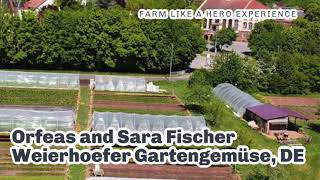
Interview (Farm Like a Hero) with Orfeas (and Sara) of Weierhoefer Gartengemüse, a German micro-market garden started in 2018. The 2,000 m² farm runs a CSA delivering 220 vegetable shares over a ~30-week season, selling primarily locally and generating roughly €100,000 in annual sales from a high-yield, community-focused model. Key practices: small affordable weekly shares (€12/week for six veg items), member pickup on-site, recipe-sharing, minimal packing, and strong emphasis on produce quality and community engagement.
Questions this video answers
2018
2,000 square meters
220 shares
About 30 weeks
About €100,000
Chapters
All right.
Welcome to a new episode of Farm Like a Hero, folks. I'm Richard Perkins. Today I'm here with Orpheus and Sarah Fisher of Weierhofer Garten gemuse. Started in 2018 in Germany, it's a high yielding 2000 square meter micro farm yielding 220 veg boxes over 30 weeks through CSA where members come to the garden to take vegetables. It's another look at profitable market gardening in today's episode. So thank you both for. For taking the time to be with us today.
Yeah, thank you for having us.
Awesome. Maybe we can start at the beginning. And how did you both get into farming in the first place? And how did you end up at your little plot? You're on now.
My garden experience started in Australia where I did some roofing on different farms. Every. I was on another farm and there I met a farm with permaculture and was very interesting. And there I really tasted how food can taste. So it was very delicious. Tomatoes I ate there and this was a shift for me. And then I came back to Germany. I studied ecological agriculture in Witzenhausen. There I. My wife now and girlfriend, Sarah. Sarah. And it's. Yeah. And from this beginning, I really like the work outside. I was. I really like work and to be outside with the sun, with all the elements. And yeah, I really tried to study, but the study thing wasn't for me. I didn't get the experience. So the book from Jean Martin Fortier came and this was the beginning of now breaking up the studying and looking arms I wear in Czechia in Germany. Different apple trees, very different. Agriculture is so different. So in different topics I went into. And then I decided to start a market garden. And yeah, I was two weeks in with Jean Martin Poitier at his new farm, Femmes de Quatre Temps. And there I could see really how things could go. So this was for me important not to only read books and to get it, but to see it and then to work. One week, it was, yeah, very best week for me. So I can visualize how things really can go. And after this, I started to grow. Yeah. And to have.
That's awesome. Yeah. And it's. It's really powerful to like. Something we'd always recommend is people go spend usually a season at something somewhere doing what you actually want to do, because all those little nuances, like feeling things, touching them, smelling them, understanding things that you could definitely never get from books or. So that sounded like a really catalytic moment. And you've only been there a couple of seasons. But you've built up. You've got a beautiful Instagram to really recommend people go to look at that, to really get a sense of what you're up to there. But you're in quite a rural location, right?
Yes. Yeah. We are in a very little village with only 300 people here and the next biggest city is 10,000 people. And yeah, for us it was good. We started with 50 shares in our first season and then growing next season 150 and this year 220. And it helped really to. I think it's important to be nice and kind to another. To bring the feeling. Yeah. With it. Combine it with the vegetables. So the product or the vegetables, they have to be very nice and colorful. And also. Yeah. I like to create a place where people can come every week and they take their vegetables and then we have conversations. They can see. This week we did. They can walk around the garden, they can see, oh, there are my carrots from. That's yeah. Very important. And to be open minded and. Yeah. And also to do the marketing stuff like a very nice website to make things easy so they can sign up very easily for them. And every week we have recipe for them to cook with the vegetables. So it's growing vegetables, but it's only one topic and then you have also.
To do the others, really providing a service. Right. And it's. It's that. That's the key to direct marketing.
Right.
To be really bring people in, but also really educate them, connect them to food, but also treat them as friends and then naturally they want to come back. Right. Are you selling? I mean you built up a really great revenue, right. You're doing about €100,000 of sales off a very small space at very high profit levels. And that's super impressive in your early stages, is that selling all of that locally in the village or are you selling to towns around there?
It's I think 80 or no, not 90% of it is locally. And we sell locally and then 95. So it's only 5% I think we bring to towns. It's a big like what you are doing here in Germany. It's starting now. It's called. And so people can. Online. Yeah. What is it they use? They can buy the product and then there's one hour we go in. So. And then they can take it with. So this is only 5% and then that's incredible.
So how I want to unpack that a bit because that's really incredible to set up in a tiny village and be Able to shift that much product. Is that reflection of how things are going due to like the COVID 19 situation? Are you seeing like a major increase or is it. There's very little competition with what you're doing or.
Yeah, it's a bit of COVID so maybe 5%, but the other 95, it's the product. So the vegetables, they're so fresh and people have to come in our csa they have to come every week. And so in summer they go to holidays and then they bring the new friends and it's about. And they talking a lot with friends and about our. Yeah, it's the salad also we have the fresh Mezclan salad mix and then also we sell our salads to what is. To a little shop. So we sell about 40 kg of salad every week and then they buy it there. And it's so good that they come to us directly and Yeah, I don't know the people like us. This area is known for wine. So the people are tasting. They're not just eating anything, not tasting what they eat.
So it's really touching into the quality of the produce as a sort of sensual thing, more so than just as consuming food that you know is trustworthy.
And what. What we found out is that we're doing small shares because people don't like to throw away food. So our CSA box is only 12 Euro a week. So everybody can afford it. Afford it. And there are only six vegetables in there every week. We plan it, every vegetable. €2 for us for our calculation. And so you can have it and it's not. You have to eat. So it's also very easy for people working with the work life. So if they work and then they have the clean vegetables and. Yeah, so it's more for. It's not only for the. Who eat a lot of vegetables, it's also for them where I have a very busy day.
That's a really interesting approach because most people I've been speaking to on the tour route so far, typically their shares would range between 8, €900 a year. So yours would be 360. So it's extremely affordable. I guess their shares would be much larger. But it's interesting that you've identified that people actually don't want such big commitment or big boxes. And to be able to shift that many in that population zone indicates that you're correct in your thinking. I guess. But that's remarkable. I want to celebrate that for a moment because that's a remarkable achievement to be able to shift that many small boxes to drive that revenue consistently, as that's a pretty amazing feat.
And for us, it's more diversity. Also, it doesn't matter if one people.
Yeah.
If it's not okay with us. So we have many small things, and we are like in the garden, if you have many different vegetables, if one doesn't succeed, you have the others. And so it makes us also more calm. And it's very good that we don't have to pack the things. So people come and we celebrate. We give them. They bring their baskets. Now, with COVID it's a bit different. So they bring the baskets, and we fill their baskets with the vegetables and have the conversation. But last year, they picked them the themselves, the vegetables, and we just were there for questions.