FARM LIKE A HERO EXPERIENCE: Remeny Farm, HU
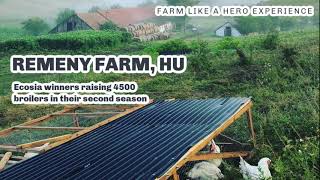
This YouTube interview (Farm Like a Hero Experience: Remeny Farm, HU) features host Richard Perkins talking with David and Anna of Hope Farm (Hungary). They describe leaving previous careers to pursue self-sufficient and regenerative farming, discovering Savory-style grazing ideas, winning a €50,000 Farm Like a Hero startup loan (with Ecosia) to buy land and scale operations, and establishing enterprises including cattle, sheep, ~4,500 broilers, and an on-farm poultry slaughter and smoking facility. The conversation covers their land-search checklist, Hungarian land-purchase regulations, local land-price context, and their goal to inspire younger people into farming.
Chapters
Okay. Welcome to a new episode of Farm Like a Hero folks. I'm Richard Perkins. Today I'm here with David and Anna from Hope Farm in Hungary and they joined us for a pastured poultry masterclass and then market garden masterclass with Curtis Stone and then they won our competition and were awarded 50,000 Euro startup loan with our collaboration with Ecosia. They used that to start up their enterprises, buying land and starting up in spring last year with cattle, sheep and running four and a half thousand broilers which they've also built a Dedic poultry slaughterhouse and smoking facility for. The farm's also in line to become the savory hub for Hungary. So super excited to welcome you to the show. Thanks so much for being with us today folks.
Thanks for the introduction.
Thanks for having us.
Yes, that's about the shirt of what we do currently. Yes. So we are here. Welcome everyone who's watching and yeah, I'm Anna, this is David. That's probably easy to figure out but that's who we are.
Awesome. We always start by asking, tell us a bit of your backstory, how you got into farming. I know you came from a different line of work originally. So tell us about your journey into this.
Well, David was the one who started the whole thing.
Yeah, yeah, I think it was like six years ago when I was totally fed up with society and all of the stress and everything and I just sold everything that I had, every business and every website I developed and I just booked a farm in the middle of nowhere and it was in a.
Forest, it was literally in the middle of a national park. So it was a beautiful scenery and undisturbed by people. So very, very secluded.
Yeah.
And I just wanted to, I just wanted to be self sustainable, make my own food, make my own house and other stuff. So this, this romantic way of living and people told me that I will never find a woman that wanted to.
To live there in the middle of nowhere. And then five years ago I came into the picture so I moved in.
And that was your first reaction when we went on the dirt road?
Oh yeah. The moment that we took because you have your main road and then you have to take a turn into the forest. And as we were going there I was like, this person might just be a serial killer but at least the scenery is very beautiful. So no, it worked out very well. We, we've been together and doing all of this farming and self sustainable thing for years and years and I kind of joined in on the whole thing. It wasn't necessarily one of My interests before this, I thought of myself as being ecologically conscious, which looking back, I was absolutely not. Like, you know, if you take a tote back to the. When you do your shopping, it's not all that much that you're doing for mother Nature, but I just developed taste for it as we were living together. It would be difficult to imagine my life otherwise anymore.
So back then we only had two cows and the permaculture garden and other very small enterprises just for ourselves and our family. And we had a very.
Calm, very, very stressless life.
Yeah. Yeah. And one of our bad days, we just stumbled upon on your YouTube channel and Alan Savory and everything's changed.
Yeah, actually. Actually we were on our way to your farm in Oslo when you showed. When you discovered Ellen Savory's TED Talk. Remember we were in the. We were in an Airbnb and you were like, you have to watch this. This is like, this is a game changer. And I remember I was really struck by it. We were also going on your farm. So that was a very new experience for us too. We've never slaughtered anything in our lives before that.
Anna was a city girl, so she.
Yeah. Oh, I used to.
So anything like this.
Yeah, I used to be. Just. Just because he asked us about our background work with computers, it. Yeah. And I was a fashion designer and seamstress working with historical and folkloric fashions, which I still do for myself. But that's just. That's just a teeny tiny hobby that farm life allows. Amount that you can spare five minutes every day. Yeah. So.
So hang on. How come you gave up your lovely stressless life to have a pretty full on farming life?
It was because I remember one morning you came back from your morning jog and you just said we have to change something. And we sat down. It was just like a September morning or something. Right. And you said we have to move. Like this just doesn't do. We can't do the impact that we want. We are not able to buy any land.
We are just selfish.
Yes.
We had everything that we wanted, but still the world is going in the wrong direction and we really don't have any impact. We are not part of the solution. We are just living in the middle of the forest and we are a little bit selfish.
We had everything, but only for ourselves. We weren't producing anything for the community or for the world or for. We weren't producing any.
Any value.
Yes, yes, none. So then we realized we wanted to move. Yeah.
To have a Bigger land base to be able to. Yeah.
So over there, as I said, we were living in the middle of a national park. We had about three hectares, a little bit less, but that was it. And there was no chance of us ever being able to buy more land because national parks don't sell land. I'm not going to get into the details of that. So we just sat down that morning and we wrote ourselves a list of the things that we really, really want, you know, a list of priorities of what we are looking for in our land. And then you know, like would be nice to have and then like optional but I'd be happy if it was there. And we started looking with this checklist.
And there was not too many.
Not.
Too many lands in the country that fit most of the category, most of the requirements.
What is access to land like there and like land prices there. Just for listeners context.
Land prices are very low compared to other part of Europe. Parts of Europe because we have some very strict laws how you can buy lands. It's very similar to France. So it's very, very protective laws. For example, you need, you need to study, you need to have a paper accreditation.
What is that like a farming to say you're a farmer to be able to buy land?
Yeah, to buy land. So you can, you can show that you know what you are doing. And this is only, you can do only this in, in Hungarian. So most of the people from Europe are out of this.
Oh yeah, you have to have the certification in Hungarian. So that's kind of the way of the government making sure that most of the lands will stay in Hungarian ownership.
Yeah, so the land prices are cheap but we have the same situation like everywhere in the world. So there started to get be big players and the small ones started to give up. Yeah, it's kind of a concentration of land also and it's very similar like other places, the average age of the farmer is 58 here. It's not that bad in like in Japan or something, but 58 and there is no new generation.
So if you. How familiar are these ideas? Like are you really out there on a limb over in Hungary as the, you know, have you networked much with people in the country? Are there any other people thinking along these lines?
A handful, but not too many.
Yeah.
To be honest, we really hope to inspire some more, some youth to take on this career or career path or whatever you want to call it. It's a very, it's one of our goals to be an inspiration to other young people because it Just can't go on.
And they don't know. How cool is this?
Yeah, yeah. Like, there's so many awesome things that you can only afford. There are life luxuries that you can only afford if you are a farmer or if you live so close to the land and things that money will never be able to buy you, no matter how rich you are. And I'm not talking about experiences, but the quality of food, the luxury of saying, I found this shiitake on the log today. I'll just throw it in the omelette when other people are to the chickens because I don't want to eat it anymore. It's luxury which cannot be described with any other word, I think.
So you tell us a bit about how you found that site. So you're looking for new land, and through the Ecosia thing, you got the loan capital to be able to start up in the way you wanted. So what was the process then? You. You were still just looking for land at that point, weren't you?
And one. One small note that we were very, very, very lucky, not just with ecosia, but we could sell our farm incredibly.
Fast in a matter of months.
We even didn't start to advertise it.
It's just the thing is that the previous owner of this farm really, really wanted us to stay. So she started to advertise our old farm for us, and she found us buyers in like three or four months, I think, from when we moved here. So we had that three months to.
Close the deal, and we get a very good price and everything went very smooth. So that money helped us a lot.
Yeah.
So hang on, you got to fill us in on that story. So you'd come and met the owner of the farm you're at now, and she liked you so much, she helped you sell your farm.
Yeah, kind of. So the timeline of this was we started looking for farms for new land in November. We came out here in the middle of November, kind of early November, December, something, maybe. And I fell in love with the scenery. It's a lot more like my. I'm from Transylvania originally, and it's a lot more like that area. So for me, it struck a lot of heartstrings. So it was partially a sentimental decision for me. But as we were looking at our checklist, it ticked so many of the boxes, like 80% of the boxes at least.
And none of the other sites even.
Got near to it, so, like, even. Not even like 50% for us. So we really liked this one. This was the first land that we checked out, and it was the only one that we actually checked out in like, a month or two. I think we came back just one more time to walk around, look at the buildings a little bit more up close, and, yeah, we just decided to buy it.
More from Richard


A review of short and intensive season on a mixed farm and restaurant/event space in Sweden






Alskade Kyckling Exploring complexities of poultry production in Sweden and what we stand for


