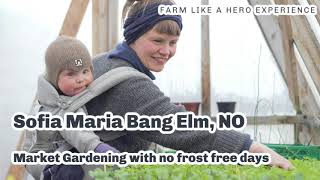
Transcript of a Farm Like a Hero interview (Richard Perkins with Sofia Maria Bang Elm) about Sofia’s experience establishing a northern market garden (Avdem/Avdamskaardskrund) in central Norway. Covers her agricultural schooling, move from Denmark to her partner’s family farm at ~600 m elevation, choice to focus on vegetables rather than dairy, early seasons (first in 2017), community support and the farm shop/cheese business as a sales platform, and family dynamics around running separate farm enterprises.
Chapters
Okay. Welcome to a new episode of Farm Like a Hero, folks. I'm Richard Perkins. Today I'm here with Sophia Maria Bang Elm, who runs Avdamskaardskrund in Norway, a film with Sofia at her farm back in September 2018. And it's an epic tale of her efforts in a climate where frost can occur all year round. And as one of the most northerly market gardeners in Europe, Sofia's done an amazing job setting up in a foreign country on her partner's family farm. Since our filming back then, Sofia's had a young baby and the farms got a new panoramic cafe attached to their existing farm shop. And there's a lot of things that have developed since I was there, including new gardens. And so I'm excited to catch up and hear more how things have been developing. Sophia, thanks so much for taking the time to be with us.
Thank you.
Awesome. I'm really excited to hear. I mean, people really loved your YouTube interview and your infectious positivity and determination to grow vegetables in a place where pretty much no one grows vegetables, it seems. And so I'm excited to. I mean, I really would point people back to that if they haven't seen it, because I think that's a great video to fill people in on what you're up to there, but maybe you could give us a bit of more of the backstory of how, like, what brought you to farming and how did you end up there.
Yes, I went to agriculture school in the west of Norway. I'm actually from Denmark, but there's this very special school in the west of Norway that has a very broad spectrum look at the agriculture. And there are so many different things you can learn. And I mainly got in there because I was as many other people, I guess I was super excited about self sufficiency and things like this. And that's like the perfect school for those kind of things. So I went there for a few years and then I met my partner there. And then we decided to move to his farm, which is here. It's actually in the middle of Norway in a pretty tough climate, 600 meters over above sea level. And then I had to figure out something to do. And I was very sure I wanted to get into farming. And after having some experience with dairy animals, which I thought actually I would, I wanted actually to have milking goats. But I worked with milking goats for a few years after finishing agriculture school, and I experienced that this routine things with doing the same thing two days, two times every day that really didn't fit my temper. So I thought about vegetables would be the. Yeah, I would. Wanted to try out that because then you have different tasks every day and it changed so much during the season. And so that was my plan and people thought I was a bit crazy to try that out up here because there are no other vegetable growers in like. Yeah, a big. Yeah. I don't know where the closest is actually, but it's. Yeah. So my father in law, which. It's nuts because we're not married, but he gave me. My partner's father gave me a piece of land approximately one quarter of a hectare and he was like, okay, just do your thing, you're welcome here. And then I just tested it out and I did hear later that they were really like. Yeah, they thought it was a bit optimistic. But the first season was in 2017 and actually went very well. Was also a very nice summer. So I might just have been very lucky or. Yeah, but it went very well and I spent a lot of time testing out different varieties to see what. What worked best in this climate. And. And also I found that even this is a very, very small place and there are like two, three hours to the nearest bigger cities. It's. There were an interest for it and an enormous support for the project from the beginning. So I've been very lucky. And then this is the fourth season and we're still going strong.
That's amazing. And it's. Yeah. For people that haven't watched that video, you're not just so far north, but you're also pretty remote. It's very rural, isn't it? And you said you're quite far from the proximity to cities. But even when I visited back in 2018, you really felt really well supported and there's a lot of interest because it just doesn't exist in the marketplace like fresh vegetables, does it?
Oh, exactly. So it's. Yeah. People have really got. They haven't really got any choice and they're pretty boring vegetables from there, from the normal shops or my vegetables. So it's like, it's like hours in each direction. We are considered the most local producers.
And you benefited from there because the farm has got a long tradition of making cheese, haven't they? And so they've had quite an established farm shop and sales with that which I think you were reflecting back then, it really helped to give you a platform at least to start operating under, which obviously was associated with quality and locality, etc. But I remember you reflecting that it was quite important for you to sort of establish your own thing, not to just be moving on to your partner's family farm and joining in, but to like have your own area of management, as it were. Has that been. Is that the case? Was that. Am I right in thinking that?
Very right, yeah, exactly. So it was very, very important to have their backup and their help. And I was able to call my. Project Avrim Gasker. And so Avdem is the name of the farm and also the name of the dairy and the name of the shop that my partner's sister is running, like the local shop. So to be able to. To use this name, that definitely helped a lot. So people already knew that they stood for quality and local and good stuff. So that definitely helped a lot. But yeah, I, as I said earlier, I wasn't so interested in dairy production. I did try that out and also cheese making definitely very interesting, but just not fitting my temper so very well. Yeah, so that's more like my partner's thing. So he's. And, and yeah, I was also feeling that it was very important for our relationship to have two totally different roles on the farm to. Yeah, because a lot of people struggling with the working together and I feel that I would like to decide everything myself.
Well, it's good that you bring that topic up and I think we know people mutually that, you know, have been going through a lot of troubles and it's a topic that's been in discussion on this tour. A lot of, you know, people getting together for romantic reasons and then realizing that they don't necessarily enjoy working together. And putting yourself into a small farm business is quite a big pressure and quite a lot of stress to get that set up and established and running. So, yeah, I'd love to hear a bit more about that. Like how. How have the family responded over the last four years? Like you said that they felt a bit nervous for you maybe at the beginning and like how's it developed and any insights and reflections you could share on that process.
Yeah, it's just all in all been really, really good. My partner's parents are so very supportive and been helping out in every possible ways. And they did set just after the first year. They really gave me a clap on the shoulder and was like, yeah, I think they're like, proud of me, if you can say it like that. So this feels really, really good. And the really good thing as well is that this is an area that. Where they don't know anything and that. So they just see it from outside, so. And they don't interfere at all in my, in my production and that's a big relief for me because I think if I had joined a farm where they did already have vegetable production and wanted to change things and do differently things differently and they would interfere a lot then maybe I would, I don't know if I would lose interest but I would definitely I'm very, very happy to just be able to make all my own experiences and start from scratch and having nobody really to interfere and yeah so that's yeah and that's something my partner can struggle with because he's like more taking over the the farm with the dairy cows and tractors and the grass production and he has to like being told in the dialogue with his father all the time like how did they used to do it and how does he want to do it and find this kind of balance And I'm happy to not have to go through that.