FARM LIKE A HERO EXPERIENCE: Tancoskert, HU
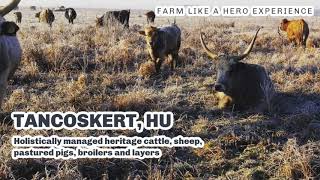
Sultan, a programmer turned farmer in Hungary, manages 50 hectares of heavy clay floodplain with rotational grazing and regenerative practices. He works around fragmented land from post-1990 restitution, old machinery, and isolation from local farming peers, drawing instead on English-language mentors like Savory and Salatin.
Chapters
All right.
Welcome to a new episode of Farm Like a Hero. Folks. I'm Richard Perkins. Today I'm here with Sultan who runs tankers in 30 hectares of a larger 200 hectare family farm over in Hungary. Producing grass fed cattle and sheep, pastured pigs, hens and broilers. The farm acts as a CSA for around 150 families. Sultan, thanks so much for taking the time to be with us today. Hi.
Hi.
I heard you, you were cutting hay today, you had problems getting your mower going. That's you're making all your winter feed at the moment.
Yes. This, this year seems like a big, big chain of equipment problems. I don't really like machinery, so yeah, probably it's a bit my fault. Everything was bought my by my father like 30 years ago and it's getting old and rusty and used up and we have have issues but we will get there.
Before we talk about the enterprises, maybe you could tell us a bit about your sort of background. And it's a family farm you're starting out on, isn't it? But tell us a bit about your journey to this point where you are now.
Yeah, so my parents are and were edible farmers and that part of the agriculture just didn't make sense to me. So yeah, big machinery, fertilizing, poisoning, that's not for me. So I left, I moved to Budapest, which is our capital and I became a programmer mostly around web design and websites and that sort of thing. And around. 2012, 11, somewhere around there, I just got fed up with it. Yeah, I felt like I wasn't producing value. You know, I wrote the 100100 first build your own calendar website and yeah, so I left and I moved back home and my plan was to take over this 30 hectare field. And back then the rewriting movement was big. So I figured I will be doing pheasants and partridges and I will be releasing them. And the focus of my company will be creating the habitat around the country and be a contractor of small game bird habitats, Which wasn't a really viable business model. Also I had to buy or I wanted to buy a bunch of equipment like building a brooding house and whatever. And the game bird industries, they start laying around January, they finish around June maybe. And the rest of the year there is this equipment just sitting there, not producing anything useful. So I looked into chickens and turkeys and whatever and slowly become interested in the whole landscape regeneration. So if you are contracting to create a small bird habitat, it's like one hectare or half or whatever just nooks and crannies around the countryside. And I felt that between industrial agricultural fields is not that useful to create a bigger habitat I needed more money, more resources. So I turned into the regenerative agriculture. So yeah, we are no now grazing around 50 hectares to the 30 I started out with. And we are trying to trade all the further away fields to move them closer to the home farm so they will be accessible by our animals. Which is quite hard because everybody loves their own piece of land and don't really want to trade. But I don't want to buy further away fields and then nobody is selling around my farm. So it's.
Sorry to interrupt you but that's because the original family farms, couple of hundred hectares, it's split up into a lot of different patches. Right. So you trying to trade to get one larger bit of land as it were.
Yeah, so the. Probably the biggest distance between the two furthest field is around 8, 9 km. So with a few hundred fields in between and the town. So it's not really an option to. To herd the cattle over.
Is that quite common there in Hungary to have farms broken up like that?
Yeah, because we didn't really have farms before 1990. We were a basically ruled by the Russians. So it was a quasi communist and at times really, really communist state. And they beaten and tortured the farmers until they gave the land to these big agricultural cooperatives run by the government. And when the. In 1990 the. These companies split and you based on some factors you got some money sort of paper like a. So you could be there as an auction of the fields owned and run by the cooperatives and you could buy these fields but not with the money. It was like you lost 10 hectares, you got a ticket for 10 hectares and if you worked a lot you got more tickets and whatever. So everybody just tried to pick the good fields and based on, you know, it's an option based on your money and Your aggressivity just small 5, 10 hectare fields were distributed them on the farming forks and slowly they gather together. So we have. My biggest field is 30 hectares but we have like 50 maybe 80 hectare fields now. But it's a slow process of buying and we don't really have farms like farmhouses in the countryside where the land is visible from big farmhouse.
It's more like production units, as it were. Yeah, yeah, interesting. Challenging circumstances. But then your parents had a different farm in pathway that you didn't really see inspiration or future in, did you? What was their kind of reaction to you wanting to come back into farm.
You will see this route is. This route works. And when I say, you know, I don't want to plow anymore. Yeah, but you must. No, not really. Yeah, you must. You will see. And yeah, so it's. And yeah, I lose some production. I can lose years in fuels when I mess up. But I'm quite fortunate with the CSA we have and with the EU grants because income payment is quite safe to try and find new ways. But with the CSA I have a guaranteed income and with the EU money, I have a guaranteed income. So we can play around a bit. But that's why we just starting to convert the further fields. You know, the first 30 I just took over and yeah, this will be grassland now. And that was it. I moved there in a trailer with like 200 broilers and three sheep and that was my company first year. But we created the csa, I made enough money to get by and started to grow. Right now I have like 70 head of cattle, so it's a much bigger operation now. But we could try on this. On this first field. That's why I started small. My first chicken tractor was run my mother's garden. Yeah, I read it's good. Can I make money off of it? And I could. So I bought 50 other hens and 200 baby chicks and just grew from there. So it was slow. The rest of the farm was run by them and when they started to retire, we turned everything into Alpha Farm, basically. So it's a big playground, so I have time to figure out how to farm this new method. Nobody does it around here, so I don't really have anybody to turn to.
Yeah, I was speaking with David and Anna yesterday and that's the feeling they conveyed. It's like, it seems like there's a few of you in the whole country that are turning to different ways and it's hard to. I'm curious what influences you've taken on your pathway in here, because obviously coming through the lens of looking at game animals, that's quite a different subset that most farmers would know nothing about.
Like what?
Where did you find inspiration that's led you to do what you're doing?
Well, my first big influencer was. Was Darao Gerard. Dara, this was. I started to, you know, see nature through his eyes, I suppose. And the area I live in and farming is a big few thousand hectares, a floodplain in the town. The countryside around the town is 9,000 hectares. And the biggest elevation difference in the whole 9,000 hectares is 8 meters. And it's Bordered by the river Tisa. And this area was the flat plain of the Tisa. And obviously it's them right now. So we can't really work with the water. But if it fills up, when it fills up, it fills up like at least once a year, maybe two or three times. You have to deal with the water. So that's why arable farming just wasn't making sense for me. Just, you know, rushing. It's solid clay, rushing to get the seed into the ground and not get stuck. Then hoping, hoping for rain because it's quite dry. We have 450, 500 millimeters of rain in a year.
Okay, let me try. And really hot summers as well.
Right? And yeah, 35 Celsius or something like that in the summers. And our wettest months is June, but. I'm not sure if my numbers are correct. But it's like this. In the summer you have 300 millimeters of rain, but the evaporation is around 1,000. And in the winter, it's backwards. We have much less rain, but no evaporation and solid clay. So it's a mudbas before countryside. So, yeah. And after that I always was, yeah, why do you want to plow that land? It's obviously a pasture. You know, it has reeds and water half a year. The rest, the vegetation is so high you can't even mow it. And they burn it and fight it. But my father was, he thought this is more free doing the herbal farming. So, yeah, then I saw. Savory's TED Talk and Michael Poland's TED Talk and found Joel Salatin. And it was really interesting because it was like, yeah, okay, so I want to be a nomad herdsman, you know, and just search the Internet. And there is. Came. Came this, this video about, you know, mob raising and savory. Okay, so yeah, now I need to do something about the flies and maggots and cow pies and whatever and search the Internet. And so it was always. I figured out something and in a day or two I found that there is a guy who does it for. For much longer than I. And it works. And it really, it was, it was really interesting and quite, quite inspiring.
Yeah, so you've really had to search in English like there's not any local resource to turn to. I guess that must be quite hard to. Like, how do you, how do you navigate that? Because it's. I mean, farming is quite an isolated, lonely thing as it is for I guess, all of us. But it's like when you're on your own in terms of not having, you know, like, colleagues to share within your own native language. That must be really challenging. Right?
The CSA movement helped a lot because there are only like 20 CSA farmers in the whole country, and they are market gardeners. But still, there is something to, you know, talk about. And when I say, yeah, my grazing methods are different, nobody understands it, you know, Why holistic management is not the same as rotational over grazing, you know, And I can talk days and they will still not understand. So. But yeah, there are a few farms, we have 10, 12 farms who are starting to do this. Mostly chickens, but some bigger animals. So it's starting to grow, starting to come. That.
More from Richard


A review of short and intensive season on a mixed farm and restaurant/event space in Sweden






Alskade Kyckling Exploring complexities of poultry production in Sweden and what we stand for


