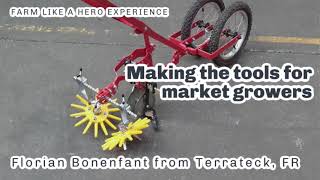
Florian Bonnenfont of Terrateck talks about moving from agribusiness to organic farming tools. He sold wire worms early on to fund research, and now targets 20% annual growth making equipment for market gardeners. The boom comes from educated people returning to farming, social media, and the cash flow advantages of small-scale operations.
Chapters
Okay, welcome to another episode of Farm Like a Hero folks. With me, Richard Perkins. Today's a little different episode. I'm with Florian Bonnenfont, who's from Terratech, which is Europe's largest small scale vegetable tool and supplies company. He's trained as an engineer and as an organic farmer, but he's acting as the sales and market development manager for most of the worldwide development, except for the United States, Canada and Australia. So I'm really interested to hear about current trends, how Terratech got started and what their future vision is. So farhan, thanks so much for taking time out of your schedule to join us today.
Thank you for the interview. My master thesis was about wire worm regulation in organic form. And it worked. Basically. Now I will reveal something which I shouldn't. I financed my thesis by selling wire worms to buyer. They were paying €3 for each wire worm alive.
Wow, that sounds highly lucrative.
It was very lucrative because my work was just to be under the potato clothes cleaner with a thimmer, get their wire worms out and the dust counting and bring them to buyer. It was two hours work for I think it was nearly €30,000.
Oh my gosh. Well, there you go. That's gonna open up avenues for someone.
Exactly. But it was very funny and it wasn't a mistake from my side. When I delivered the wire worms, they asked me to put them in in potting soil. And me as an organic farmer, I put it into organic potting soil with high biological activity. They've been killed by all the nematodes which were in the potting soil. So two weeks later I got a call from Bayer. Lucky I am, they paid me before all the wire worms were dead. And I said, I can't deliver more, it's not possible. Because I think they would have found out that that was the reason. And basically this is where I started to understand that microbiology and looking very carefully into soil is a solution for the new type of farm.
Yeah, you said so you, your interactions with the large sort of agribusinesses like Syngenta, Monsanto, those things, you were pretty disillusioned by finding out they didn't have solutions to the things that they're trying.
To address that I knew from the beginning that it was not my type of farming. My mother raised me with organic products and always a lot of self cooking. So get always fresh food from the markets twice a week or three times a week, which is in Germany. Then not possible anymore because it doesn't exist. So the gap, because I grew up In France, went back to Germany after the divorce of my parents, was a big issue and a big change in.
My life and maybe we can segue back into. So the company really started with humble beginnings and it's grown massively right over those seven years. Maybe you could describe a bit like where you're at now as a company.
So now at the moment I would say so we are growing about and we try to keep it that way. Not more than 20% a year, which is gigantic and it is difficult to manage.
What do you think's been major influences in the rise of. Because from my own perspective as an educator in this field, I think it's market gardening. Small scale, intensive. Market gardening has grown in popularity more than any other arms of regenerative agriculture. And is that like how few sort of. What's your understanding on how that's been coming around?
I think there are three ways if I'm not wrong. So once it's the highly educated people who are leaving town and installing themselves into the countryside or close to city on a plot of land and start farming because of they have their vision. Of course the new media with YouTube, Facebook, Instagram had a big role to it. The influencer like you, like Jean Martin Fortier, Curtis Stone. It's a big, big movement. Due to that then money is a big issue. You can't start a farm on 5, 10, 15, 100 hectares just from scratch. This was the second one and the third one is just that even in universities they are now talking about the cash flow and the money return on short term and that market gardening is the best way to do that.
Yeah, certainly it's those points of access to land, particularly here in Europe and often young people wanting to come into farming without that farming background who. It's a low barrier to entry and you don't need to invest a lot. And so that's been a big rise. And it's interesting you were telling me just before we got on the call about the like something that I really try and impress on people in our educational work is like to buy the right tools at the right scale for what you're doing to optimize your work. And they're really not big costs. Things like a greens harvester, €600. It's. It seems a lot to someone who's trying to pinch pennies and put too much of their capital into actually buying a plot rather than leaving adequate funds to actually start up successfully. And so I always really try and impress those points to make sure people don't get disillusioned by setting up in a bad way and then overworking themselves as a consequence. But you had an experience like that yourself. Maybe you could share that with us. Don't.