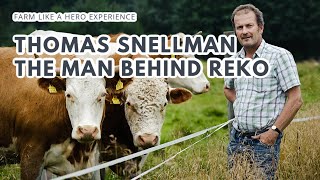
Interview between Richard Perkins and Thomas Snellman (founder of the REKO direct-sales model). Snellman describes his personal farming background—born on a small farm, worked as a milk producer until 1998, then switched to small-scale beef production and now keeps more than 30 animals. He converted to organic production around 1990, worked with farmer organizations to develop markets, and in October 2012 encountered a French CSA/AMAP pickup model which inspired him to start REKO (a shortening of Swedish/Finnish words meaning 'fair consumption'). The conversation also touches on how REKO spread across Scandinavia and practical lessons for running successful groups.
Questions this video answers
Altogether more than 30 animals.
Around 1990.
He was a milk producer until 1998; thereafter he moved to beef production.
A shortening of words for 'real/fair consumption' in Swedish (real konsumtion) and Finnish (reiloa kuluttamista) — intended to work in both languages.
He cites an evening visit to a French town on 25 October 2012 when he first saw the pickup/CSA setup.
Chapters
Okay, so welcome to a new episode of Farm Like a Hero. Folks. My name is Richard Perkins. Today I'm joined by a special guest, the Ricoh founder, Thomas Snellman over in Finland. I'm personally super excited about the Ricoh model. It's something that we've been a part of setting up several ricos that form the majority of the sales at our farm. And it's a movement we've seen spread all over Scandinavia and further afield too. I'm really excited to get into to talking about the history of the model, how that came about, and also hearing about what makes a successful group in Thomas's experience, and also potentially looking at any shortcomings in the future of the movement. So, Thomas, thank you so much for taking the time to join us today.
Thank you, Rikard. And hello to everyone watching this interview.
I wondered firstly if you could tell us about your relationship to farming. Am I correct in thinking you have a. Is it a beef herd over there in Finland?
Yes, actually. I'm born on a small farm 61 years ago and I have four sisters and four brothers. I'm the second youngest of these and I was meant to be a doctor or going to university because I was the only student in our family. But I ended up to continue with the small farm. At the time, it was like to make your own living in this countryside. We used to have about six or eight milking cows at the time. So after my military services I decided I feel so happy being out in the nature and especially in my forest. So I thought it would be a good idea. I have to admit I don't have any education in farming at all. I'm like born on a small farm and learn my job by doing so. I don't have any farming education, but I have been working as a teacher for other farmers.
And so today. Is that true? You have a beef herd now?
Yes, yes, yes, yes, I have a. I have a beef. Small beef cattle. That means I try to be self sufficient on feeding them my little cattle. So for the moment I have altogether with more than 30 animals. And I started as a milk producer until 98, but then it was too much work for me. I'm a little bit lazy. So I decided to turn into beef production. And since then I've been on vacation all the time. Compared to the world before?
Yeah, certainly. And so I'm curious then, how did Rico grow out of that? Was it from a personal need? And maybe first you could say a question I get asked all the time is what does ricoh actually mean.
Ricoh comes from the shortening real consumption in Swedish. I'm a Swedish speaking. I belong to a Swedish speaking minority here in Finland. And when we try to establish this system, I tried to find out a shortening that worked in both Swedish and Finnish. And it's very, very difficult because Finnish is a totally different language. But in this case it was quite close. In Swedish it's like real consumption. And in Finnish it's reiloa kulutta mista. So I could use both this with the same shortening. But real consumption that means fair consumption. So mostly the name comes from. It was the most convenient when it should reach both the Swedish and Finnish speaking. Because where I live half the population is about speak Finnish and half the population Swedish. That's the background of the name. It was like not a big thing when we started. I didn't know the future for it when we started. Like its own life a little bit also.
How did it very first come about then? Was it a personal need to sell your products? And how did you come up with the concept?
No, actually it was born in one second, but. But in one way it was also a result of experience from before. In the 90s I was like working in the farmers union to promote organic production. I converted myself into organic production. Among the very first here in our region, 1990. And in the very beginning I directly suggested for the farmers union that we should like promote organic production. And I was. I got a little bit responsibility for this and I started to discuss with processing industry, with slaughterhouses, with dairies, just to get produce going to the shelves. And it was. Sweden was far before finland in this 10 years at least. So as a Swedish speaking I could look on the situation in Sweden and see that the development of organic production there. But it. We didn't succeed. And it was mainly when coming to supermarkets they said no, this will not work organic, no one demands for organic. And even if like we had the backup from the processing industry, we never succeeded. So Dennis went almost 20 years, even more. No, perhaps about 15, 20 years. And since. Since about 20 years after finishing with the dairy farm, I decided I should learn French. So I went to France, working on a sheep farm for a couple of months just to learn the language because I didn't speak one word before. And I got so many friends there. And during the years a former director for agricultural school invited me and one Evening, it was the 25th of October 2012, he said I would like to show you something interesting. And he took me to Duella Fontaine, a small town in the middle part of France where they had a map delivery like a CSA community port agriculture and a couple of farmers showed up, opened their cars and started to put produce on tables. And certain times people showed up picking up these produce and I never seen anything similar before. Where I live CSA was totally unknown, no one knew about it. And I saw this like, this is genius. This like could have solved my problems that I had 20 years before. So directly I decided when I will come back to Finland, I will try to start something similar in Finland. And I know exactly the time when Rekko was born. It was 25 October 1731.
To listen in to unedited long form conversation. I'm super excited to announce the Farm Like A Hero Experience is Now Live. Our2020 special features. More than 70 interviews with Europe's best regenerative farmers in long form conversation, weekly Q and A sessions with myself, as well as the private Facebook community. Our Epic Hero membership is now only open until June 11th, so join now@farmlikeahero.com and we'll see you in there.