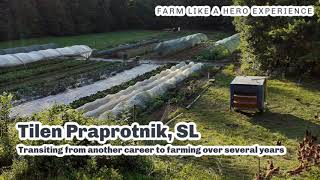
Tilen Praprotnik left archaeology to build Svegerilla, a 2.2-hectare market garden in Slovenia. He took a slow approach, influenced by Jean Martin Fortier and Eliot Coleman, and focuses on winter production despite harsh constraints: last spring frost mid-May, first autumn frost in September, and near-total darkness by November.
Questions this video answers
2.2 hectares.
2016.
University degree in archaeology.
Around mid-May.
Often beginning to end of September (can be as early as Sept 1).
Chapters
Welcome to a new episode of Farm Like a Hero, folks. I'm Richard Perkins. Today I'm here with Tylin Praprovnik, who runs svegerilla. It's a 2.2 hectare market garden and microgreen operation in Slovenia, started back in 2016. So super excited to hear more about the operations there too. And thanks so much for taking the time to be with us today.
Yeah, it's my pleasure and a huge privilege. Unfortunately, I was not able to watch most of the episodes by now because I was too busy during the summer, but I'm looking forward to some winter evenings.
Yes, I think that's been the case for a lot of people, I would imagine. But I think for the people following along, it's just been amazing to hear so many diverse stories and there's some really great producers. And, you know, a really important point of this tour for me was just seeing that so many of us are looking over to America or other countries for inspiration and methodologies, but we have all the best people in here in Europe, and just connecting each other and talking and hearing our stories has been so valuable. So I hope you'll get a lot from that and share with us too. So maybe we could start. You could tell us a bit about your background, like how did you get involved in farming originally and what's your pathway been to this point?
Yeah, I'm one generation removed from farming, so my parents were not farmers. They were like working class, suburb or semi urban type of people. And. Yeah, but I always feel this connection with land. So ever since my childhood, I feel like land is calling me. And you know, ever since I remember I was growing like, stuff, vegetables from my early childhood. We have a big tradition of like allotment types or like house gardens, vegetable gardens in our country. So maybe not so long ago, almost everybody was growing their own food. So in that context, I think I'm farming the whole of my life. Then during my study years, I'm actually, I have a university degree in archaeology and I still practice a bit of archaeology. So I try to combine it with farming.
Can you elaborate on that at that point? Because I'm fascinated by archaeology, how that blends together for you.
It's like a slow process of getting away maybe from archaeology and going into farming. So the year that we started that was 2016, I had maybe only five clients and the huge majority of my income came from archaeology at that time. So every year we're letting it a bit go and I have a privilege to work on projects. So I don't have a fixed job or, you know, I can earn my money like at a certain time, maybe winter or things like that. So it's. Well, this year it's been really difficult combining these two things because we started also poultry operation in our farm.
You got too busy. I don't want to focus.
Yeah, I.
Don'T want to focus too much on the archaeology, but I'd love to hear what, what sort of things does that see you doing? Like, what work?
Yeah, I had quite a busy career the years before I started farming. It was just like excavating some Roman frescoes and mosaics and Roman towns in Slovenia. It was really like some of the highlights of my career.
Amazing.
And it was really amazing because, yeah, it was maybe like some of the archaeologists wish they were researching those kind of things here also, so. But that's the kind of things I was doing. But, you know, this work of mine in archaeology can be like done also in stages and process projects, like maybe only during the winter, things like that.
Yes. Nice. Is that, have you found that the methodological, patient approach with archaeology, does that translate into your farming practice, which is all about detail, orientation and patience, observation?
Yeah, maybe it's. I certainly want to take my farming slowly, like one step at a time. It's like I don't want to rush into things or take too many risks. So we started really slowly and we were developing from that point on. And I think that reflects my approach to life, you know.
Do you think that. So what, what was. You've got sort of farming and cultivation in your, in your blood, but is that what was key points that made you decide, right, I'm gonna start farming now?
Yeah, that was in the winter of 2016. I saw some of things that Jean Martin Fortier was doing in Canada on the Internet and that was. I see that as a turning point. I also discovered Elliot Coleman at that time and I started watching your work slowly. So it was like, yeah, this is possible, this is feasible, you know, and at that point we had like huge family garden already because I was always trying to be self sufficient with vegetables, things like that. We obviously didn't do animals because with vegetables it's easier. But at that point I was looking into winter production. What is possible in the winter? Because in summer obviously can produce a lot of vegetables and excess of vegetables. But for me, the Holy Grail was always the winter season because it's a huge challenge to be self sufficient in winter in our climate.
What's your, could you tell us maybe your frost dates just for reference for listeners around Europe.
Yeah. Our last spring frost date is like middle of May. And this has been a bit different in the last two years. There seems to be something wrong with the weather last two years. Although I have to say we had a good summer this year and very, very productive. And I would say the last, the first autumn frost will be just now, maybe beginning, end of September. But it can happen that we have frost 1st of September or we can have a really nice autumn. Maybe we are a bit more exposed to those kind of weather things because we live in the foothill hills of Alps. So right behind us, it's like 2000 meters plus high hills. Yeah. So if they don't have frost maybe 50 km from us, we will already have frost.
Okay. Yeah, yeah, yeah, yeah. It's a beautiful photo looking out over your. Your scenery with the Alps in the background.
The.
So it's a similar sort of length growing season to what we've got up here. What's the winters like? Are you like deep under snow typically, or.
No, no, no. I remember snow from my childhood almost. It's like we used to have a lot of snow, but last almost 30 years, the winters have been progressively like drier. Yeah. And yeah, we will have like days with a lot of snow, but then it will go away. Or we even had a few winters without snow.
You'll have like a snowy vista up on the Alps, but you will have melted off down below there.
Yeah, exactly.
Yeah. So it's possible to grow through the winter, but limited, I guess, right?
Yeah, yeah, it's limited. It's also like with the lack of light, our cutoff point with the light is maybe first of November and then we get more than 10 hours after February 1st. So then you will see rapid change. But we don't have the infrastructure yet for so much winter production.