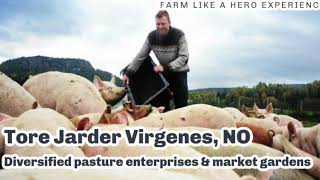
Tore Jardar S Wirgenes transformed his family's sandy Norwegian farm from monoculture to regenerative agriculture over decades. His soil tested at just 1% carbon, and a severe drought in 2018 forced faster change. He now runs a market garden, CSA, pastured pigs and cattle, and credits mentors like Elaine Ingham and Joe Salat for shifting his approach.
Chapters
Okay. Welcome to a new episode of Farm Like a Hero, folks. I'm Mitchell Perkins. Today I'm back here with Torre Ferguson as Engelsguard. That's a CSA in southern Norway and Torre has been on a journey transitioning from conventional to regenerative practices that you might remember from our YouTube channel. I filmed the 30 hectare farm on the YouTube channel back in September 2018, detailing the market garden CSA, pastured pigs and cattle and the ridge sale style Eggmanial. And it's one of the greatest examples of diversified regenerative farming in Norway that I've heard of. And so I'm super excited for today's episode to see how things have been developing and systems have been solidifying there. The farm sells through Self Harvest CSA as well as RICO rings and I'm super excited to have tode join us today. So thanks so much for taking the time out of your schedule to be with us.
Thank you. To listen to what we are doing.
Yeah, I'm really excited. We've got lots to talk about and obviously you've got a lot of different enterprises going on at the farm and I think people are going to be really excited to have a big update of how things are going there. But maybe we can start back. For people that haven't seen that video on YouTube, could you maybe tell us a bit about your journey into farming and the sort of transition of mindset that you've been through on your journey?
Yeah, that's. We started like my parents was doing, was a typical farm with potatoes and grain and the animals was left and the beehives was left and it was quite monoculture system. And for, yeah, it's now soon 20 years since I told my father that I want to take over the farm. And he also told me that when you're starting up you should, you should focus on more organic farming. And yeah, I figured out that, yeah, after some years that it was possible to do organic farming also. It was, it was a time there. Then all the farmers around were saying it's not possible to do organic farming around you and you have to introduce animals to fix it. So yeah, I believed in that. But after a while there was actually company in Norway who do free ranch organic pigs who contacted us and said, can you please start up with this? So we got a contract of 5, 600 pigs per year to deliver. That was like 12, would you say mother. Mother pigs who has two rounds with the piglets every year. And yeah, we just did it. That was a big trouble. But it opened a lot of doors and you start to understand the whole thing. When you do this amount of pigs it's actually not the nicest part for your soil. It's quite hard. And you know here in this part of Norway it can be 40 minutes in the winter but it can also be zero winters. And when you. When you go out with a big, big tractor in the soil and it's just. It's just shitty. So we saw quite early that it's a kind of damage on the soil. But we was pig farmers so it was. It's not that important that we have the best soil around. But we still had the grain and we still have potatoes in the system. And for every area was doing this we saw it was. It's getting worse. You can take the penetrameta and check. It was like bed on out there. Yeah. And I can also look on to my neighbors fields and it's still happening there too with big, big machines and they have to go out in November to pick up carrots. It's hard for the soil. And yeah, there was some. We understand it was some holes in the organic farming, typical organic farming. Who. Who was quite hard to have a fix on. And of course we also saw that still organic farming we lost our carbon in the soil out there. It was. Our soil is like sand. It's light sand and it's like down to 1% of carbon mater in the soil. It's quite bad. It's very bad. And yeah, I get a lot of what you call influence from other farmers of course. And some people come here to the farm and on this point there was a young man who was just knocking on my door and he said I want to work here. I quit my job and I want to work here and just learn do farming. That's yellow also was in your film there.
He's still there.
I felt he was a little bit crazy. He pushed me far away and he was quite annoying. He know that I say that but it's. But in that period I started to understand much more about this. And we took a trip to you also in the oven there. That's four years ago now. And I remember you. I was coming to you and I had. I just had ordered not a tilling machine but we call it trese. Like going around there to like.
Like for tilting the soil.
Yeah, yeah.
Practically like a power harrow.
Yeah, yeah. So you said please don't order that and take the money. Go and visit singing from farm and learn more about this stuff and use the rest of your money. On compost. So we nearly did that. But it takes still some time before I understand it really. How everything works and how everything works together. That's the fine part to this. And yeah, we met Elaine Ingham one time and Joe Salat and we met and we got lot of good, good information and there's so much good studies and all this. So he was thinking, okay, we. We do all this change now.
So when I was it. When I came to see you, it was 2018 that. So that was like a real big push year for you guys to set up a lot of diverse, different things.
Yeah, we did a lot. Maybe too much. And it was. It was like the first summer of like 70 years or something with it was dry and sun and 30 degrees every day. Yeah. Not normal here at all.
That was the great. The great drought that is documented on our channel for the listeners from abroad. It was a major drought year here in Scandinavia.
Yeah. Yeah.
So hang on, let's just recap. So you. You started a market garden of around a hectare. You started pastured eggmobile. You still have pigs. You got cattle out there and you're having babies and working just with yellow, mainly.
Right.
So that was pretty full on.
Yeah, it's. It's. Yeah, it's. I don't know if I can recommend it for everybody and maybe you should take it little bit step by step. But right now it's just. Yeah, we have come to the fun part. So we have the control now. But it's a massive change of our farm and how we manage everything, how we sell everything, how we're thinking. So let's.
Can we go back a step then? So the. Because you still have some pigs, but you're not producing anywhere near that number that you used to.
Right. We quitted the pig farming and introduced it more in a good system here on the farm. We have it to the max. Pigs is easy to sell here. It's good economy in it. So we had 5, 600. We are over 100 now per year. But the fun part of that is that I think I have the same income for 100 pigs compared to those 5, 600.