FARM LIKE A HERO EXPERIENCE: Tycho & Karoline, DK
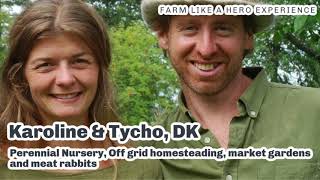
Richard Perkins visits Tycho and Caroline's Danish permaculture homestead, the Haven, which grows 50 species of perennial vegetables and runs a nursery, market garden, and rabbit operation on a 900 square meter plot plus rented farmland. They discuss building an off-grid straw-bale house, navigating local regulations, and turning homesteading into income.
Questions this video answers
Around 4 hectares.
About 900 square meters.
30 years.
About 50 different species.
Chapters
All right, welcome to a new episode of Farm Like a Hero. Folks. I'm Richard Perkins. Today I'm here with Tycho, who runs Permaculture haven on around 4 hectares with his wife Caroline in Denmark. And it revolves around an edible perennial nursery and seed business, a market garden, pastured rabbits and perennial crops, as well as educating people in these topics and more. They've built their own off grid straw bale house and they're developing a larger agroforestry plot with grazing. So it's kind of a homestead with small various enterprises that make up their combined family income. So thanks so much for joining us today, Taka.
Yeah, thanks for having me.
Awesome. So you originally from the U.S. right? That's right. How did you end up there?
Well, basically I met my wife and she imported me.
And tell us a bit about your California. What is your, what's been your folks route into this? Like, did you come from farming backgrounds in any way or like, how did you get involved with what you're doing today?
Well, I wouldn't say it's a farming background, but basically as a, as a teenager I had this like, everything's getting ruined. And I grew up in the big city in San Francisco and it's like skyscrapers and freeways everywhere. And at some point just kind of clicked in my teenage head that I didn't want to have anything to do with that. And so I thought I need to learn how to hunt and gather in the woods. That was my like dream back then. And, and so I basically started learning foraging a little bit about hunting and stuff like that. And after, you know, starving in the woods for some experiences, I decided as I got a little older, so I was like, okay, maybe I'll start basically just homesteading and got into gardening. So I've kind of come in into farming basically through the self sufficiency, independence angle. And I did a little bit of market gardening about 20 years ago now in the States and just basically broke my back and not literally, but tons of work and kind of gave it up after a few years and then just went back to homesteading. And that's kind of how I got into it. And you know, it's a, it's been an interesting journey because I have experience with a lot of things. But now turning it into a business, that's where the challenges is for me. So learning those business skills have been an important learning.
What has been Caroline's background is she, she grew up on the same path.
She grew up on a hobby farm. So a Mom that was basically growing vegetables and meat on the farm. So she kind of got it in that way. And then she became a biologist and wanted to save the world and learned that telling people what not to do wasn't a really good way to save the world, but rather looking at, okay, how about we change, make an example of how we can live differently? And that's basically how she got into it. And then after we met and I moved to Denmark, then we've just been basically kind of focused on. On growing food and that kind of thing.
So the vision for the Haven is that it's a homestead that has a myriad of activities, but it's also producing various forms of business, that you've got self sufficiency, but you're also making business livelihood out of that too. Yeah.
So kind of in a nutshell, we, we bought a plot in an eco village and it's like you have to build your own house. So we did that. But the plot, it was only 900 square meters, which is tiny. But we thought, well, this way we can hopefully build our house, become debt free, which we are now, which is awesome. And so we built a little straw bale house and basically a little homestead garden, a forest garden on the one side and a little kitchen garden. And it's actually in those first years there where I started working with the nursery and it was basically just to make plants for my own garden. And then it was like, well, we have extra, and there seemed to be interest, so we started selling from our little plot. And that was about five years we did that. And then after. Yeah. In 2017, we finally got the opportunity to rent some farmland which is right next to our house. So it's just really awesome.
Yeah.
And that was.
Land's pretty expensive there. Now it's hard to get access to land and it's very expensive.
Yeah. And we also ran into some weird laws that because we technically live in a town, even though we're out in the countryside here, but it's technically a town because it's a village. We have the problem that there's rules against us even using farmland. So we've had to actually argue that we had a nursery and it's right next door, the piece of land. And we actually went all the way through to the Ministry of Agriculture or whatever and got permission. And the, you know, the agriculture consultants and things, we, we know they're like, oh, you'll never get permission for that. But. But we did. So now it's kind of a something other people can use. As a precedent. So because access to land is really hard, you have to have a farm to access land. But now we've done it and we have a 30 year lease on it, so we can actually really play with it.
Yeah. So tell us about the nursery bit, because that's something that I see their scope for dotted round multiple places in every European country. And to find useful, weird, wonderful agroforestry type trees is quite difficult. And I know like from knowing Martin Crawford down in the uk, like he's been shipping plants literally all over Europe and there's just a lack of people doing nurseries. So tell us a bit about how you've like the plant species and how you've decided to roll with that.
Yeah, it's actually a really interesting part of our business because it's, it's kind of exploring new species and I feel like there's like a duty to try new things constantly. It basically started because we had our, we were planting our forest garden and needed plants for that. You need like just loads of plants to fill out a forest garden, especially the perennial ground cover layers. And so we basically started really small and then scaled it up as we could as interest was there. And there is interest, we usually sell out. Like there's not. We can't make enough plants for the interest and it's. We make some trees. So we make, we do a lot of seedling trees, especially not that much grafting. There's a lot of other nurseries that fill that niche for like standard top.
Fruit and stuff, you mean?
Yeah, exactly. So I mean, we make a few apple trees but we basically don't sell them because people that come to our nursery, they want weird things. So we, you know, we have a, basically a big focus on unusual things that you can't get other places because that's, I mean, that you have to find a niche where that isn't already filled, you know, and, and then perennial vegetables is actually a big part of it, of our, of our nursery business. Probably the big, biggest part. It's. Yeah, we probably have 50 different species that we sell. Yeah. And those are mostly also started by seed, either in the fall or the spring. And then we grow them out for basically most of them ground out a whole year before they can be sold. So it's kind of a lot of, there's a lot of planning.
Can you tell us some of the weird, wonderful species that you're offering?
Yeah, so we do some nut trees by seed. We do like Cornelian cherries as some of the Trees, you know, heart nuts, walnuts, chestnuts, stuff like that. And then we do a lot of bushes, also berry bushes, like Elaeagnus, silverberries, we call them. Those are super popular. We just can't make enough people just. They just get torn off the shelves right in the first few days of the season. And then a lot of other berries. Aronia is a good one. Some of the also usual currants and gooseberries and stuff like that. Let's see what other unusual ones. Also honeyberries, the loniceras. Those are pretty popular. Yeah. I mean, there's toon tree, Chinese mahogany, has like an edible, really amazing flavor leaf that. We love it. And I think that spreads to others.
They are like, what's the situation in Denmark? Are there any other weird, wonderful nurseries that you know of just trying to present the case to people? Like, there's scope for doing this all over and for finding the varieties that performing really well in the local climate and.
Yeah, yeah, exactly. I mean, there are a few other nurseries doing some of the similar things that we are. There are definitely a few doing trees. I know, definitely two that are doing kind of also unusual trees, aside from all the normal things. And then there's. I think there's two other nurseries that are doing, like, edible perennials and basically. But, you know, Denmark is a small country, but it's also kind of spread out because of all the water breaks up the country. So, you know, we're in the west part of the country and there is one other nursery I know of that is doing some of that, but otherwise the other bigger one is in the east of the country, which. So it's. There's not a lot of competition for us at the moment, and we try to have a good, you know, collaboration with the other nurseries as well. You know, send them. Send people if they're on the east part of the country to send them over there and so on. But there's. It's a. It's an open niche. We could. We could expand it, but I don't. Yeah, there's. We have. We have some rule stuff we try to keep under. Because the size of that now we're. We don't have any control visits, checking potting soil, checking which species we're selling. All that stuff. We're under a level that's kind of under the radar but still legal.
More from Richard


A review of short and intensive season on a mixed farm and restaurant/event space in Sweden






Alskade Kyckling Exploring complexities of poultry production in Sweden and what we stand for


