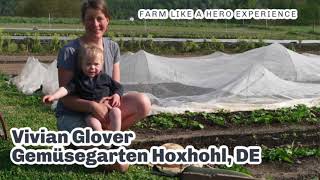
Vivian Glover runs an 8-hectare organic vegetable CSA in Germany with 90 shares, and her partner Alexander operates a separate 12-hectare mixed farm 30 km away. She describes her path through organic farming education in Eberswalde, seven years running a farm shop, and the real obstacles to acquiring land and succession in Germany, where she now helps connect retiring farmers with new entrants.
Chapters
Okay. Welcome to a new episode of Farm Like a Hero, folks. I'm Richard Perkins. Today I'm here with Vivian Glover from Gumusegarden Hochschule in Germany, a farm established in 2017. I met Vivian in Germany where she joined a four day regenerative ag intensive that we put on in April 2019. And she's running an eight hectare organic farm with a 90 share vegetable CSA and has cattle on the rest of the land out on pasture year round. And in an interesting situation, her partner Alexander farms a 12 hectare farm about 30 kilometers away. And he's producing about 3,000 boilers a year out on pasture, as well as multipurpose laying hens, pastured pigs, and runs the CSA for meat and eggs as well as selling to shops. And they collaborate together around their work and organization and customers. So I'm super excited to hear about how all that works. And Vivian, thanks so much for taking the time to, to join us today.
Well, thank you for having me.
So I'd like to just concentrate firstly on your farm and your history. Like, how did you get into farming in the first place?
Well, my grandfather built me a wooden farmstead when I was 2 years old. And that was when I decided to become a farmer. And then Scott, I realized what conventional farming was like. And at first I thought, well, I don't want to do that. And there wasn't really an alternative around then when I was younger. But then I finished my school, I found the possibility to study organic farming and marketing in Eberswalde, that's just northeast of Berlin. And that's what I did. And right after school I went there and did as many practicals and internships as I was able to do when I finished. Then I started working on a farm where I'd spent my practical semester and built the farm shop there. Helped build the farm shop. And then I ran the farm shop for something like seven years. And then I decided it was time to do my own thing.
So you got some good exposure to sales, customer relations, managing people and that sort of stuff. Did that really help with establishing a real farm?
Yeah, that definitely helped because I know what customers are like, how I can reach customers, what they want, how they think, how they decide. And that's really, really helped a lot to create my own CSA and to give the people what they want.
Yeah. So in the process with like you're collaborating with Alexander, but did you, when did you folks meet and did you intentionally start on separate parcels?
Well, no, not really. Well, we met at that farm there something like nearly 10 years ago. And then we decided we wanted to farm together. And we had the opportunity to take over a farm where the children didn't want to carry on. And we spent something like two years planning and talking and finding possibilities. Then more or less from one day to the other, the farmer's wife said no. So that was it. Then all the work that we had the two years before that was just finished within, from one second to the other. And we then had to find different solutions. And Alexander went to work on a different farm then. And I carried on working where I had been working at a farm where I ran the farm shop. And then I did. My goal was to have my own farm when I turned 30. So when I was something like 28 and a half, I said, well, I have to start planting now. And that's what I did. And when I was 29 and three months I had my own farm.
Amazing.
Alexander did just carry it on for another one and a half years. And he wasn't really interested in vegetables right from the start, so he wanted to do something with animals. And we only had this one field for veg, so he was starting to look around for something else. And his father wanted to move from within the city, outside into the countryside and started to look around for something. Then in the end they actually, both of them together, found this farm, which is where his father is living now, and Alexander's farming, but we're not living there actually. We live in the house that my grandparents built on the edge of a village about four kilometers from our vegetable garden, about two kilometers from our cows, and well, about a 30 minute drive from the other farm. We don't actually live on a farm. We just live in a flat in the house that my grandparents built.
Okay. What an interesting start. And so just to clarify, the cows are not on the same farm as the vegetable plant?
Well, they belong to the same business, but they're not on the same farm. And we don't. We've got this farm where the chickens, where the broilers are, and that's a proper farm with. With farmstead and everything. But that only. We only started that in 2018. And before that, in 2016, I bought a field, only a small field where I was able to set up this vegetable garden and I leased a couple of hectares and took over a herd of cows that was grazing there. That was how we only got those, that land, because otherwise that's the most difficult thing here to get land to start at all.
Okay, I see.
So we live in the village. Then 4 km into the one direction is the vegetable garden, 2 km into the other direction is the cattle, and then a 30 minute drive to the broilers.
That's an interesting setup. And. Well, I'm curious to jump back a step because I know that there's a problem in Germany as well as many neighboring countries with the aging farmer population. And now I'm not sure if I'll get this correct, but it's. Isn't there something going on where the farmers are really trying to pass the land on? Like people are looking for new solutions because their sons and daughters often don't want to run the farmers. Is that the sort of arrangement you were coming into? Is there any more you could say about that? It's obviously probably a bit of a traumatic experience, I guess. But do you know, is there anything insightful that you could share that would be useful reflection for others in that situation?
Yeah, well, you definitely need somebody, something like, I think, do you call it mediator? Somebody that helps you along with all the process and isn't really involved personally in the whole thing. You definitely need somebody like that to find a solution that suits both sides. And there's more and more professional help around organizations that offer advice or offer mediating like that as well. And Alexander and I, we were quite active in the young, organic, young farmers community here in Germany and we organize a conference every year and a special event for whether where people can meet up, where farmers are looking for people to take over their farm and other people that haven't got a farm are looking for an opportunity. And that's helped quite a lot of people. But we only started organizing that after we had our own experience. It's been around now for a couple of years and it's actually helped match up people looking and people wanting to find somebody for their farm.
That's amazing. And could you share the name of that for German listeners?
Yeah, that's the Junglandvirte Netsberg and the event I was talking about is the contact forum Hofelbergabe and it always takes place at the end of February or beginning of March.