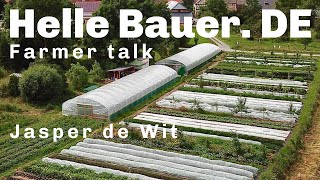
Jasper and Anna built an agroforestry and market garden in Germany on a €15,000 investment, running a half-hectare operation with 300 laying hens and multiple tunnel beds. They've navigated bird-flu lockdowns, pest problems, and regulatory inspections while growing the farm shop and joining the global Save Soil movement.
Questions this video answers
€15,000
300
About 500 m2 of tunnel bed space
About 1,500 m2 outside bed space
Approximately half a hectare (≈0.5 ha; reported bed space total ~2,500 m2)
Chapters
All right, It's a real pleasure to be joined again by Jasper who runs Hellabauer in Germany with his partner Anna and they've been featured on the YouTube channel a couple of times in the past and have been incredible past students here. Jasper did our internship program and set up one of the sweetest little agroforestry, no dig market garden and pastured polehood enterprises over in Germany. Real pleasure to have you back, Jasper.
Yeah, thank you. Awesome to be here. I'm looking forward to get talking to you again.
Yeah, well give us a little for people that watch the channel that know about what you're up to. Maybe describe Hellabauer in a nutshell. You're obviously Irish, not from Germany. So how did you end up there and what is it you've set up there?
Yeah, well, like you said, I grew up in Ireland. Grew up in a camphole community beside a little farm. And the farm was a. Like a Demeter. Demeter farm where we had cows and a garden and all sorts of things. So I grew up sort of in the farming scene but not so much in it, just a little bit on the side. Meant to help out in the holidays and stuff. And that's where I met Anna. She came to volunteer there for a year and I met her a few months before I left Australia for a year. Bad timing as it always is. But yeah, we ended up meeting up again after I came back from Australia and got together. And long story short, then I ended up moving to Germany where I really didn't have a clue what to do with my life and stumbled across permaculture and all the rest of it through permaculture, then found your farm pretty much at the start, I think before I even started doing videos and stuff and was following it and thought this sounds very, very interesting and I wasn't sure what to do and I had an idea that I want to start some sort of a project but I didn't know how, didn't know what. So I decided I'll come to Richdale for, for the internship. Done that. And there it came, very clear, very fast what I wanted to do and how I was going to do it.
So you basically left the internship program and just full on started up your enterprise on a super low budget now and listeners can go back to the old YouTube videos that we saw your egg mobile and the market garden starting up on really low budget. You put about €15,000 in to get your business going, right?
Yeah, exactly. Like I said when I was at the internship, made My business plan. Knew I wanted to start a market garden. Went back to Germany. You asked me did I want to stay on a bit, but I was too excited. I was like, no, I need to go home to get something started. So went home, talked to Anna's father, he lives there and the village where the farm was. And they said, here, I need a piece of land, this is what I want to do. He was like, sweet, let's go and have a look for a piece of land together. A week later we found this farm which was for sale in the village. He just sold his company. Had a lot of spare time. He was workaholic, so to say. A lot of spare time, some spare money, looking for something to do. And I was just looking to start this project. So it was kind of perfect timing.
It's a really nice sort of collaboration. Right. Because he was interested in. It's like an old ruined building that you've been doing up with natural methods and I believe you're sitting in your office that people can go back and see what that used to look like before it was done maybe.
Exactly. So basically the deal was he concentrates on like renovating the farm property. The house as you say, it's a Beautiful just over 200 year old timber frame farmhouse, massive house. And we have our section where we live in is maybe a quarter of the house roughly. And at the back we're putting in like apartments to rent out all the apartments at the back as well. Still lots of renovations going on now after five years, bits and pieces still have been done. And there's also beautiful big barns that we've been renovating and stuff like that. So that was his idea, was that he will focus on that for me. Perfect. Because I would never have had the capital or the time to do either.
Yeah, sure.
And then I could.
Jasper, it's worth saying they're listed buildings too. Right. So you have to do them up with a certain level of materials and expense that would be very prohibitive for yourself.
Yeah, exactly. Never would have been able to do this project by myself. Like it only works in the context that we have it. But yeah, then I had my time and energy to concentrate into setting up the farm at the start by myself. And after the second year Anna joined in and too when she finished her studies and she's full time at it now too. She's in charge basically of sales side of the operation and I'm managing the different enterprises and that's going really well. We have small market garden getting bigger half a Hectare. We have the minute. Okay, there's I think we have a bit over 500m2 tunnel space, bed space in the tunnels and then outside with like 1500 square meters bed space. Yeah. And then we have the egg mobile, as you said. We have 300 pastures layers which are moved around, which are built together with Alberto met at Ridgedale as well. And yeah, basically it's based on yours. I mean, anybody listening can have a look at it. There's plenty of video on YouTube and stuff. But yeah, there's a nice video, has boxes in the middle.
It's a really, I mean it's not really based on my design. It's like kind of completely your own design, isn't it, with these kind of like a homemade version of the chicken caravan automated nests. And it's a super sweet egg mobile, super sturdy. And yeah, there's a video of that on YouTube where people can see inside and see how that's working. But I wanted to tell us about that, Jess, because I know you've had your sort of bouncing back and forwards with regulators there with your eggmobile and we talked about that on the video on the channel. But I know you had to do like, you had to make sort of additional sleeping space. Did you. I've seen on your Instagram where you've had like almost like a broiler pen out the back of the, like, how is it with the regulations and where are you at with the eggmobile now?
Well, after first year they came, checked it out. Once I registered I had tick ins and they were like, what, what's that like? I've never seen something like that before. And you're completely confused. And I tried to complete explain the context, what we're doing, how it worked. And I mean the Germans really love the rules and they love sticking to them by the letter. So this woman thought it was a cool idea, but it didn't fit into her little box of what she thought was possible. So she basically, in Germany, I don't know what, what the rules are in the rest of Europe. And in Germany, basically they need to scratch scratch room. They need access to the scratch room 24 hours a day because when they're sleeping they always want to go down and scratch a wee bit. And basically so how we solved the problem was we just put a hatch at the bottom of the egg mobile and technically every evening I go out but a net around outside the egg mobile and open this hatch so they can go down and scratch on the floor. So that basically that meets requirements. Yet so that's how I dug about it, basically. But what you've seen on Instagram, this sort of broiler pen that I had in front of it, that was last year during the.
And bird flu. Yeah. To give them some covered space that they could get out and move around and.
Yeah, exactly. Our lockdown for the birds came the day that I got my new flock. It was horrible time. I'm like, so they just came and couldn't let them out. Like, usually my plan would be because I have a. Like a winter quarters for the chickens too, or they have an area where they can go outside, but I don't want them on pasture all year and just wreck the place.
Yeah.
So we built the winter quarters and the idea was if it ever comes the lockdown, then they go into the winter quarters for as long as needs to be and then they come back into the egg mobile. I mean, it's not perfect, but it's a. It's a good solution. The problem being at that stage was the old flock was still in the winter quarters. The new flock just moved into the egg mobile lockdown. And that was.
When did it lift in the end?
18Th of May.
Yeah. It's a funny thing, isn't it, because we raised the first thousand boilers last year in the tunnel. And my conclusion was, I'm never doing that again.
That's horrible.
It's not nice. And with the layers, it worked. We had the two eggmobiles docked on each side of the tunnel and it was okay. But by the time that the ban lifted, it was reaching a critical point where you wouldn't want to keep them in there without putting, like shade net instead of plastic or something. So it's a serious issue. Right. Because it's likely that this is going to happen more and more frequently, I would guess. And so what is your perspective on that? Are you making contingency plans or like, how are you relating to that element of the business?
Well, like I said, the plan is actually to have them in the winter quarters. And I mean, this year the time was just horrible. Or last year the time was just horrible. When I came, I couldn't call the. My delivery guy and saying, I'll stop. I don't need the chickens.
Yeah.
Because it was literally on the day that we got the news and he was already on the way there. So, yeah, I'd say in the future, if something like that happens again, I'll just take a caterpillar tunnel out of the garden, but that beside the egg mobile and have that as an area for them to be in. That would be my, the best plan that I can think of to deal with the situation. But the best would be if. Yeah, like I said, one. Just having one herd on the farm at the time and having them. Yeah. Then that works fine.
So you feel like you can manage it into the future. It's not going to throw you too much.
No, I mean if it, if it does get to the stage where it is every year they're getting locked down, then the, the area that they can go outside of the winter quarters, I would maybe even put a roof over that just so they can still, they have, still have their area to go outside and stuff.
Yeah, yeah, that's.
That's just an idea that I had. If it is literally gets the stage where they're constantly, always locked in because I know like good hide a whole day. November, they're getting locked in and they're not getting out again. I don't know when they're getting out again. But that's the last two years that's been the. Yeah, the deal for them guys. We're a bit luckier down here, huh?
So it's been interesting because you, like people that have been following the channel, know you started off taking on this big asparagus plot that was part of the farm and that was part of the initial farm shop and then managing a lot of turnover and a lot of people and that was quite exhausting and new experience for you. And so it sounds like you've been on a journey of scaling right down but now you're scaling sort of back up again. Is that Kazana's become like a full time part of it that you need to scale it up again. Are you still trying to sort of find that perfect balance point?
Yeah, a bit of both. I mean, now that Anna's joined in, one thing that became very clear for us is this year we're looking for a gardener, full time gardener to employ and to pay for those extra wages. Obviously need a bit more turnover. I mean I sort of had a five year plan in place the first five years working my ass off, earning as much as I can. Everything that I earn goes straight back into the business to build it up. And that's what I've been doing for the last four and a half years and it's worked really well. And now slowly our priority, our context is changing. So we're looking more at stability and quality of life to just improve that. I mean we have a great quality of life. It's not like we don't, but just working on that a bit more. Instead of the goal of just get this company up and running, it's working. Now we have our customer base, everyone's sweet. So now we're moving basically into the second phase of the business, which is more.
Yeah, that's great to hear. And I think I'll refer people back to previous videos because you talked about how you did your marketing and you did some really cool things in the beginning to get that customer base up and also landed on that sort of existing farm shop that gave you a sort of little head start, I guess. But it's really cool some of the events you did. And I think people can go back and hear older episodes if they want to hear more about that startup. But it's really cool to hear. And I wonder then what is like, what's the vision going from here forward? I know you. You finished building up the farm shop as well, right?
So, yeah, we had the farm shop, what you were talking about, which was part of this asparagus farm that we held. It was up the top of the. A little bit away, like a few hundred meters from the actual farm. Now we have built a farm shop on the farm itself and the old pig stables, renovated that to one side of. It's like this big beautiful banquet hall you could call it, which we'll rent out every now and again for weddings or different things. We've been experimenting with that over the past few months. And it's a beautiful room and it's.
Yeah, it's really worth. I'll link your Instagram things because you've got really beautiful photos on there. But it's, it's pretty beautiful old style buildings. It's a super beautiful farm shop, isn't it?
Yeah. And on the left hand side beside this big hall, then we have the farm shop. And they're a cool house and egg pack range, stuff like that. And yeah, that's, that's really great having people come on the farm. They drive down into the farm and there's the whole ambience. I mean we have our flower beds now. Last time you were here was still a big building site, but every year it gets a bit more beautiful and a bit more aesthetic. Putting in some flower beds and different bits and pieces just to make it. When the customers or anybody when we come outside, we're just like, oh, it's great to be here. And it's the same feeling that people have when they come to the farm shop. And it's, it includes all the Senses it's not just go and buy your products and leave. It's really, it's. It's an activity. When people come to the farm shop, we have for example in the village there's also. There's a woman who has like a zero waste truck. So she renovated a truck and goes around, sells pasta and different things, bits and pieces. And she'll come to the set herself up on the farm that time. And we have the farm shop open and it's really event. There's people sitting, having a picnic on the grass and coming into the shop and kids running about everywhere. That's really nice.
So is that really changed? Are you running most of your sales from the farm shop now?
Everything. I have a few pickup points where go and bring boxes away but everyone else goes through the farm shop.
Super nice. And has that really streamlined your sort of day to day operations in a way?
Yeah. It's great having things a bit more centralized. Like it was a bit all over the place at the start. Yeah. Anna's managed the shop. She is managing the shop and she's done a great job. Like it looks beautiful. She's great with people, great with customers and she does her little newsletters and stuff and really has a huge group of people that like seriously loyal customer base that's always coming back every week. And that's largely thanks. Thanks to Anna definitely. I mean the vegetable quality does a bit too but the customer service has to be there and Anna's great at that. Just the passion and the energy that she's in the shop with. It's really, it's really nice to see.
Great. So you've kind of got quite a separate set of roles and that sounds like it's a nice way to have things set up.
I mean at the end of the day we work together but we do. We have our separate areas where everybody's sort of in charge or has their area of expertise where we're also where the shining. I mean otherwise most likely we would get in each other's way that time which obviously it doesn't help. So I think it's important to have work together on the whole but have little areas where you're concentrating on. I think that works really well for us. I mean she's always down in the garden helping and she's always there for harvest and stuff. But her area of expertise is the shop where she's doing every hand. If something has to be done for the shop then she's organizing that.
Super nice. Just going back, you're Saying you're hiring a full time grower this year. Is that something you want to plug? Are you still looking and if so, what are you looking for?
I mean somebody would have to be very quick. We're pretty much, I mean there's a few people coming in February for trial week to try it out. I mean if somebody didn't want to still join or send an application and they would do it quickly but basically looking for a garden first of all, starting for one one season and definitely if things work out, if we get along, the opportunities, staying longer.
I mean you're looking for someone based in Germany.
We want somebody based in Germany. For sure. They have to be able. Like one thing for us is we would like to have the opportunity to maybe go away for a weekend and the person would then have to, or whoever's employed, but maybe have to look after the shop for a weekend or whatever. So somebody that speaks German is definitely necessarily important.
Okay, so last minute applications for any Germans looking for a great job. Well, that's always good to know. And you had, you were always talking about your. Because you're very into yoga, right? And you're teaching yoga. And so you had a vision for the upstairs of the old pig barn above the shop that was going to be your yoga studio. How's that project going?
Still conceptual at the minute. Like I said, the first, the first five years, really concentrate on the farm. That was the plan. That's what I've been doing. It's a concept that's constantly evolving my head. Like I'm really looking forward to getting it done next winter. I'll be getting cracked into it for sure. Yeah, that's the idea. I mean I love, I practice yoga every day, easily two hours a day. For me it's super, super important. It keeps me in place where I need to be to do what I'm doing well. Keeps me mentally focused and full of energy and flexible and strong and all the rest of it. But yeah, it's also something I'm really passionate about doing and teaching and I think a cooperation of yoga and regenerative agriculture has so much potential just to raise awareness for why. Why are we doing it? Why is it important? I mean I can picture in the future a week retreat, maybe come here, do yoga, do some different things, go out into the garden, really connect yourself, learn the different processes. Not just 100% focus on yoga, but learn ecology and all the different aspects of. They're all linked and intertwined in so many levels that I think it'd Be really, really awesome just to offer that to people as an experience, just to raise this consciousness and awareness for what we're doing and why it's important.
That's like a nice further income stream that will be quite reliable and like a specialism that you offer, I guess.
Exactly. Definitely make things a bit easier financially for sure. And I mean, everyone's ready here on the farm. We have that room. It just needs to be built up basically. It'll obviously cost a bit and a lot of work, but it's going to be super awesome when it's finished. And Lego was saying Carlance is renovating apartments, like holiday apartments on the farm itself, which can all be linked in with that together. And it's all one giant thing that's intertwined and working well together, which is really nice.
How do you then manage that between like Anna and then her father who's very much engaged with the buildings, etc. And I guess her mother also in some degrees. How do you manage that together? Do you have like defined professional roles or like how does it work, working in the family in that way?
I mean, obviously there can be challenges every now and again, but most of the time it works really streamlined. Everybody has their area of expertise and everybody's given the space to develop themselves in that area most of the time very well. And I mean at the start as well, I thought it could be maybe a bit much, but it works really well. Like everybody really respects each other and works well together. I mean, Anna's mom, she's also retired, but she's working flat out on the farm too. I mean, I remember a few years ago she came to me and she said, I'm finally doing what I always wanted to do. Because when she was younger she imagined working in the garden. It's always something that she really enjoyed doing but never got to do it. She worked in the office and done different bits and pieces. But now she's. I mean she's. She loves the chickens. That's her passion, her hobby. She has her own little herd of chickens. We built her a tiny egg mobile that we can move right on lawnmower and she breeds out a few chickens, also looks after the big herd now that they're in the winter quarter. She sorts out the eggs and everything, which is great for me. It frees for a bit of time. She loves it. She goes down to the garden and gets. Gathers them a wheelbarrow of greens every every day, wind, rain or snow. She's away then garden to harvest whatever the leftover Spinach or whatever and bring it up to the chickens. So, yeah, everybody has their little areas and they're focused in those areas. It works. Works really well. I'm super happy. Everybody else's too, from what I can see.
That sounds really perfect. What's the deal with. Because when I was there, we did like, a little short training. I can't remember when it was. It was a couple of Years ago.
Now, November 2019, I think.
Yeah. And something we talked about then, it was obviously something that was going on a bit for me over the last years, was about space, like private space for me at the farm here. Always having people living in my backyard in a very intense kind of process and not having much private space. Also managing a business with a partner. And we talked about it a bit then because you were starting to have people coming and you were all living in the house, but the house was still being done up and it was at times challenging, I guess. Tell us a bit about those kind of processes and how that's been working out for you.
Yeah. So pretty much every season we have had different people come onto the farm for different lengths of time. Helping, working, doing, learning by doing, so to speak. And the setup that we've had in the last few years is so in our house up at the top. You'll see it also in one of your videos. I think back then up in that room, there was a few dead things and an album with a few Hitler stamps and stuff in it. But there's two really beautiful rooms up at the very top of the house that we've renovated. And that's basically the rooms that we have for people coming, usually through woof or an internship or whatever. And so basically, we live in the same house. We share a kitchen. We have two bathrooms. So one of them is for Anna and me, and the other one's for staying. We have a living room and a dining room that's for me and Anna. I mean, the house is pretty big. There's a lot of space, which is nice. So Anna and me have her own area, so to speak, on the ground floor, apart from the kitchen, which we share. And then on the second floor, there's the bathroom for whoever's helping. And then we have our bedroom and room to do yoga and. Which is nice. Having the backyard is nice. And then upstairs they have their own area. And then we have like a communal, just leisure area, so to speak. But the thing is, for us, it's been important, like you said, this having space is critical. And having the area to be yourself is super important. And for Anna, and maybe both, that was a big. A big theme over the last years. And how we've dealt with it basically is compressing that time when there's people on the farm. So the winter we're here alone, we have our time together and we get to have a bit of a break and do our thing. And the summer season is just. It's hectic, whatever way you look at it. I mean, that's the reality of having a farm. And most of the time in the summer we're outside anyway, so it's not like we're all in the house together most of the time. Everyone's done outside, like two years ago now. We've built this outdoor kitchen. We have a beautiful pizza oven and a barbecue area and everything you need to cook outside, basically. So one of our solutions for it is basically to try and get things out of the house so we're not all stuck together in the house, but that there's so much area and so much possibilities to be outside or do your own thing that it doesn't really get to the stage where you're stuck on top. Things get out of hand. I mean, of course, there's always challenges. And that's the thing working together with people, that's something we've been dealing with over years. And I mean, for me, it's about focusing on communication. How do I communicate? That's super important. It's never something that I concentrated on before. Never thought it was important until I realized how important it was. And that's then a focus of something you can learn, you can work on. And as long as the communication's right. And I mean, for me, as. And for Anna, as leaders in that position, so to speak, that's something that we also had to learn and develop the skills to be able to do those sort of things. But I think it's always getting better and more streamlined. And I mean, it also, of course, depends what sort of people you have.
Do you have like, quite defined times, like that sort of time after work? Do you have, like, policies or, you know, however you want to say it, like a way to like, define when you're available and what's home time and like, separating work from leisure, etc.
Yeah, we're very like. We have our weekly routine whenever hands done. Mondays are planting days, Tuesday's harvest, Wednesday's shopping, whoever's in the garden's weeding, doing little tasks that need to be done. Thursday is tunnel day, and then Thursday we then have A half day. So after lunch, everybody's off, can do their own thing, go away, whatever, doesn't matter. But Thursday afternoons, off and cleaning. So after lunch, clean the house, get everyone sorted, everybody has their rolls, their bits and pieces, get everyone clean, sorted, and then everybody can do whatever they want for the rest of the day. Friday is harvest day again. And then Saturday morning we have the shop open, and then Saturday afternoon, Sunday off, do whatever we want. And so basically, we have this very strict schedule, so to speak, which we do try and stick to as well as possible. And I think it really helps to have. Have a boundary, because then, I mean, also not just for. For personal and relationships and having time off, but also on the farm itself. Because if you have a. If you have a boundary of when you're working, you have to fit the tasks that have to be done into that time, because remember the first years of it, sometimes you're doing ridiculous hours, like 14 hours a day or something in the garden, just because you're like, I have to do this after this, after this. And I mean, you can work all day, but when you set yourself this boundary, then you have to get what's important, prioritize, get it done. That's how it does.
You feel like you've got to a good place with that. Like, what's your sort of weekly hours when you're dialed in?
I think we got to a very good place for that, to be honest. I'm super happy with it. Weekly hours, I mean, we'd be on. I'd probably be on about 50 hours a week in the summer, great, 10 hours a day. And I mean, I'm super happy with that. In the winter, you have a lot more time to chill out and do your thing. And I mean, I'm super happy to work 10 hours a day. And we have that time off on the Thursday evening, which makes up for Saturday morning in the shop. And Sundays are super important for us. That's always. Since after the first year. The first year when we had asparagus, we were working every day all day. And also after the asparagus, there was no day off. Like, I was just constantly working. And at a certain point it came to point where I go, all right, I think I pushed myself a bit too far. We need to set some sort of a boundary. And from the second year on, Sunday is religiously off. I don't care who needs what. For me, I'm not doing it on Sunday like that.
Sometimes it came up as a theme in the Hero tour. I did where it was. Quite a lot of people seem to reflect, like, you know, these three to four years of starting up a business where you. You do feel compelled to put in those hours and you kind of need to, because you're working it out and you're not dialed in with lean sort of processes. Yeah. But then it seems to always come around after three or four years and like, okay, I'm exhausted. My relationship won't last through this. I can't do this. And that's like a critical maturation, I guess, which is. But it's not unusual. I can. You know, I expect most people can relate to that process in some way. And that's super cool. You've reached, like, a really. It sounds like you've been stable in this for quite a while now, which is great. I mean, you look great. You don't look exhausted and burnt out.
We are talking in genre, I guess. I've been having a break for a while, but to be fair, I have to say last year was probably one of the toughest years that we had. And I don't know why that was, to be honest. Well, I have some ideas, but last year was, for me personally, and I think for Anna, it was a really tough year. I think the weather had a lot to do with it. Like, we had a terrible, terrible summer. We didn't have a spring. Winter stayed until, like, May, and then summer was just horrible. I ended up running a harvest knife in the mini cap and was out for a while, and Anna then got sick because she just completely overworked herself. When I was. When I was out, was it really.
I mean, I've seen it on your Instagram feeds when that happened, but did it. Was it really bad?
It was pretty bad. I mean.
Sorry, that was my.
No worries. Yeah. Well, the week before, I burnt my foot on. I don't know what it was. I think it was some sort of a plant. Like, there's phototoxic plants. Like, I think there's different plants can do that, too. I think celery can do it. Parsley. And there's different things in contact with uv. It causes, like, a burn on the skin.
Yeah, that's right.
I had a really, really, really bad burn on my foot, and I don't know where it came from, but basically I was. Couldn't walk, couldn't put on a shoe, couldn't put on a sock, and there's massive blister on my foot. So I was mad for about a week, and that was just about getting better. And I Went back to the farm on the Thursday and Friday afternoon, smashed the harvest knife in the mini cap. I was super lucky, like, super lucky that I had straight on the mini cap because, I mean, there's very little skin and anything else on the kneecap. But I was swinging the knife and I was just also.
What were you harvesting?
You don't even want to know. Harvest day was finished and it was clear nettles. So stupid. Like the most stupid thing ever. But it just wasn't concentrated. Head was completely somewhere else. I hadn't been frustrated because I wasn't able to work because of my foot. And then I just felt myself hitting something hard and I was like, hey, there's nothing hard down there. I looked down and I see my kneecap. And I was like, no, no. Blood gushing out everywhere. And quickly ran to the washing station. But a tower ended. One of the guys that was here, Paul, threw me in the wheelbarrow and took me off to the farm and said, anna, you need to take Jasper to the hospital. I had to get a few stitches and stuff, but I was super lucky that I didn't properly chop any. What do you call them? That's the one in English. I didn't do too much damage there, which I'm super, super lucky with.
So it was a bit of a warning to get back in balance.
And that was a proper warning. Yeah. And that was. It was at a time where it was really needed. So I learned a lot from last season, but last season was. Was tough. And then I was out for two. Literally couldn't. Couldn't even walk for two weeks. So it was properly out and Anna picked up the slack together with an intern that we had here. Paul had done an amazing job looking after the place like they done. Awesome. But that was obviously just too much, the psychological stress of it for Anna and the work was too much. And then she ended up burned out and got a bit sick then for a few weeks and it was just all these things coming together. And I think it all started with the bird flu and the chicken's been stuck in the egg mobile. That was horrible.
Yeah. It's a horrible nagging feeling, isn't it, to know, like, you don't really have many options, but you're responsible for so many creatures.
Exactly. That's where it started. That's where the season took a downturn and that was at the very start of the season. So I was a bit tricky. And this flock never really fully recovered from it through the whole year. They had their problems with being stuck inside for two months.
And did you get like, like we started seeing feather picking at the end of the time when the bam was lifting and it was like not only was it getting very hot in the tunnel and obviously you would have to pull the skin off and put a shade net, but it, they started showing stress behavior and I think I noticed like a lower percentage were laying them because I have these graphs from each year that I can anticipate eggs coming in and how many when and I could see that that was impacted very early that you could see they won't recover fully from that. Weight gain was lower and things like that.
Yeah, it was exactly the same for us. Ours also get started with featherpecking and then we started giving them lots of things. It was nearly a full time job looking after the hens, like bringing them GRE to peck at and different things just to keep them occupied so they wouldn't heck at each other. And then one day it started and they started cannibalizing each other and that spreads like wildfire. So we had to take the whole herd apart into four different herds. But one, one in the barn, one was in the egg mobile, one was another barn. And that was just, that was horrible situation to have to deal with. Like really, really horrible situation. I mean we dealt with fast and we, we, we got on top of it within a few days thankfully. But it was just, it was horrible. And that, that stayed with us for the whole season. I mean that sort of energy. Yeah, it was nice. And then the garden was tricky too. I mean the.
Let's talk about the garden a bit because I mean you've scaled it up a lot now you're saying nearly 5,000 meters of actual bed space.
No, there's about 2,500 meters bed space. I think roughly about that. So it's half a hectare in total. The whole garden.
Ah, but okay, so half of that is actual bed space. Okay. There's a lot for like you're working, what with one person beside you mainly or do you have a couple helping?
2 usually. And then Anna will be there for harvest days because there's a lot of.
Tunnel space as well, isn't it?
It's.
Yeah.
I mean that's one thing that I really enjoy growing tunnels. Like I, I love it, I love the summer crops. But last year obviously that didn't go too well with no summer. The summer crops struggle. So it was tough.
And was that like things like tomatoes? Like I saw a lot of the farmers in Luxembourg when I was there. Just lost entire tomato crops, like thousands of euros, just gone. Totally.
I mean, for us, we managed to keep them quite healthy for quite a while. When I chopped my knee, that's when it started. And I didn't. There was nobody that could see what was happening because they didn't have the knowledge to know what was going on. And I wasn't in the tunnel. I was lying on the couch unable to move. So I didn't spot it for two weeks. Came back down the tunnel. I was like, no way. Oh, man, that's the tomatoes gone. And tried to. Tried to take it out, but that spread like the blood spread all over the tomatoes. The cucumbers got mildew and they all died. And I mean, the aubergine's done all right, the paprika's done really. Other peppers done really well. Melon's done all right. But it was just.
It was.
Wasn't. I think we harvested a third of the tomatoes that we harvested the year before and we had a few extra beds last year. So it was really like. Wasn't good.
On your energy, isn't it? I'm curious actually, because I'm going to grow melons this year and I haven't grown them commercially ever. I'm not growing them commercially, but I haven't considered spacing. I would treat them, I guess, like a courgette plant. Is that similar sort of spacing that you would use?
And yeah, so I've done it the past two seasons. The first season we laid them up like cucumbers, which is a lot of work, but it worked really well and we had a really beautiful, Nice, nice melons. They don't fruit like cucumbers. Like, you need to leave it out for the flower. And so the pruning was a bit more work. And last year I just dedicated the caterpillar tunnel completely to melons. Just let them spread just under landscape fabric with drip underneath it on the timer. Every 60cm of melon plant, pop them in, set on the timer and came back to harvest a few months later. Which, I mean, from. For the work that you put in, which is not none, it's pretty good. Like you get a lot of. A lot of melons out.
Yeah.
But, yeah, the problem with mounds is they're all bang ready in one go. And last year was really late in the season when not everybody was that keen on melons anymore. It would have been much better if they arrived. I don't know.
I'm pretty perishable, right. You've got to harvest them at exactly the right time and then you.
Exactly.
Good condition.
I mean the customers do love them and the taste is amazing. Even last year, considering how bad the wilder was, they still tasted pretty. Pretty damn good. But now they are. You need to get them harvested and sold and out of there. Very small time period. Yeah, I mean it worked for us once. When we have them ready, we'll make a big display in the shop and Anna will know. Anna will say to me in the morning, I'm selling all the melons today. And she'll sell all the melons. So I mean it worked for us and obviously through the boxes as well. We had 100 boxes last year, so that's 100 melons a week that are out of there. Which is then. I mean it helps.
Yeah. Is it like, how many varieties are you growing now? Sounds like quite broad.
Yeah, it's pretty broad. I don't have the exact number in my head. It's probably around 30.
Right, good. I guess you've got more diverse tunnel.
Crops on that way. Yeah, yeah, exactly. So we can do a lot of peppers and aubergines.
Yeah.
I really love ginger. It's been good fun experimenting with that over the past few years. I think this coming season I'm gonna put one whole caterpillar ton of the ginger so we can really dedicate the space and get the humidity up and get the heat up. I mean if you want to do it properly, you'll need to dedicate. I think I need to dedicate a whole tunnel to it. And I think, I mean, I was told the ginger just goes like ridiculous. I mean people love it. So I'm 100 sure that we can sell caterpillars.
Awesome. Nice. What's the. Where do you like buying seeds from? Like, are there any particular companies you like to shout out?
I like Bingheimers at Gut. It's pretty awesome. Rheinsat in Austria. Buy a few things from them and then any hybrids I'll buy from Berling Myers. I mean he buys in the seeds from other places but it's. That's a really nice guy. If I need something I can call him and say I need Decimus or do you have any advice? It's my seed guy. He's awesome.
I actually, I bought all my seeds from Bingham Heinemann this year, which is the first time I've bought from them. But I've heard good things from people.
Over called it like I've only ever once had seed from them that wasn't good. It was just some. It was salad and it just was horrible. Just didn't germinate. But apart from that, I've never had any complaints with any mrc. They've been really, really good quality.
What's happened in your mocket gun process then? I think last time I was there, you were basically throwing out the broad fork because that was not doing anything for you anymore because your beds are established. I guess you're establishing more beds. So that's change in process. But how would you say your perspective and practice on the ground has evolved over the last years? Is there anything that's like, really been insightful that you want to talk about?
Well, one thing for us, we've struggled a lot with different root weeds, the rhizomes, like, what do you call it? Bindweed and horsetail. We have a lot of bindweed and horsetail on the, in the market garden, unfortunately. So for us, one thing we decided last season was to go away from the Woodshire paths because it was just, I mean, this stuff was always, especially the, the bindweed and the horsetail was just coming straight through the wood chips. And it's so much work weeding in the wood chip paths, getting that out. So we decided for a few seasons to just hit the, hit the path with the wheelhole and try and get this epidemic of the, these perennial weeds under control and then go back to wood chips. I mean, I love the wood chips. It's just a decision that had to be done because it was far too much time being invested in the weed in the past.
Was it like the paths were more weedy than the beds?
Yes, because the paths are so hard to weed when they have wood chip on them. Like, it's not fun weeding in between wood chip. It's great when it smallers things out, but if it doesn't, then it's far too much work getting them weeded. That's why I made that decision, to go away from that for a few seasons, just to get that under control. And I think last year definitely, definitely helped. It looked much, much better at the end of the season. What else are we doing? I got a, got a tilt through what to use the odd time, especially if you have a roll compost or something, or if the compost is just really dry and hard in the summer, I'll just hit it with a toaster just to help with germination or different things. Apart from that, I'm pretty much standard practice. The way we've been doing it the last last few years. Nothing overly new, just refining processes, finding a few Small tools really help. And not like a small planting tool from Teratech. It's. I don't know how to explain it. You hold it in your hand and it's like a small handle with like a little metal thing like this where you basically just stick it in, make a hole, pull back and that really. I mean that's for transplanting or transplanting. Yeah. And that's probably spent transplant up like 40% at least. Just from that one to. That's been super, super awesome. I could work so fast. About to really, really love it. Just small things like that. Just refining small processes and making things streamlined down the garden, leaning it up as best as possible. Like for example, the stakes, bed stakes idea from Never Sync, like he stick beds, which is pretty helpful because then the beds don't move around. Especially I mean when you have wood to pass. It doesn't matter. The beds don't move around when you don't. And for me it helped a lot to have the stakes. So I can.
What do you mean to mark the corners?
Mark the corners of the bed just with two little wooden stakes. And then when you're preparing or planting a bed, you just run a line off it or a line up. I mean some. Some people are good at planting in straight lines or sewing straight lines. Some people aren't. That just makes everybody good at it, basically.
So the aim of that is what to. I mean, obviously it's aesthetically pleasing, but it's to keep the bed from drifting. If you don't have defined pathways, like with wood chip or something, it stops the bed sort of widening onto the path.
Yeah, exactly. And just being able to plant straight every time, that's important. If you want to go through it with a hoe or something or also for aesthetics or for different things, having a straight line instead of having a limit transplant or so on like that is. It's important. And I mean just we always mark it with like a little bad marker which we mark the beds with. And if you have this line that's run straight up, it's perfectly straight every time. Which just helps with all other processes. Just small bits and pieces like that. But are you still.
I thought I heard you say like, if you've made. When you were talking about tilta, you were saying you. If you've made compost, are you still mainly relying on like municipal compost or you making your own with the chicken?
Both, both. So we make our own with chicken manure, with a horse farm that we get a lot of horse manure. From. And all the vegetable scraps are composted through the season, which we do. We get a lot of compost from that. But for example, the last years we've always been setting up new blocks and for that you always need a bit more compost. So we're still relying on municipal compost quite a bit. But it's something that we're just working towards getting as self sufficient as possible.
Is it like reliable in terms of the change in quality on different batches? Have you found it works out okay?
Yeah, for us. I mean all the batches are Germany strict in that regard. You're getting the paper and it's exactly, exactly says on that piece of paper exactly what's in your compost. And every single compost is meticulously checked and everything. So I mean, it's not the best quality, but we know what's in it and it's consistent.
Do you have to supplement that with like chicken manure or anything like that though?
I haven't in the past or sometimes a tiny bit for the summer crops, but not much. That's how it happened.
That's pretty cool. Tell us a bit about the community over there because something I was on a trip recently to Luxembourg and that for me was super special because it was the first time I got out and about for a while. And what really touched me about the sort of veg growers and the CSA movement there is just how communicative and collaborative they are together. And really like, it's obviously a lot of people living in close proximity which helps support that. But I was just really moved to see every month they meet up on one of their farms in this sort of wider network and they will brainstorm ideas, share lunch together, just hang out. And it's something they've always done. And it was really beautiful to see people collaborate on that level. And I wonder, I know there's a lot going on in Germany and it's sort of the last couple of years has felt like one of the hubs in Europe for regenerative ag and market gardening and things. Is that something that you experience over there?
Yeah, for sure. Germany things have been exploding over the last few years. Like there's a. There's a few really good networks starting to be set up. There's one new one that was set up last year, Cooley Breeds, called Set up from Manuel, the guy that organized course when you were here, and Toby and a few different people are organizing that. So basically that's just a market garden network for Germany where people get together. They always have. In the winter they'll have like a series of farms being presented. I presented mine again this year and then at the minute it's all online obviously because of the situation, but so they'll have. The context was a. What was it, 45 minutes or something. You give a presentation, then it's like 45 minutes, question, answer. And afterwards then split into smaller rooms and just. Yeah. Talking to each other, swapping ideas, different things like that. It would be awesome if we could do it the same way as in Luxembourg that we're actually going to people's farms. But Germany's quite a bit bigger and further apart. So online is the way things are done here at the moment. But it's. It's really nice and it's a really good community of folks that are connected and everybody. There's so many new farms popping up. Like it's ridiculous. Every year there's so many new farms. Like the market garden in Germany group. I don't even know how many members at the moment, the one on Facebook, but that's exploded over the years. It's ridiculous. And there's so many farms popping up. There's one started now which is like 25 km away from me, which is really cool. It's cool that things are popping up also close to home.
What's the sort of COVID situation there? Is it like. How do you experience that in Germany at the moment?
I don't know. I don't pay much attention to it, to be honest. I'm on the farm doing my thing, paying attention to it.
Is it not affecting sales and things that you can normally.
At the start it was awesome for us, like when it first kicked off, so many people came to the shop because. Because the whole situation and we got a lot of customers through it, which was nice. But I mean as we're selling food so the shop can always stay open and I mean the only thing is that there's restrictions on how many people can be in a certain size of room or whatever. But that's all minor, minor details that are easy to sort out for us. The one thing that's been pretty negative about it, as you said at the start, we've liked to do different events and different things on the farm and obviously that's not so easy to do anymore and we haven't really done them in the last two years.
But like sort of pop up open days or meal things with other chefs.
Or whatever, that's something that we're super interested and excited about doing. And different farm tours and open days and so many different possibilities. And that's something we do love doing, but it's just. It's too much effort to organize and too much risk to organize at the minute.
Whatever.
Yeah. So we just. We left it for the past few years and just concentrated on our own thing, which has been all right, too. But we would love to be able to do things like adding it.
Yeah. It sounds in some ways like it's a mixed blessing in that. Like, I'm just thinking about that journey to get more balance and. You look great, Jasper. You look really well. Partly the yoga, partly the food you eat, and partly having like. Yeah. Stepped into that new place with more balance is really great. See.
Thanks. There's not. I think I'm more feeling more energetic in the life and ready to go than I have probably at any stage during my life, to be honest, which is nice. I mean, I just turned 32 two days ago, so constantly getting older, but feeling younger in a way. So that's good.
I don't want to dampen it, but my friends and I all found 33 was like the tipping point.
I love a year ago.
Tell us a bit about. You were excited to talk a bit about this thing you've been getting into. Conscious Planet.
Tell us exactly. So part of my. I mean, yoga has been concentrated on the Isha foundation, which was set up by Sadhguru, which is an Indian yogi who's set up. Like I said, this is our foundation, which is huge. It's a worldwide movement at the minute or foundation. They have centers in America, mainly based in India, and different trainings and yoga programs all over the world, which have changed my life for the better in so many ways. And one of. I'm in Sadhguru does. Or each other foundation does so many things on so many levels, especially in India. They have different things called, for example, one of them, Save the Weave, where they're focusing on old textile production in India that's starting to go fall apart and they're setting up new mills and blah, blah, blah, different things. One thing they've been doing recently over the past few years is Calvary Calling. It's another movement. So basically in India, there's a Calvary Basin, which is a large area of land where there's, I think, 5.2 million farmers. And they've set up this thing called Cavalry Calling, which is a campaign to raise awareness and money for the Cavalry Basin to fix the river and help the farmers, because the farmers, I mean, the soil has Been totally degraded, turned in the desert, all the rest of it, which is happening all over the world. But they decided to focus on this area because of its importance in providing food for India. It's a huge agricultural area with like I said, 5.2 million farmers. And they've focused on teaching the farmers different practices of regenerative agriculture, agroforestry being the main one, which is huge in India. Like it's massive. Through Eshad foundation they've planted 62 million trees over the last years in the Kaveri Basin. That's a, that's a lot of trees. And basically now they've started a new movement which is a global movement called Conscious Planet. There's videos on YouTube, you can check out consciousplanet.org if you're interested. You should check it out. It's super awesome. And basically the idea is to start a global movement around saving soil. Like I don't need to tell anybody the importance of soil. Probably it's listening to this podcast or this video. But this movement is to try and really, really raise the consciousness of not just people that are now interested, but everybody. So the idea is to bring this consciousness to 3 billion people. That's the goal. And Sadhguru himself, he'd be coming to London on 21 January, holding a conference there about saving soil and then he's going to drive, this is a 65 year old man, he's going to drive alone on his motorbike from London to India, which is 30,000 km to, and stopping in different countries along the way just to raise awareness for soil and the importance of soil and biodiversity basically. And this program is now looking for volunteers to get involved and spreading the message, contacting different people. It started three weeks ago and I think at the minute we're 3, 4, 5,000 volunteers which is constantly growing every day which are getting involved in the different sections in different countries. Like I'm in the Germany group. Kit, big ended Kit was over with us in Permaculture. Richie Permaculture. When I've done the internship, he's big ended in England and just have a look at it. If you're interested, get involved because I.
Think I can link for it as well under the show notes.
Exactly. There's so many like small movements starting here again, but here and there and there's so many small people doing cool things and doing small projects there. But the idea of this movement is just to raise consciousness and raise awareness on a massive global scale because it's great small projects Starting everywhere, that's the start. But if you want to influence politics or influence any sort of a democratic system must be huge numbers of people building, putting pressure on governments to change different laws and different bits and pieces and the only way you get that sort of pressures with a massive number of people. So the idea of this movement is to basically generate this massive number of people who are aware of if we don't sort out soil within the next few years, we're all going to be not here for very long. And I think it's a super important message as we all know. But it's great that there's now one, one group that can unite so many different fields all together. If people get involved and start hopefully some sort of a global change. That's the idea.
Super nice. That's. It's maybe a good place to draw to a close on acting locally, thinking globally. Super nice. I think listeners will be very happy to hear an update from you. A few people have been writing and asking for that. Super happy you joined us today, Jasper and yeah, I'm super impressed as always. It's an inspiration to me to see what you're up to and wish you and Anna all the best for 2022.
Yeah, thank you. Thanks everybody for listening. Especially thanks to you Trevor and you're doing and how you've helped us get started here and be a massive inspiration and just give me the knowledge and the resources that to start this place.
Yeah, super. Well, thanks very much. Where's good for people to follow you, Jasper? Still Instagram, Facebook.
Instagram is the main one. Facebook's sort of starting to fall apart. I don't know what's happening there but our website, we don't really update it that much. The main area where we're usually posting stuff is Instagram.
You mean Facebook's falling apart in general or you're.
I don't know what's been on there but maybe. I think the whole company's a bit, I don't know what have you noticed a big difference like people don't look at our posts anymore for some reason. I don't know if it's the algorithms or what's going on but it's probably.
A bit of all of it. But I think it's. It's changing, isn't it? That's for sure. But you've got a super lovely Instagram. I'll put that all in the show notes below so people can follow you if they're not already. And yeah, I look forward to catching up with you and hopefully visiting before too long.
If all goes well this year we'll be getting married. So then you'll have to come to the farm for that.
Definitely. I will come from that. That'll be perfect. When are you going to do that? Last year.
We were going to do it two years ago, but then you know how it goes. Last year we didn't even bother trying to plan it. But we'll try this year again. See what happens.
Thanks so much, Jasper. Lots of love to you guys. And yeah, we'll be in touch.
Thank you. Take it easy. Bye. Bye.
More from Richard


A review of short and intensive season on a mixed farm and restaurant/event space in Sweden






Alskade Kyckling Exploring complexities of poultry production in Sweden and what we stand for


