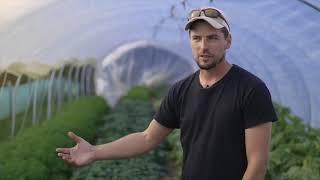
Richard Perkins runs a 25-acre regenerative farm in Sweden with pastured poultry, forest pigs, and a no-dig market garden. He shares his seasonal rhythms at 59°N, daily workflows, and a Facebook-based sales model that connects farmers directly to local buyers. He trains other farmers through 3-6 month immersions on low-cost, scalable enterprises.
Questions this video answers
About 25 acres (half forestry, half pasture).
Approximately 1,500 square metres.
About 1,200 laying hens (typically).
About 4,000–5,000 meat chickens each year.
Approximately €250,000 worth of products in a six-month production.
Chapters
So we're a farm, homesteads as well as farms, but three primary enterprises here are pastured poultry, so meat chickens and we have pastured eggmobiles producing eggs and a no dig market garden. And then everything else we do is on the side that significant income, but it's a sideline income to what we're focused on. Well, I went to agriculture school when I was 18 to study organic horticulture and crop production in the UK at an agriculture school there. And I left there with a lot more questions and answers. People were studying machine operation and maintenance and even within the organic sector, chemical application rates and things like this. And I knew that I didn't want to farm in that way. So I embarked on a longer global trip looking for people that had different solutions. Well, I travelled well, I travelled globally looking for examples of good ag and that led me away from vegetable production. I'd worked a lot in UK box schemes growing CSA vegetables and it was really hard work, it was really poorly paid that got me interested in looking at animal based agriculture and I had to look aboard. I looked a lot at the States and other parts of the world. I traveled a lot and it took quite some years to find really working examples. And I found it very hard to find people willing to share data like numbers and facts and figures. And so that's become a key part of this farm is creating a place that shares the sort of data that I wish I had had access to when I was learning, because it's numbers, facts and figures. And what I see is most of the people coming into farming now or the people most likely to succeed are innovators and entrepreneurial folks who don't necessarily come from a heritage of farming background. And that's a very steep learning curve. Starting a business is a steep learning curve anyway, but starting a farming business is perhaps the hardest thing you could do. And so we really put a lot of priority on sharing information and numbers and putting a focus on the business side of things, which is not what most people get excited about when they think of this type of farming, but it's obviously the only thing that makes it function. So I started finding a lot of figures and people willing to share in the States. And I've always been an advocate for mixed farming. And I think if we look back at the history of farming, farming was always mixed. People had animals on pasture, they had perennial crops, tree crops and small amounts of annuals to meet their needs. And I read a lot historically Cato Plato's work of how farms were designed 2 1/2 thousand years ago. And then I read George Henderson's work. Famous UK farmer, mix farmer, who really brought pastured poultry enterprises to life back in the 20s and 30s. And so coming from that old heritage of England, where I grew up in the mix farming small fields surrounded by hedgerows and people doing small, intensive mixed farms, that was really the sort of context with which I always approached farming. And yeah, so my learning has been drawing from different people, from very different walks of life in farming. And so here we're very much based, our farm in Sweden here around pastured poultry and forest raised pigs and integrating that into an agroforestry system. We also produce market garden vegetables and microgreens, things like that. So a small, mixed, diverse farm where we can start to close nutrient cycles and also provide a full human diet, which has been really important to us. So I came to Sweden, it was seven years ago now, and I met my current partner and she was also interested in farming. And for the first time in my life in Europe, I looked around and I saw a country where people had massive accessibility with resources. There were big buildings, empty buildings, big fields. And the price of farms was shocking for me, having grown up in England, where and for most Europeans, the access to land is really challenging and it's really expensive. We're quite rurally situated. We're in a triangle between Oslo, Stockholm, Gothenburg, and relatively very remote. And that's probably the main reason this farm has attracted so much attention, is that we are driving a very high level of economy in a very small space, in a very short growing season in the middle of nowhere. And so we're not on the edge of a city with a million people. And, you know, we're making it work in the middle of a rural setting. And that's what I find most impressive about it. So we are about 25 acres and this farm is half forestry and half pasture. So we run market gardens on 1500 square meters, which is not a very big market garden. We run about 1200 laying hens typically and 4 or 5000 meat chickens in a year. And we were able to turn over the value more than the value of the farm and the investments we put in the farm every single six month season that we run. So it's a really good venture. We get a long holiday here and it's drawn a lot of attention to people in Europe and around the world because of our focus on enterprises that can be started up at really low cost and are scalable and modular. And that's what we need here in Europe because most people have very limited access to land and most young people coming into farming have no money. And so we really focus on choosing enterprises here that A, are symbiotic, but B, are things that people can come and really learn about tangibly here, get enough experience to then confidently go away and set up according to their own context in their own country. Something that's been really interesting with our farm is we've set up quite a unique sales model. It's really efficient and the most efficient sales model I've come across, which we started off as buying clubs, mimicking what Joel Salatin in America brought about. So having our customers meet us halfway because we're busy farming hard. And so we would have people come and meet us in the local towns. For reference, we're about 20 minutes away from a town of 5,000. So it's a village where I come from. And then our biggest selling point is Karlstad, that's about an hour's drive, 70,000 people. And we have another marketplace, a town of about 15,000, that's 45 minutes away. So that's for context. We're pretty rural and it's not a huge customer base and there's not a large amount of restaurants in that area. And we managed to shift about quarter of a million euros products in a six month production which we then sell throughout the year, like meat products and eggs sell throughout the year. The vegetables just in the summer months, obviously. And what's amazing is those sales points have now transitioned to a model called Reco, which is a phenomenon that came out of Finland and it's all based on Facebook and we've helped spread that in Sweden and it's now spreading across Scandinavia and some of our students are moving that to South America, South Africa, America and Canada. And it's a really cool model. So it's all based on Facebook. And we as a group of producers get together and we put a listing up and we get all the people in the local sales area to join that group. So for example, In Karlstadt there's 70,000 people and we're up to 10,000 members in this Facebook group. So one in seven people is looking for local, well made food, like integrity food, you could say. So you make a set of rules for the group of how you want to conduct yourself, whether it has to be certified organic or whether it just has to be local. And you decide together how to do. And each week there is a meeting at a set place. And so because we set these groups up in the local towns, we set them at the time, we already did our drop off. And what happened is we just basically exposed ourselves to everyone else's customers. So it worked really well and didn't change what we were doing. And each week you put up an advertisement. It can be video, photos, you put your sales price, etc. How people can pay you. And here in Sweden, it's a cashless society, so everyone pays with phone apps and stuff like that. But the fact that you say I want to buy some eggs, some chickens and a vegetable box like this, the fact that you say you want that on Facebook means it's technically a contract. So this gets us around the trading laws, so we can do this in the car park in the middle of nowhere. And this runs for an hour in summer and half an hour in winter. And we're turning up dropping €5,000 of products in an hour back to the farm. So it's super nice. Everyone's prepaid and they actually pay on the spot with a payment app. And it just cuts out all the job of sales. And I think a lot of people are shocked to start growing things and then realize that actually sales, marketing, it makes up half the job of the farmer. And to find efficient ways from the get go and then be able to support others to jump into that. It's been amazing. And we've seen the amount of people starting small farm businesses has risen with the growth of this sales model here, which is really fantastic. So it gives us access to a. In a very small catchment, we have access to a high percentage of the local people, which is really supportive. And something I would also say is having a broad product portfolio really helps. When we have fresh chickens for sale in the summer, it's much easier to sell vegetables. That seems to be a key to the success of this farm, is we have a very broad range of products that it's much easier, and I remember those words of Joel Salatin, it's much easier to find 100 customers that will spend $1,000 with you than to find 1,000 customers that will spend $100. And that's certainly my experience of running a mixed, diverse farm. So we have two main objectives for this farm. The first was to build a profitable farm that builds soil and demonstrates best practices in what we would define as regenerative agriculture. And the second main function was to support and facilitate others to go out and do the same. Because ag schools here in Europe and probably in most parts of the world are focused on perpetuating a debt based Oil based soil, degrading ag. And that's what I experienced at ag school. And so we wanted to open up to facilitate people with real hands on experience in how to actually run these things on the ground. And particularly decision making, business planning, which is what most people seem to suffer with. I used to do a bunch of consulting work and have traveled to many farms around Europe at least. The sticking point was always finances and decision making and that's where people struggle. And all of these innovative models that you can start at low cost and be paying off your expenses and making money in the first year. You can't learn them at ag school. And that's probably true all over the world where institutions are always behind the times because they have to be governed by public opinion essentially. So we really wanted to create a space that was open to people to come and get engaged. So we've tended towards running really long term farmer training and quite hardcore, you know, more like farm boot camp. So a lot of young people coming into this kind of business, they're growing up in a world that missed a bunch from a few generations ago where people had a different work ethic in the rural environments. People are growing up today in a very different context where attention spans and commitment and discipline and these things aren't even valued by people that are, you know, 10, 15 years younger than me. And that's. I've watched this changing with my younger siblings and I'm concerned about that because farming is still hard work. However smart you are and whatever great tools you've got, it's still hard work and it's possible to make it work. But people need a reality check to somewhere where they can test it out in their experience and see what they're capable of and so that they can design business plans that fit their time, place and circumstance. Because it's very easy to go on YouTube and see all these fancy things promoted. And it's often very partial, like people don't understand the difference between gross profit and actually getting a paycheck or this kind of thing. So we wanted to create somewhere where we could really give people a springboard and they're testing their own experience of are you up for this? You know, this is doable, but it's going to be hard work and you're going to have to marry yourself to this thing and work super hard to get it stable and make it function. So we've tended towards really long term trainings here and between three and six months typically because most of the trainings you can go to in these kind of topics. Holistic planned grazing and how to design agroforestry systems or market gardening. They're often short trainings that don't leave people confident in how to go and do it for themselves. And ag schools can't offer this kind of training. So we felt we wanted to offer long term intensive immersions into things so that people could really feel and touch and smell and see the results of their labor, which is important. And then we would offer them. So we used to work in a profit sharing model where they would train up and then take on more and more responsibility and get an increasing paycheck for the work they do. So it's like, cool, now you know how to grow veg, that's great. But like, hey, you've got to be able to sell veg too. So do you want to manage sales? Do you want to do the accounting? So we'll pay you more, but you've got to do more. So that takes some seasons. And so we've been playing with different ways of offering people learning experience that leads them to a place where they can jump off and start. So we're farming up here, 59 degrees north. So in the summer months, the season comes very quickly. Spring and autumn are very short and it quickly transitions from dark, cold winter to high to summer and then it's quickly winter again. So we have about 110 days without frost. That can vary up to 30 days each way and swings quite dramatically each year. That obviously affects vegetable production massively and it influences the pasture based productions too. And so it also influences our work schedule. So we work long hours in the summer. But we're also complemented with six months of basically me here for one hour a day just keeping, you know, collecting eggs and feeding cattle. And that's my workload oven and a delivery once a week. So we get a very long rest period, but that's compensated with very long hours in the summer. It doesn't get dark here till 11:30 at night for most of the summer. And so you, you know, you naturally energize to work long hours in the summer. So we get up at 6 o', clock, got to open their eggmobiles and they start laying eggs at 6 o' clock because the sun's been up since 4. And we'll move all the animals first thing in the morning. So we move the egg mobiles, we move the cows and sheep who cut the grass in front of the egg mobiles. And we time their interactions so that they receive all the Fly larvae from the cow manure and follow them around the pasture like that. Then we remove all the boiler chickens and that's quite a big job. And then we basically spend the rest of the day in the market garden. Market gardens take a lot of hours, so that makes up the majority of the workload here. And so all animal moves in and then we have regular points where we'll collect eggs and sort eggs and we have a nice workflow through the week. So Mondays is chicken slaughter day. We will smoke a lot of chickens and pack them on Tuesday and send them out for delivery with veg on Wednesday. So Wednesday Thursdays is our harvest days and straight out to the RICO points and all of the restaurants along the way to that. Friday is cleanup, turn beds over, tidy the farm, anything that needs doing, project work and then weekend downtime as much as possible and then back into that cycle. So that cycle runs June to end of October. And for reference, like our frost free dates here would be like 6th of June is safe and 15th of September, that frost is coming back and that could move a few weeks either direction. So it's a fast and furious growing season here. I work most days of the week because I'm doing a lot of projects out the farm, but not working on the farm. Like I work on the farm five days a week and then I do basic chores which amount to maybe an hour, hour and a half over the weekend. So I'm here all the time. And that's the thing with livestock. Like if you commit to a livestock enterprise. Part of our function with education is getting people to see like the scale that things need to be done at to generate certain economy and the time involved and how the day looks. Like many people get into market gardening because you don't need so many skills to enter that. You don't need a lot of land, low startup and running costs and you can make a decent living in a small space. But I make three times as much money per hour. I tend my birds but. But the hens is all year round every day, seven days a week. So it's kind of, you know, what do you want your days to look like? I only have to spend an hour a day, but it's every day. And then the broil is that it's a summer only operation. But then I want to sell them all year round to keep the customer base happy. So we work, yeah, you could say I work seven days a week, but I have very little to do on my weekend days. So we get a decent amount of Downtime. But that's the thing with livestock. It's a seven day a week, 365 day a year commitment. So the gardens here are no dig set up. So we operate the market gardens just putting compost straight on the ground. And here in Sweden, the rain is distributed throughout the year. It's quite high precipitation. So we put wood chip down between our beds and big load of compost. In the beginning, these beds are built straight on top of pasture with perennial weeds and things. We do no dig because it's a lot of work in the beginning, but it leads to less weeds, less water. And using this wood chip for pathways, it actually helps us soak up excess water. And what we find is that means you're walking around in a clean garden. It means we minimise washing of veg, like salad mixes that we cut with the greens harvester. We don't need to wash them because there's no dirt bouncing up on the leaves. And anytime we can minimize washing, we're maximizing shelf life. And that works well for us here where restaurants, by regulation, have to wash things again anyway, so it seems unnecessary to do otherwise. And it's part of a marketing thing too. Like our farm looks beautiful and it's presentable and it's the first thing a customer sees when they come into the farm. And so that translates to like a level of care and quality that they come to know our different products with. And so tools in our market garden are a little different to other market gardeners. We basically use a board fork in the first few years to loosen up beds every time we turn them over. We basically don't use that anymore because it doesn't bring any benefit. And no dig, we basically put our focus on the soil and we have organisms digging for us essentially. And we've seen the ground radically transform over five or six years. We're now in a position where we make enough compost for running this style of market garden on farm, because we keep chickens and cows over the winter on a deep litter on peat moss. And we have a peat swamp that we own down near the lake here. And so we can bed our animals in a way indoors. That captures all the nitrogen from the manure and we compost that for a further year and that gives us enough volume to maintain these beds. In the beginning we would buy that in and now we have enough that we can just maintain. So no dig uses a lot of compost in the beginning and then those applications reduce over time because you've got a nice clean work Surface. So we used to use a board fork. We don't need that anymore. We use simple like we're still operating on the 75 centimeter beds, the 30 inch beds that are very common over in the states, based on all the tools that you folks and others have been developing that are just revolutionizing the efficiency of market gardening. And to be frank, that's part of the reason I got back into veg growing. Because I worked so hard for such poor pay as a young grower in my late teens, early 20s, and you know, it put me off and it turned me onto animal farming because I just saw different possibilities. But the rising up of these new tools built for 30 years inch beds is just, it's such a game changer. It saves so much time, it saves so much physical wear out. You know, market garden is such repetitive work that it's very easy to get strained limbs and joints. And that's, you know, as we get older, that certainly becomes more in the forefront. And so we really focus on efficient seeding tools. We use the bed roller to compact the surface before using a seeder. I particularly love the six row seeder from Johnny's. In fact, all of our direct seeding is with that tool. Because here in this cold, short season, we want to transplant everything possible because we just don't have time to direct seed much. We'll direct seed mescaline mix, rocket, arugula, we'll do radish, things like that. And that's working really well with the six row seeder for us. We then use a tiltha sometimes. That's a great tool for smashing up compost because the compost we make on farm is not as fine as stuff you would buy from a professional maker. But what we found when we were buying compost, it was the same constituents as what we had. It was organic boiler manure, organic cow manure and peat moss. And said, well, we have these things, so we make it, but we don't have the machinery to make it fine. So the tilther has allowed us to smash that up and create fine tilths that we can use. The six row seeder in the paper pot works fine in that. So we use the paper pot transplanter for a bunch of stuff. Brassicas here at this latitude get really damaged by flea beetle. That's one of the major pests in Sweden. We don't get so many diseases, but flea beetle and slugs are big problems in Sweden. So we use the paper pot for some stuff. We use the greens harvester. That's A very big time saving tool for us. And pretty much that's the only tools we use. We don't have a large array of weeding tools. We don't have much weeding to do with this method. So we don't, you know, most of our time is spent harvesting and packaging, except for in the early spring when we're planting out beds and prepping the new season. And then come end of October, this garden is packed down. Something we do with no dig is we cut the plants out and leave roots in the ground. So if we're using a direct seed crop on top of that, we need to put new compost to be able to use the seeder. But there's a massive amount of root network under big plants that we want to be decomposing in the ground to feed the life in there. So we tried to apply really good market garden planning and thinking with what we see as optimal soil care. And that's our approach to market gardening. We're growing quite a big mix of vegetables here, maybe about 25 different species of different varieties. And we transition from a vegetable box model towards this Rico model. And so we grow throughout the summer, lots of fresh salads. Swedish people eat a lot of fresh salads in the short summer because fresh veg is available. So short time during the year, we grow and use the greens harvester for mesclun mix, which is based on lettuce leaves. But then we'll put in spicy Asian greens and arugula and things like the baby brassicas. And that tool's really been incredible time saving for cutting long beds of like. It's one of the most profitable crops. We grow on a little 10 meter long bed that's 75 centimeters, 30 inches wide. We're getting 40 kilos in 42 days. So that's a net of about €500 on a tiny little bed. And that used to be painstaking work. We would cut it with little serrated knives on our hands and knees, and that takes 25 minutes to do well. And what we found with the greens harvester is that takes about two minutes flat and it leaves a really nice cut. And what we found with that is you get a much better regrowth. We'll cut those crops two times and then pull them out. But we get a much better even cut, so you don't get any old leaf in the cut, which is really good. And then another thing we use it for is microgreen production. So we're growing those in paper pot trays, really shallow trays and the quick arm that allows you to put the paper. Cut paper. Sorry, the quick arm that allows you to put the greens harvester parallel to the top of the tray just allows you to push those trays through so fast. And that's definitely a game changer for anyone growing greens or microgreens at any kind of scale. So farms are typically can be a place that's a bottomless pit for throwing money into. But market gardening is one of those enterprises that has really low startup costs, so putting money into the right tools doesn't need to break the bank. And it's very easy to return the cost of tools and structures and setup in a market garden. That's been the experience we've had here. I'm totally motivated by feeding my family amazing food. That's why I wanted to build a farm. I decided that at 15 years of age. I knew I wanted to bring up kids and raise a family around amazing food. I've always grown up in a rural location and I really inspired to spend time in nature watching the ecosystem here develop. And we've become like every time you bring a species to a piece of land, you create the habitat for seven more. In this place, we now have two species of nesting birds of prey. I've seen wolves here on the farm. I've seen beavers, I've seen elk most weeks of the year, what you call moose in the States. And we've become a little island that nature's moving back into because we're not sprayed and we're not bare ground. We're creating a habitat whilst producing amazing, diverse food. And that inspires me a lot when I wake up every day. And then because we're quite a public site and a lot of people are following us through various channels and it's really heartwarming to see people pick up some of those models, adapt them to their context and then start farming successfully. That keeps me very inspired to keep sharing and putting information out for others.
More from Richard


A review of short and intensive season on a mixed farm and restaurant/event space in Sweden






Alskade Kyckling Exploring complexities of poultry production in Sweden and what we stand for


