This YouTube video ("Farming is everybody's business") is an interview/conversation between Richard Perkins and Swedish farmer Jurgen Andersson about regenerative agriculture, holistic management, and personal responsibility. Jurgen describes his transition from conventional farming, critiques industrial food chains, and promotes grazing-managed perennial systems to rebuild soil vitality. He cites examples and figures (Gabe Brown's five regenerative principles; rule-of-thumb economic and carbon/photosynthesis estimates), mentions Pleistocene Park/Mammoth Steppe restoration, and urges consumers and producers to form cooperative legal/financial arrangements ('lagom' / la gum) to support regenerative farming. The discussion closes with practical pointers to Savory Institute hubs and Jurgen's operation (Fjellbetet).
Questions this video answers
"10 years ago" (as stated by Jurgen Andersson in the video).
"We need $2 extra for every dollar we give to the food chain" to pay for environmental and public health damage (video statement).
An estimate of prehistoric wildlife: "1500 million tons" (mentioned in the Mammoth Steppe segment).
"3% more photosynthesis" to halt annual increase; "6%" to maintain for two generations equals total atmospheric increase; "10%" more carbon in plants and soils equals all fossil fuels ever burnt (video claims).
Keep the soil covered; minimize soil disturbance; increase crop diversity; always keep living roots in the soil; integrate livestock.
Chapters
So I'm here with Jurgen Andersson, who is a wonderful man and is the leader of the savory hub here in the Nordic regions, as well as running a mountain grazing operation, Fjellbetter, which you can see down in the links below. And today I wanted to hear some thoughts from Jurgen about, would you say, about your journey from conventional to regenerative agriculture and conventional to regenerative living as well?
Yeah.
Figuring things out and going through the hard journey of realizing that you've been doing everything wrong and thinking everything wrong all your life and then trying to deal with that.
And Jorgen's a very wise man. So I think this presentation that you'll see is a wonderfully succinct way to see inside someone that's thinking holistically and what that really entails.
Hey. I am Jurgen Anderson and this dog was named Bess. I believe our civilization is more like a flock of cows than we are like titanic, happy cows, but running towards a dangerous cliff. But all it takes is a brave little dog running in closely, surprising and convincing the herd to turn, and suddenly we are on our way to green pastures and shading trees. The dog doesn't need to understand everything. It is just causing a sudden disturbance, enabling better visions to emerge. I am a Swedish farmer and 10 years ago I discovered holistic management and regenerative agriculture. Here are animals grazing in wintertime, and that is all it takes to be strange. What is natural has become strange and quite often even illegal. Since six years, we are giving service to a Nordic network for regenerative agriculture, and our hub is participating in a global network facilitated by Savory Institute. Some people depend on nature for survival, and the truth is that we all do. Always have and always will. But the civilization we born into suffers from a stupid idea separating us from nature. Stupid because it allows us to do damage without realizing we are hurting ourselves. And stupid because it makes us blind for nature's capacity to help us out in our mess. Good thing is that it's just an idea and we can just get rid of it. Serious problems calling for attention. Underperforming ecosystems. Wasteful management of resources. Inflicting symptoms such as climate change and social unrest. As we address underperforming ecosystems, the threats of climate change will go away as well. Here's an image of a vital ecosystem. It illuminates the absence of animals everywhere else. The picture shows a symphony of life orchestrated by evolution. The tunes played by the grazing animals are crucial. They provide services to the innumerable life forms, embodying the soil. The underperformance of this ecosystem is caused by us, our ignorance and our arrogance. And since it is Africa, I am as well addressing myself as a European. We do have a debt to pay. Here's another underperforming ecosystem. It generates green growth, but also only for a part of the season, and only at the cost of massive inputs. Our harvests from here are starch, sugar and oils, mostly used as unnatural feed for animals, and some of it as even less natural food for humans. The food industry or food chain is controlling the most and the best of global resources for food production. Yet it is only feeding a minority of us, which is somehow a good thing, since most people eating the products are losing their health. Rule of thumb is that we need $2 extra for every dollar we give to the food chain in order to pay for damage on environment and public health. But this is the kind of agriculture I was born into and educated to perform. I used to compete in ploughing and took pride in the volumes of food a small number of farmers are able to produce.
It sure wasn't a pleasant journey to.
Question all those values and to realize traditional farming as the art of preventing photosynthesis and and biodiversity. It is still true that this tractor is a wonder of efficiency. And this plough is genially designed. And most of all, that diesel is nothing short of a miracle. If I visit the land a couple of times with my machinery, I can sell oats for two Swedish crowns per.
Kilo, while the middleman are now mixing.
That oats with water and sell it for 200 Swedish crowns per kilo as fake milk at twice the price of real milk. The middleman now keeps 99% for themselves, leaving 1% to pay for the diesel.
If we were to transform this land into perennial grassland, mimicking nature and producing.
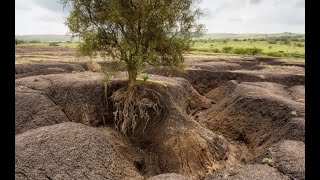
Milk, I would have to build my skills as a farmer and do more work. But my costs for diesel and such would almost vanish. Healthy soils would transfer its vitality to people, while money and nature would be saved. So grazing animals are required to build the vitality of most ecosystems. But these animals are a very powerful tool, just as able to do damage as they are to do good. To the left, we see what can be the result from a small number of animals spending a long time in the same place. Plants trying to recover are grazed again and again until they perish. To the right is what it looks like when bigger numbers of animals are constantly on the move, enabling the grass to fully recover between grazings. Here is Tanzania, and another example of cows capacity to destroy. Once the rain finally came after cows having reduced the capacity of the soil to receive it, Devastating erosion was the result. Same cows could have been managed to build this soil, Enabling it to receive and store all the water from these rains, Enabling green growth and year round steady flow of clear water in the stream. So when we see brown water like this, we know that somebody upstream had been using animals or diesel to destroy life on this planet. It is a lot about roots. Low value monocultures on high value land with tiny roots, leaving plants very vulnerable. As much as roots are a way for plants to get what they need, they are as well a source for the living soil to receive its energy from the sun. Reunited agriculture is defined as enabling highest imaginable vitality of ecosystems. By effectively satisfying human needs on this scale from 0 to 100, we can estimate the present vitality to be somewhere in between no life at all and the highest vitality possible on the specific location. As we become dedicated and creative for highest imaginable vitality, we will experience a faster and further recovery Compared to what nature is able to do without us. Anthropocene is our time on this planet and let's make it a glorious one. Here is Gabe Brown in North Dakota. Gabe has developed and implemented five regenerative principles for Keep the soil covered, minimize soil disturbance, increase crop diversity, Always keep living roots in the soil, integrate livestock. The amount of carbon has quadrupled now surpassing levels of the ancient prairie plant. Available nutrients are now 10 times higher. Without adding any fertilizers. No matter the intensity of the rain, his soils are absorbing and holding the water. Yields are up and costs are down. Gabe and his fellow pioneers are now spreading the word. And we give thanks to Internet since institutions are still fighting holistic management. The Mammoth Steppe, a pristine state of nature now in the absence of animals taken over by the taiga forests and the tundra. But this used to be the biggest ecosystem on the planet. Sergei Zimov, a Russian scientist, shows the Mammoth Steppe to have been extraordinarily productive and why it desperately needs to be restored in order to preserve the permafrost in the far north. To the left, we see an estimate of the prehistoric wildlife 1500 million tons. And to the right, we see that grazing animals now are less than half of what they used to be. And we know that most of them are not allowed to play their role in nature. We need to free our livestock and manage them properly. When we do, the wild animals will return as we have already seen it happen in Africa. And as the grass returns, we must build the numbers of livestock and wildlife to keep up with life returning to our soils. This picture shows flows and stocks of carbon. It shows abused ecosystems still playing the big role and providing the realistic opportunities regarding climate. Sequestering runaway carbon into our soils must be the ultimate no brainer of all times. For perspective, we can compare annual photosynthesis with annual increase of atmospheric carbon. In theory, we need 3% more photosynthesis to put a halt to the increase. 6% maintain for two generations equals the total atmospheric increase. 10% more carbon in plants and soils equals all fossil fuels ever burnt. The more carbon in our soils, the more water it holds and the better it grows. The better it grows, the bigger the cooling effect from plant transpiration. The cooling from 5% more transpiration equals the global warming at present. Another cool thing is the chemical decomposition from the sunlight on the transpired water vapour. In a functioning ecosystem, it breaks down all the methane from the animals. And yet, one more cool thing is how bacteria from plants follow the water vapor to the atmosphere and enable the creation of raindrops. So the more it grows, the more it rains. As you are noticing, we do have a major problem with so called junk science used to distort our focus from properly addressing the challenges of our time. Science is a great tool, but as with all tools, it requires proper management. We need to realize that institutions tend to become more stupid than the people managing them. This knowledge should keep us from escaping the responsibility to think for ourselves. How should a regenerative society be defined? The society emerging from people in implementing personal responsibility. Sometimes you hear people calling for institutions to become responsible. But institutions are tools in our hands, just like axes and spades. So blaming our tools and then what? As much as we hate responsibility, it isn't going anywhere. Biggest possible satisfaction of human needs with smallest possible negative sacrifice. That makes sense, does it not? Corporations and institutions for the benefit of our lives. Or is it the other way around? Our lives for the benefit of corporations and institutions. We are in fact stimulating growth on the sacrifice of resources and nature. Running together towards the cliff without a reason why. We do need the courage of that dog. So do you choose to be influential and participating in whatever seems important in your life? 0 is the total victim of circumstance. Never responsible for anything anytime and 100 is the perfect opposite. That may give us some challenge to imagine what that would be like. Swedish people happily admits they are somewhere at 25 on this scale. We tend to say it is all their fault. They are so stupid. We Rarely say improving things is my opportunity to give more meaning to my life. Does democracy emerge from victims of circumstance? And with market economy defined as responsible people making free choices to sell or buy, should we question whether democracy and market economy are great ideas still to be tested? Now bear with me now. I claim planned economy and capitalism equally being the opposite of democracy and market economy, diminishing perspectives to a left and right debate of the most favorable mixing ratio between the two. Looking at it this way, democracy and market economy will emerge as a natural consequence of people choosing to be responsible. Big institutions and big corporations, as ineffective as they are, thrives among victims of circumstance. Efficiency of local economies emerges where people choose to or simply have to be responsible. 70% of the civilization are still feeding themselves within local economies or the food web, while 30% are at the mercy of the food chain, losing health and wealth to a destructive beast built by us. It already controls 75% of the resources, but it wants more and it wishes to sell products of even lower quality at an even higher price. And unless we climb the ladder of personal responsibility, it will have its way. Previous picture in background an arrow indicating direction to regenerate ecosystems. To the left below is the prevailing model designed for the success of middlemen such as corporations, banks and institutions, leaving farmers desolated and consumers misinformed and alienated. Above is where we are heading as we realize that farming is everybody's business. I call it la gum when there are enough relation and legal agreements between farmers and consumers to transform the roles of middlemen into mere functions of societal service. So in my perception, here is the choice of our time. Head on high speed towards the cliff, leaving management of land to corporations, institutions, or to bitter, desolated, grumpy old men, and of course to diesel or move in closely to the responsibility of nature and each other, establish platforms for crowd equity, funding, innovative legal agreements for access to land, and surrender to holistic management. Here is the cliff. Becoming responsible for our lives reveals the necessity to define what kind of life we want and how our actions will take us there. It reveals as well the necessity to shape our future resource base to the capacity of supporting the life we want for ourselves and for our children. This is, in short, what the framework of decision making called holistic management is about. We need to figure out how we are going to design the monuments of Anthropocene and make them more impressive than anything previously built by less experienced and less powerful civilizations. My vision is 10 billion architects on one single project. The highest imaginable vitality of Ecosystems accomplished by effectively satisfied human needs. It is a great thing to be standing on the shoulders of success from 2 million years of learning by failing.
So I really love the. I love that you brought up Pleistocene Park. It's one of my favorite projects that I've talked to you folks about before, and we are second on the list to get a woolly mammoth once they're available. But it's really. Yeah. Something that really stands out for me in that video is the call to personal responsibility and the fact that it's so eerie, obvious that what is good for us as humans holistically is what is good for the planet and its ecosystems holistically.
And we are. We need to realize we are afraid of taking on responsibility. At the same time, we sort of realized it is the only way to have a life with meaning, to take something on, do something.
We've been talking about a lot with our interns here that are about to leave, but about this, like, are you up for it? And, you know, taking on responsibility. And for me, farming is obviously still a huge responsibility, huge workload, but it's also the most rewarding lifestyle I've. I can imagine. But it's that responsibility that really brings meaning and value to what you're doing every day. That makes work, rest and play the same sort of thing. The lines between those things blur.
Yes.
And life is short.
Yes.
Let's do something.
Okay. And what do you think about, like, this movement's obviously growing. Like, what's your perspective from the savory hub? The savory hub's perspective of how things are moving. And we're seeing a lot more people from all over the region coming here, which has changed in the last years. A lot of Germans, Europeans, people from elsewhere. But are you seeing the same sort of groundswell?
Yeah.
I mean, all over the world, it's catchy. It is a world movement, and a part of it is within the savory network. It is in other networks. It is really a global movement going on. And as much as it is an agriculture movement, it is people.
Getting their.
Act together, taking responsibility for the life. That is really striking. When you meet these people, they're all coming from the same idea of taking their own life as their own responsibility. That's what's happening.
Is there anything to say about. How would you address a group like this? Like these interns that gathered here, they're young people that they're in an important juncture in their lives. Some of them, when they are taking on the family farm or inheriting their family business. And they are either gonna go, you know, the pride and arrogance route of following grandfather because that's the way we do, or they're gonna be innovative and make take the risk to make that change. And what would your. Do you have any reflections or thoughts or advice for people in that position?
Well, a thought would be that we can look at how people have been doing things over, you know, the thousands of years and how the ideas of mentorship or people who have been trying something, making sure that they make the time for the next generation to sort of share the wisdom.
It may be a good thing to.
Send your kids off to school, but that's not enough. You need to stay with the next generation and learn for yourself as you are getting older. And to make sure that they are given the support they need. Because there's a lot of new reunited farmers emerging right now. And they sure need support from a lot of people from whoever has been doing it before and from everybody. Because farming is not a solitude thing. You can't do it on your own.
Sure. Yeah. It'd be miserable. Bend over. Old men. Grumpy old men.
Yeah, those grumpy old men.
They are.
They should sort of teach us something that. How it shouldn't be done.
And it's important to point out that like it's like your video was entitled Agriculture or Farming is everyone's responsibility.
Yeah, everybody.
It's important for consumers to take responsibility as well, even if they're not in the production chain.
Yeah. And that's fun to do that.
It's interesting.
And it brings you health and brings.
You everything and it brings meaning also.
Sort of a no brainer really. Yeah.
And there is this industry to just.
You know, to realize what it's doing and to make sure that you are doing what you want.
Yeah. So the savory hubs are now, they're in I don't know how many countries now worldwide. But that's a great place for people to find out about holistic management training, which covers things like holistic decision making and financial planning. And for those people that are ranching or farming, livestock grazing planning, things like that.
Yeah.
And where can they find out information about that?
Savory Global. You can find a lot of stuff.
Savory Global that's in the links below. And then your operation up in order in. It's kind of in the middle of Sweden, but it feels like in the north.
Yeah. So it's. It's Fjalbet is the name. And. And you can also look for la gum, which is the word. I got another YouTube clip.
What does lagam mean? Because people, many people aren't Swedish watching this.
So this is an old Swedish word which is the word lagom. And this is the old spelling to.
Bring in the lagohum.
Lago, H U M. But it just.
Means what works for everybody.
It's just the word that then when it's functional for everyone than it is lagom, it's in a Swedish way of saying everyone benefits.
Yeah. So.
And then one way that most people think of is if you want to make. If you're drinking around the table and you only got one bottle, you have to sort of take not too little, not too much. So it makes it last for everyone. So it's just to make it work for everyone.
And when it comes to the consumer.
And producer perspective, those farmers cannot do this alone. We need to be in the same team, consumers and producers. And that's what we call a sort of a log immunity.
Sharing and connecting and not competing, which is often how it looks on some of these social media channels is like there's still an edge of people competing with each other in Facebook groups and these things, but it's. Yeah, we need a lot more support and networking. I'm super honored that you've come to drop by. Yeah, it's been some years since you came by this place.
This is one of the places where it's happening.
It's a pleasure to see you, Jorgen. And yeah, I hope you folks find this video interesting. It's a really beautiful way to encapsulate a lot of the things that I try and talk about and others that you follow also talk about. But I thought it was very clear and very concise. So maybe you can leave some thoughts and comments and questions that Jorgen can see also. Maybe he'll have time to respond. I'm not sure. We'll see. Sure. But yeah, there's links below to Jorgen sites and to the Savior Institute, so you can find out more there. And we'll see you in a video soon.
Bye for now. Thank you very much.
Don't.
More from Richard


A review of short and intensive season on a mixed farm and restaurant/event space in Sweden






Alskade Kyckling Exploring complexities of poultry production in Sweden and what we stand for


