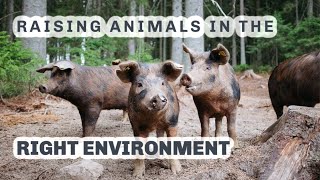
Richard Perkins moves pigs across a wet stream using a temporary bridge and opens new permanent laneways. The vlog covers broiler batch sizes, mortality rates, egg-production forecasts, and updates on strawberry plants and staff rotations.
Questions this video answers
May 17, 2017.
800 birds.
Four and a half weeks old.
3% mortality out of 1,000 birds.
About 150 eggs at the moment; forecast to reach about 700–750 eggs per day.
Chapters
Today is pig moving day and we finished the fence up and we're getting the pigs from over here around through the gate down here, and we've made a pathway for them up quite a steep bank and up this little temporary laneway we've made with electric fencing to the gate right up on the hill there. Raining a lot recently, and the river behind me is really high, relatively. We moved the eggmobile into front field today, the heavier eggmobile, which is a bit of a logistical challenge to get through the thin gates. And soon the second eggmobile, the lighter one, will be coming in too. It's really great to have the birds in front. Of. Last wire's on. It's time to go find some pigs. Now. The fence isn't electrified and we're hoping they don't bother testing the fence because once the pigs escaped up in these forests here, and it took a very long time to get them back in where we wanted them again. We made a little bridge yesterday. We're going to have a look at that. This is the little bridge we made. It's just four tree trunks with soil and a bit of turf on top of to encourage them over the water. You see, the water is quite high. We've had a lot of rain now in the last couple of days, so the river's swollen a bit, and the pigs won't like to go anywhere near that. They're probably going to be a little bit skeptical of the bridge, but it's feeding time nearly, so hopefully that will encourage them. So this land is where the pigs are going to come out. This is the riparian that protects the stream. So we're going to be opening up this gate for the pigs to come through over the bridge and up the hill. Now, it's a bit of a logistical issue getting the net set up in here. However, we shouldn't have to do this again because we're going to start constructing our laneway. There will be permanent fencing here, and that permanent fencing will go all the way along this axis to the forestry and connects up with the stream crossing at the other end. So we have a paddock here, paddock here, the paddock we're moving into now, this paddock, and one up here, and they'll all be connected with the permanent laneway. So we can easily move the animals without trying to drag electric netting through this long undergrowth. It doesn't look that thick right now, but when you're up here trying to move fences, pretty thick and easy to get very tangled up. This is a little Drainage valley that started flowing much more the year since they cut the forestry up at the top. I showed you in yesterday's video. It's not too deep down here, but I think the pigs will be skeptical of crossing here to start with. The bigger pigs can just jump through that very steep bank up here. But yeah, there's been a lot of water on the northeast side of the fence where you can see asteroids coming down now. It's quite a flow because of the amount of rain we've had and it's not going to be the normal access way to this paddock, but we're going to take them up there today. This is the flow that's come about from a couple of days of rain that's only really started since they clear cut, you know, a number of hectares on the top of the hill there. We've heard they're going to be cutting hundreds of hectares above us and around us in the next couple of years. Now, the pigs don't like going up really narrow spaces, but it's the best option we got right now until we get our laneways. This is where the permanent access will come through from the other paddock. I'm just tightening the last wire on the tensile fence and then we'll be moving the pigs up. This is where we've got to get them to, so it's a bit of a long journey. They're in the paddock on the other side of the road there and they're going to come down through the gate, over the river, up this steep hill, down, up the very steep hill around the top here. There's a few hundred meters to get up to the gate and into the new paddock again. There's more water flow here. It's always been moist there, but not a continuous flow. But when they get here, they have this beautiful two tone kind of paddock. The young regenerating forest here and the beautiful old forestry up here. It's going to be really interesting to see how they enjoy this space. Here's the pigs gathering, The babies coming. Start of the adventure. Some of the pigs are still there and four of the girls, one of the boys, three of the girls, one of the boys are up here with me. So these are the first four up and they just happily, calmly following the fence line. Might not be so easy with the others. They're scared of the bridge. We've been trying to get the first few over the bridge to encourage the rest, but they just decided to keep going and they're off. They're gonna have a really nice time in this padd. So four made it now it'll be interesting to see. I can't imagine they will come back down again. I imagine they will be off exploring now. So they've got some in a little holding pen just on the other side of the river. Reuben has a mind of his own. A big boar and he's not ready to come yet. Well, we gave up at dinner time and decided that the pigs are just not that motivated to cross the bridge. The four that are up here are very happy and they're, they're penned in now so they've got a nice night to explore. You can see one of the big sows behind me, maybe in the trees and the others are down in the young forests and they're having a nice time in there. But we're gonna wait till the pigs are hungrier and more food motivated to get them across the bridge. Some will teeter across the bridge and then they go back again. And in the morning when they're hungry for feeding time, I think it'll be easier to get them across. So it's all okay. Didn't go perfectly as planned, but pigs up here are happy and the pigs down there are happy, so we're happy too. Here's the other three pigs and this is a beautiful habitat for pigs. Plenty of roots and things for them to explore and to eat too. It's going to be a big disturbance on this landscape, but it's really an ideal setting for raising high quality pork. And these Linda woods are good foragers. They grow a lot slower than the traditional Yorkshire breeds that most people here have for growing pig fast, but much darker meat and really thick back fats are great for sausage and other charcuterie products. More like a wild boar in taste. So wasn't the most successful moving of the pigs and most of them are still here behind me in the old pen and they're going to stay here for the night. And in the morning when they're hungrier, we're going to come down again and hopefully they'll be a bit more motivated by food and draw them across the bridge. Pigs are always a bit dubious of going over water and even though it's a nice bridge there, they're still skeptical. And the sound of the river is very strong right now, which I think puts them off more. They've been over the river before at least a couple of times, but I think we'll have more success in the morning.
Well, we're going to dry brine this turkey, because if you brine it in a salty solution, it will soak up the water and gain weight and stay juicy inside the oven. But it will also taste much more watery because it's extra water that takes it out. If you do it in a flavored brine, which might sound senseful, it will first bind with the ions of the salt before it does with the proteins of the stock. So the salt will go in but not the flavor of the proteins. Same effect as with just a watery brine. So the dry brining is just patting it with salt and it will contain the water inside or the juices inside the bird, but not have a watery taste effect.
Day 10 in the brooder. I just scared the birds. It's day 10 in the brooder for the second batch of 800 birds, which is the size of the subsequent batches we'll be doing this year, and they're doing great. So the deep litters really kicked in and we added water and turned over the bedding and now we're adding layers of bedding as they need it. But these birds are much less worried about temperature. We're much less worried about the temperatures. It's heated up outside, obviously it's been cold and cloudy and rainy, but it looks like temperatures are going up at the end of the week and we'll get some good weather. But very happy with this space this year. It's been really optimal in many ways. Broilers are doing great. They're now four and a half weeks old. The birds on pasture and putting on weight well and remaining healthy and active, and they're moving very naturally. Sometimes we have batches of birds that don't move forward so well when you pull the pens forward. But these birds have been pretty good from the start, which is great. We've had a 3% mortality rate out of a thousand birds, which is fantastic at this point. And the birds are stronger and healthier every day. And so I expect it to be a great outcome from this batch of birds. This rain that we've had in the last week has just really greened things up now, and the grass is off and birds are very happy and the hens are doing good. They're all laying about 150 eggs at the moment, and it's just going up every day exponentially now. We'll soon be having about 700, 750 eggs a day, producing about 16 tons of eggs this year. Trees are just coming into to leaf still, but it's great to have the herbivores on the neighbor's land right now, it's really allowing our grass to get going and we've got some good regrowth. The laying hens have already been here once and the grass is doing great. The birds are still feathering out. They're still very young birds, only four and a half weeks old, but they're in good health, strong legs. They're not keeling over and dying. There's a lot of myths about these hybrid high production birds. As long as you control their feed and limit their feed so they're on a restricted feed program, they remain very active and alert and healthy. The new pens are fantastic. Much more lightweight than the old pens and pretty elegant. So far, very happy with them. Astrid and Marie have been looking after the boilers. They're in rotation. The different power managers rotate through different chores and they've been doing an amazing job. So I've just come back from town and more strawberries. These are replacements for the ones that were lost in the post. So we've now got 1600 strawberry plants from Paper 800. Now we've got to find out where we can actually put them. This is what the ground looks like about 10 days after the hens have been here and growth is really kicking in. But it's only having a beneficial impact from them scratching away the thatch and leaving their fertilizer. I've said before, chickens are very potent tool for a small farm where you just don't have room for large amounts of herbivores to do the same job. But with this grass having a month of growth without the cows and sheep on it before we bring them back in, it's really going to be very interesting this year to see the results of that. Same goes for the boilers. I mean, they leave the ground pretty bare looking where they've been. This is two days ago, but actually they've just trampled the grass down. It's still there as we go back three days, four days, five days, six days and seven and eight days. It's green again and it's really growing up again. There's still manure on the ground, but the grass is coming back fine and it will explode into growth with all that extra nitrogen. That's all for today folks. Off turf sauna and take it easy for the evening. Thanks for watching our videos. Don't forget to click subscribe and check out Gracie's backyard in the links below. The Kickstarter that Olivia Asselin is running. He's put on a stretch goal to add some extra bonus footage to the video and also, if it raises enough, he'll subtitle the whole thing in Swedish, which is amazing for local people. There's very few videos about this kind of stuff in Swedish, so thanks for your time, as always, and find out more in our book, Making Small Farms Work. See you next time.
More from Richard


A review of short and intensive season on a mixed farm and restaurant/event space in Sweden






Alskade Kyckling Exploring complexities of poultry production in Sweden and what we stand for


