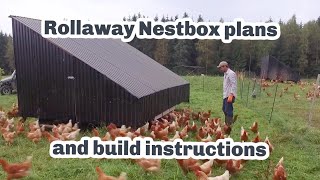
Richard Perkins (Ridgedale Farm) open-sources 3D CAD plans for low-cost rollaway nest boxes and describes how pastured layer enterprises are run on his Swedish mixed farm. He covers eggmobile construction and costs, enterprise economics, integration with polytunnels and composting, bird sourcing and feeding (including specific feed rate), predator management and fencing, daily routines for moving/collecting/packing eggs, and flock turnover/winter housing. He emphasizes low startup cost, high return, automation of nests, and suitability as a complementary farm enterprise.
Questions this video answers
May 29, 2021
€1500
€30,000 of eggs a year (as stated)
16 weeks old
130 grams per bird per day of organic layer pellets
Chapters
Welcome back to another video folks. Today I'm really excited to open source and give away the 3D instructional CAD plans for our low cost rollaway nest boxes. Step by step, easy to follow instructions so you can build the low cost, reliable, awesome rollaway nests that we have and have shown you for years now on our channel here on yout. So Pas de Layers remains one of my favorite enterprises. It's super low cost to start up. The egg mobile you see behind me cost us €1500 to build using a lot of scrap timber and things that are lying around. And it's an incredibly well thought out space for keeping pastured hens. Now that eggmobile kicks out €30,000 of eggs a year and we got two or three of them running at any time. So with a start up cost of around €1012,000, you've got an enterprise that can produce 60 to €90,000 of income. Now here up at 59 degrees north in Sweden, we have to have the birds indoors for five months of the year because it's just so cold and such deep snow. And so we integrate that into our mixed farm here by having them in the polytunnel space during the winter when there's not enough light to grow plants. And then in the spring when those birds are changed over to a new flock, we take in a front loader, we take out all that manure and bedding that's soaked up. You know, we're using a deep litter system, a carbonaceous diaper that's collecting the nitrogen from their strong manure and we put that in windrows and we compost it down for a year. And in that way we've become self sufficient for compost in our no dig market gardens. It's an incredible way to close nutrient cycles on the farm and but it's also an awesome way to have multiple uses of expensive infrastructure like tunnels. And that's a model now that hundreds of people all over the world have taken on and are running successfully. I love this enterprise because the kinetic energy of poultry on the ground has a massive impact on our grass. We've seen over 30cm of topsoil growth in the short time we've been here through keyline ploughing, but through intelligent planned movement of livestock and particularly poultry. Now, I've said many times I never set out to be a poultry farmer and I certainly wouldn't have moved to rural Sweden just to farm chickens, but they've become such an incredibly important tool on a small farm because of the animal numbers. We can have in a small space. And that's really critical. And it's why these enterprises can be profitable. In fact, if you've read our book where I detail and outline a sort of comparative analysis of 13 different enterprises, poultry are by far the most profitable of the animal enterprises. You don't need so much land, you can start up at low cost and they produce high value products quickly or consistently. And that's why we've run pastured layers, pastured boilers as the backbone of our farm economy. So pastured layers is a really simple enterprise to operate. It's a great complementary enterprise to run with herbivores to get the manure cycle so you get the beneficial insects and larvae from larger animals like cows and you can follow behind where the grass has been cut short by the herbivores and which allows us to run this electric fencing and not short out the fencing. And then we get the scratching action and kinetic energy on the surface of the soil from the hens who are getting all those nutritious omega 3 and 6 rich bugs out of the animal manure. And they're leaving behind their animal impact as well as their manure. And we get beautiful pasture growth in exchange. It's very simple to run. Two 50 meter nets is big enough for an eggmobile up to 400 hens. We're using a portable solar energizer that can kick out three to 4,000 volts down those two wires. And that's sufficient to keep birds in and keep predators out. Here we have buzzards living in the trees you can see here we have wolves, foxes, etc. We've never lost a bird to a predator except when birds have escaped out of the fence and then they're vulnerable. There's such a dense amount of animals in a small space here that they keep themselves safe. Imagine you're a dive bombing predator bird who dives on things for a living. If you broke a wing trying to catch your prey, that's life threatening. And so I think there's just a critical mass that makes this intimidating to predators. It's all about good electric fence, good energizers, making sure your fence is running properly. And then the birds are locked in there at night, which is predator proof again. So it's a really robust, simple model. Now we buy point of lay birds. They're 16 weeks old when they come to us. And we do that because at the time of year that you would raise chicks, you would need a heated barn facility. And here in Sweden, when it's minus 30 in the winter, it's not economic. It's better for us to go to a bigger supplier, take the birds in at point of lay and they've been fed organic feed up to that point. We feed them on organic layer pellets. We're feeding 130 grams per bird per day of a balanced organic laying pellet. And that's one that's got fish proteins as opposed to soya base because, well, chickens didn't evolve to eat soya now did they? They're omnivorous. And that winter, sorry, that, that feed ration is actually the same in the wintertime because whilst they it's colder and they need more energy to keep warm, they're not running around so much. Like they're literally moving all day in the pasture here. So it actually balances out. We also give them root crops and storage crops in the winter to keep them occupied too. And so it works very nicely. Eggs are an incredibly important staple item for market sales or RICO sales. However, you sell to customers directly and if people have tried your eggs raised in this manner, moving all the time on fresh grass, they will never go back again. It's a marked difference. And our eggs are incredible. And it's very easy to sell vegetables or meat boxes once you have a good egg eggs subscriber list. We actually sell in three months subscriptions. We only sell in trays of 30 eggs and you have to buy many months at a time to minimize the amount of customer interactions and invoices we have to do on the back end because we're busy and we have a lot of different products in our portfolio. But that works really nicely as an efficient operation. Now this year we're running two eggmobiles with 700 hens. And in the morning we get up at 6:30. We have the nests already open on automation and the door is opening at 6:30. We come up just before and move one of the eggmobiles. The daily operation takes 20 minutes to move one egg mobile and feed the other. Then we come back after breakfast and collect half the day's eggs. And we do that with a quad bike with special collection crates and we'll collect half the day's eggs and feed them another third of their food. We always split up feed in the batches because some people will give poultry free access to food for a certain amount of time. It's much better to let the birds get hungry in between feeds because they will forage and peck at the ground. They will find insects, they will forage greens, and it's all translating to vitamins and minerals that make them healthier and better eggs, satisfied customers that are getting much better products. Then we leave the enterprise alone until about 3:30 when the last egg collection happens. Nest boxes close automatically and then we check the nests are clean, collect the rest of the eggs. So it takes about 45 minutes, 50 minutes to get up to that point. And then we need to pack and sort the eggs because we sell off the farm and to restaurants as well. We need a certified egg packery, which is something I've documented in our YouTube channel, etc, multiple times. That's very easy to achieve too. And so the eggs need sorting and packing and stamping and that's where our record collection happens to. It takes about 20 minutes to pack the eggs from one Eggmobile. So if we've got two Eggmobiles, it's about 40 minutes and then we do the record keeping and that's it for the day. So it's a very low input enterprise. In fact, it's about a quarter of the time needed to make the same amount of revenue from something like a market carton. However, it is seven days a week and it is 365 days a year. Once the animals have gone into the greenhouse after the tomatoes are cut here at the end of the August, we'll let them ripen up and by the end of October we pull out all the plants and we'll bring the chickens in off the pasture when it starts to get really too wet and a bit miserable for them to be outside. The grass has gone into dormancy and stopped growing and they will go on a deep litter system all through the winter. We'll do more regular egg collections in the depths of winter when it's really cold to stop the risk of frozen eggs. And then those birds will never come out that tunnel. It will become time for their one bad day, as it were, and they will be sold as stewing hens or as smoked meat or pulled meat. Or we might sell them live to other small holders or small farmers that want birds of a year old. We then replace our flock and we get another flock in because we want fresh birds out onto fresh pasture and keep egg production very stable and high. Obviously hens can go on laying much longer, but their production dips and that makes it uneconomic. And so for us, we time the new flock arriving so that the old flock, as their production goes slightly down, the new flock is coming in and we can keep our subscriptions rolling, keep the customer base happy. I believe that eggs are a really undervalued product. If you can think about it as a source of high quality protein. Eggs are very, very cheap. And I think having talked to many farmers all over the world, certainly further south in Europe, places like Germany, people are getting more sensible prices for their eggs, like 50, 55 cents. And that makes the business really worthwhile. In our case, we sell for about $0.40 ex VAT in flats of 30 eggs. And that's very efficient to handle for us. And it's very good value. It's in line with the same price as mass produced organic eggs in the supermarkets here. And so we think we're offering a really good value product that's very economical for the time input. And as I said before, it's a great complementary enterprise. It works well with other livestock, it works well behind someone else's beef or dairy herd. It's a great one. You can start on other people's land if you're having trouble to access land. And it's a great complementary product to add to a veg box. Now, those of you that have followed our channel over the years know all about these nest boxes. You can build these for about €300 and they will last many years and offer really reliable egg collection. Nowadays, we've got it automated, which I've shown in videos in the past on this channel using our friend Cahill's innovation. And so these are opening and closing on their own. And all we have to do is keep the nest mats clean and tidy and we get beautiful, clean eggs. And so I want to give away these free plans for you folks so that you can build this really quickly and easily. You've got all your cut measurements, screw lengths, etc. And it's super simple. Anyone that can use a simple saw, a screwdriver, you're going to be able to build this and it's going to work really great for you. We've never had to train birds to use these. It's the only safe space in their moving environment. And so the birds naturally take to it from the first day and we just get beautiful, clean eggs. And that's how you make this business work functionally and economically. It's just a joy when everything is working smooth like that. Okay, that's it for this video, folks. I hope you enjoy those plans and find them easy. I'd love to hear your feedback from that, because that's what the whole Ridgedale Farm Builds book is built around. If you want details of that, we'll announce as soon as that's out. It'll be out as a PDF and as a hard copy book with a hardcover so you can use it on the workshop table. And everything works beautifully. So I'd love to hear your thoughts on that. Thanks so much for watching as always folks. Don't forget you can find out a bunch more in the links below and we'll see you in a video soon. Bye for now. Sam.
More from Richard


A review of short and intensive season on a mixed farm and restaurant/event space in Sweden






Alskade Kyckling Exploring complexities of poultry production in Sweden and what we stand for


