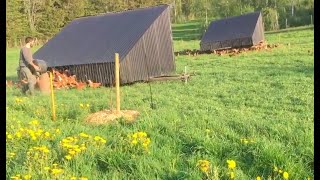
A narrated farm-vlog by Richard Perkins describing a busy training week on his Nutfield farm. He reports unpredictable weather and its cultural/environmental impacts, updates on market-garden progress (including a transition to a paper-pot transplanter), poultry management and eggmobile moves, grazing plans for cows in tree-lined paddocks, composting and biodiversity observations, and evening training sessions hosting international participants. He notes specific operational details (paddock sizing, plant spacing, crop yields) and reflects on the educational value of on-farm training.
Questions this video answers
1250 square meters
About 60–80 dung beetles per cow pat
Argentina, Puerto Rico, North America, Canada and various European countries
Seven to eight trusses with about 70–80 tomatoes each
22 cm spacing
Chapters
Well, it's been unpredictable weather with, you know, ultimate changes here, which is often the case due to the microclimate we're in with the surrounding water as well as ridges around us. We've had forecasted thunderstorms that just disappear and then later come up in the night. Heavy rains last night and beautiful sunny today. It's really hard to predict the weather right now and that's becoming the case.
All over Sweden, where up in the.
North, the Sami people, the reindeer herders, are saying that their old knowledge is lost and they can't predict the weather patterns anymore. To the extent that all of their cultural knowledge is being lost and they're not finding it viable to herd the.
Reindeer in the same way.
Today's video, we're just looking at a few clips on the last days. It's super busy here on the training with a really beautiful group here and we're having a great time together. But it's full days and don't have much time for making videos.
So just some clips to update you.
On what's going on at the farm.
They're back again. We've always had. Well, last couple of years we've had swallow rest here right in the middle of the dining yard above the clean crockery.
So things are progressing in the market garden. We've had some nice moisture levels and that's been really great for getting things going. But we did get affected by the cold weather and I think it deserves a whole video update. Just on the market gardens with the big transition to the paper pot transplanter and we've been working out the ins and outs of that, but time so compacted with the course going on that.
I haven't had time to really make.
Up much video clips. So I'm going to do very soon a video really looking at how we found the start of the season. It feels like we're a bit behind with the gardens, both due to the transplanter and getting used to it, but also due to the weather, we got hit by a cold snap and I feel like things are starting off slower this year, you know, with the poultry as well. So I think I'll do a separate video very soon looking at all that's been going on in the gardens. And we've got some. Most beds are full now and we've got some good growth and salads and micros going out. But we'll do a little update and I'll show you some of the ins and outs and little tricks we've learned with that.
Chestnuts on the hill, mist in the meadow. 20 past nine people are here from Argentina, Puerto Rico, North America, Canada, all over Europe. Everyone's settling into sauna and I'm putting these lights in the hagmobiles. The hens are really coming out now in the evenings and tomorrow we've got to take an eggmobile.
Into.
So this is like the creek. It's coming out of a spring up here. So we've got to get them over here. There's only one crossing down here, but right now the cows are in the way. So I might even set up the fence ready for tomorrow just to make it quicker because my team are on brooder as well as cows. But we need to move the cows before they move the eggmobile. Eggmobile moving is time sensitive. Not right now so much because they're not move, they're not laying eggs. But it becomes time sensitive that you need it opened up. Just going to give them a little scare. Part of their predator training, I guess some might see it as totally unnecessary, but I like to give them drone strikes and a little bit of scaring in the beginning. Not to stress them out. That's not my intention. My intention is just to get them used to reacting and they have instinctive behavior. If you pass a silhouette of a predator bird over a young chick, it will react. But I think it's good with drones and with just a little bit of scaring to get them, you know, keep them on the edge a little bit. For the aerial predators, we're right here.
On the tree lane.
You know, there's buzzards and there's fish eagles and big eagles out here. So I think it's just beneficial in the first days to get them used to responding to, you know, stimuli in the environment. But they're doing good. So. Happy hens. Been a lot of rain. We had a big thunderstorm today as people arrived. Some are camping, but. But I'm very grateful for the rain. It's, you know, it's really needed after last year.
I was just recounting a bit of.
The story of the drought last year and it's, you know, it was super rough and I feel like I've said before, this year is a lot about. I just hang this here on the edge of the nest box. That does the trick to get them back in. Yeah, I feel like this year is catching up. You know, there's a lot of spots in the pasture that, you know, some people might be used to having in their fields all the time, but I feel like we've Taken a lot of pride in, you know, really managing our grassland and just improving it dramatically. It's beautiful with this mist in the.
Meadow.
But, yeah, that's not a big deal, you know, considering the droughts. But we've popped up okay. If you look at the neighbour's fields, our grass is in really good standing and it's all fine. But yeah, I feel like part of reducing the poultry numbers this year was specifically about have to try innovative things with my foam, because I just can't do everything with one hand anymore. Part of the intention with, you know, reducing the poultry this year was partly for educational purposes, to really train everyone on every stage of, for example, the slaughtery. Whereas if we're doing many, many thousands of birds, we have to roll really optimally as a workflow, so we can't really, you know, you need someone to get trained up on one position and stay on that position and master it, rather than have a go at everything which people in the learning setting typically want to do. That's not a great way to run the farm. So we've lowered the numbers a bit to accommodate that learning because I think it's so important.
Where can you go and learn that.
In a working farm? There's not any places. And so that has a massive value in what we're doing. But part of the intention also was just to allow the ground to really recover. And I think if we had the amount of poultry that we had last year and had another drought, I mean, we would be basically working in a desert again. I always wrap these posts and they have clothes clips. Don't know if you'll make them out, but they go opposite directions. Bop. And that's where you get a good connection. Also, electrically, that's important to connect them like this, otherwise you will find it hard to undo them again. So we always leave a little bit of a gap between the fences here. I've got the cow's water running through here, but just to make an easeful flow when you're egg collecting or whatever.
Beautiful.
It's nearly 10 o' clock at night and this is how light it is. And it's beautiful with the mist. When it comes to autumn, you have thick blankets of mist on the meadow and you just see a cow appearing out of the mist when you come up to them. That's a lovely time, Spring and autumn, lovely times of year. Looks like we got some nice weather now, which is great for taking people on a big tour and having a look at what we're up to at this Magical farm. Making composts, chopping greens for more subservient. We're going to chop straw too. Mixture of greens. Much more diversity equals much more biological profile. €20 for this old chopper safety. Third, things are peaceful in the brewer. Temperature's sitting nice. As I start to talk now, I'll disturb these birds. They're very content. Good space distribution, obviously at a good temperature. They're just waking up, really. Morning ghosts. Cows are on about 1250 square meters right now. They're loving the dandelions. Beautiful morning again. But we're just taking the tops off at the moment. We're going around the fire quite fast and leaving enough armoring for these birds and soon we'll be four days ahead. You can see there's a lot of biological activity. We picked up some of the manure to make compost yesterday and we had 60, 70, 80 dung beetles per cow pat, which is nice. So once we have the grazing plan together, it tells us how much space the cows need each day. And because we have these tree lanes here in Nutfield, they're 10 meters apart. This is a savannah planting of chestnuts, walnut, pecans and all other kind of nuts that you don't find growing in Sweden. Really the chestnut here, because we got a fixed width. We know, for example, if the cows in here for X amount of days, how much they need each day. Right now it's 1250 square meters, and that means we just need to walk 125 meters, which you can measure out by foot. So they're getting big strips and that's leaving the ground with enough armoring on for quick recovery and short enough grass for the eggman bill. So you can see the difference between the paddocks the hens are in now, and that's ideal right now. So we're going to zoom around the farm once and probably zoom around the farm again to keep on top of the grass because we have so few herbivores. Then we will start to slow down and boilers will come into the mix at the same time.
So some things that we do in the evenings of the trainings is have all the participants that want to share about their farm and projects that are going on. It's always amazing to see the skills and gifts and strengths and talents that people bring and just the opportunities people have in front of them and very varied projects. Some people are inheriting family farms, some people are already running really big farms and some people are looking to start up. So it's a really dynamic group and just lovely to see the sort of interactions and inspiration that go on. And I love it. I really just enjoy the sort of melting pot of people from all over with different cultural and life experiences coming together and really focusing in on really good stuff. And it just brings my energy up just knowing that we're all here, just honed in and focused on really good, wholesome stuff that, you know. You know, perhaps we should have learned more about it at school, but we're all showing up here and it's. Yeah, it's really heartwarming to just see the amount of attention and care and thoughtfulness that goes into these kind of processes. And yeah, it's really grateful for such opportunities to work with amazing people from all over and create these networks that then go on and watch people develop and change over time. It's been a feeling this year, like I really would love to just spend a year going around seeing all the people that have passed through here and what they're up to and just how important it is to highlight some of the people who perhaps don't have so much of a voice. And I know that a lot of our viewers have really enjoyed the little trip I made last year going to see, you know, other people's farms. So let us know in the comments below if that's something that you think is worthwhile and it's something I'm considering. I don't know quite how it could ever work out logistically, but perhaps it's because the summer is the time I would have to go and do that, really. And it's. I don't know. I partly don't want to leave this place and I partly don't see how I could, but possibly as a way to bring someone in to manage the farm for a few months where I could go off and do some intensive travel. I'm not sure about this, but I just see, like, how impactful it can be to just put people on a pedestal and really highlight their work and great things that people are doing. And I know it's had a great impact influence on connections and attention to some of the people I've highlighted in the past. So it's something I'm seriously considering because I just get overwhelmed when we have groups come like this, just how much amazing stuff is really going on that you wouldn't come across. And perhaps people that don't have such a public platform but would really benefit from having people see their work and what they're up to. So let us know what you think about that in the comments.
So our salad's all up and big first tomatoes coming in. So we've got idli here, my favorite, little yellow cherries, seven, eight trusses with 70, 80 tomatoes each. And we're putting in all of these other tomatoes at 22cm, pretty intensive with lettuces on each side here. Giant red mustard, scarlet frills, spring onions, and then there's mitsune and giant reds. So these are ready to be harvested.
We're eating these every day, but we'll.
Be selling salad bunches. You'll remember these were the first crops that were put in with the paper pot. So pretty soon this will be full up of cucumbers and tomatoes and hopefully better conditions than last year. You remember we had some calcium deficiency. We're on a compacted subsoil base here, but looking good.
Rainy day today, so exciting times with the course in full swing. And we're going to have an evening barbecue at the lake tomorrow. It seems like the little window with good weather. And just a little update from the last few days while we've been getting on, but I'll make some more updates in the next week because the little boiler chicks are doubling in size at this time, so things are moving fast. And I'm not having time to keep up with what's progressing on the farm, but everything's really coming into bloom and summer is coming on us. We've had a lot more rain than we could have hoped for, really, based on the predictions early in the year, which is hard for campers, but great for the landscape. And yeah, it's really nice to just be in lush greenery again. Thanks so much for watching, folks. Really appreciate your views and comments. You can find out a whole bunch more in the links below to our online training and other links there for you as well. And we'll look forward to seeing you in the next video.
More from Richard


A review of short and intensive season on a mixed farm and restaurant/event space in Sweden






Alskade Kyckling Exploring complexities of poultry production in Sweden and what we stand for


