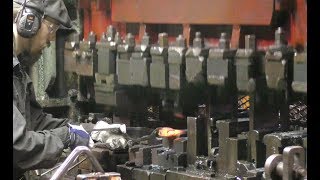
Richard Perkins visits the Gränsfors Bruks axe forge to document its history, production process, and finished tools. He outlines the site’s origins (a scythe workshop in the 1860s that shifted to axe production in the 1900s), shows the production flow—forging with old power hammers, scoring, rough grinding, hardening (heated to ~820°C then quenched in cold water), tempering/annealing (heated to 195°C for 60 minutes), tumbling and final sharpening—and highlights the quality control and rejection of substandard heads. Perkins handles and describes finished products (hatchets, splitting maul, hand adze, fro), notes a splitting maul head weighing over 2 kilos, and recommends Gränsfors Bruks tools as long-lasting investments. He closes with a plug for an online course/Q&A.
Questions this video answers
1860s
1900s
Approximately 820 °C (then rapidly cooled in cold water).
Heated to 195 °C and held for 60 minutes.
Over 2 kilograms.
Chapters
So we come six hours north to the home of Grand Froche books where they make some of the best axes in the world. We're going to have a look at their production, how they make these axes. So I'd been wanting to go to Grand Foch Brooks to see the productions for quite some years and it's been a long time to get away from the farm and go quite so far north. And it's a really fascinating place. They've been producing axes there for a very long time. It started originally as a scythe workshop in the 1860s and then in the 1900s turned towards axe production. And you know, the basis of the forge that's there today was set up. They're using very old power hammers and it's a really interesting production cycle. The video quality hopefully will show you a good sense of what the production looks like today. The audio is a little bit poor because it's very loud inside obviously, but I hope you get something out of seeing how they produce some of the best axes in the world. Okay, now you're ready.
Okay.
It's a big pig.
Sweetie.
Where did you find it? You have to restore Poitier, I think. Confined. I don't really know if it's possible to.
In the main boarding room we've got these amazing 100 year old power hammers that's being forged into access by the different craftsmen here that you see in the great town. It's, it's, it's, it's, it's, it's, it's, it's, it's, it's. So once the axes have been scored, they come in here for really rough grinding and then they need hardening which involves heating them up to 820 degrees Celsius and then they're rapidly cooling cold water. So that process makes the metal strong but really brittle. So then they need to be tempered and that's sending this from behind us. So then once the rough grinding and the hardening happen there, the steers anneal to take away some of the stresses of the porging and hardening process. In this case the ground poison heat the steel to 195 degrees Celsius for 60 minutes and keeps the axe there to anneal it, which tempers it. The hardness of the finished steel depends greatly on the carbon content of the steel, but also on the temperature of the annealing process. Once all that's done, they tumble the stone, the axe head, ceramic ore to take away any burrs before it goes to its final sharpening to make the finished product ready to be handled.
So this machine is tumbling the finished blade, the little ceramic balls after they've been annealed. And then this is where they get finally sharpened and handled. You can see some of the rims that are put on the handles of splitting actions, for example. And then these are truly sharpened up and polished, ready to go to the handling station.
It's.
Was really cool to see the productions and I really like the. The forging process. It reminded me a bit of eviscerating chickens. Just these precise, intelligent movements with minimal movement between each move to create the perfect product. And it's the sort of job I would get really into. I think it's really cool to, to sit and just watch the craftsmen working and just performing their, their thing. And you see all these rejects. Like the quality of the finished product from Grand Forch Brooks is amazing. And they reject anything that's subpar. I came away with this beautiful old axe that's used for making log houses, essentially. Now these come in a couple of different variations. This is quite flat with a bevel on this side. You get them left and right handed, as it were, or double bevelled into the middle. So this is used to work alongside a log for flattening or planking for flattening logs, to make log cabins, etc. And you see it's got room here. It's used with both hands to do fine work to take down the edges of large pieces of timber. And I wanted to play around with doing some of that work because it's very traditional mode of building here. That was how our house was built. Also. Really nice quality axe. We use their hatchets for kindling and things like that. And I've used their splitting maul for splitting firewood. Now this is a really nice heavy maul. It weighs over 2 kilos in the head. I've had this for some years and what's nice about it is it's actually forged and tempered to withstand the impacts of hitting steel. So you can actually use this splitting maul for driving in wedges for really big and twisty logs that you're trying to split. It's important when you do that that you only use a maul that's been specifically designed to hammer steel. There's a lot of force when you impact steel with steel and you need to wear goggles. It can be a little dangerous. And it's important you maintain the sharpness of the head, especially when you're splitting like gnarly wood and that you maintain the edge here. It shouldn't mushroom out. That can be quite dangerous for you. So you should always file this surface down if it starts to mushro out if you're hitting wedges a lot. But this is the. The larger mall that they do and it's. I think if you're living with fire as a way of heating your home, etc. This is an essential tool. I love it. I also wanted to get their little hand adze and adz is like a tool you would use to dig out a canoe, like working below your feet. So an axis. It's like a chisel axle essentially. But they do a little hand version that's really nice for woodworking, be used in boat building, but it's also used in just carpentry around the farm. I also wanted to get their fro because I lost my fro during my packing to come to Sweden many years ago. A fro is just essentially a straight blade facing downwards with a handle that you use for splitting wood. And you see from the array of tools they have on the wall there, they make amazing quality tools and they obviously cost a bit of money. So I decided to refrain and not spend too much all at once. But it's really n to see their productions and to have a sense of place with the products that you see here in Sweden. I know that they ship all over the world and I can highly recommend them as you know, if you want to invest in a tool for the rest of your life and a tool to give your kids, I reckon these are some of the best ones out there. So I hope you found that video enjoyable and interesting and click like and share and subscribe. If you enjoy our videos in general, today is the first live questions and answers on our online training. So if you're not involved with that, come and get involved. That's on the full subscription. We've got a whole bunch of people from all over the world on that. I'm excited to answer some of your questions direct and that will get saved and put into the course material. So looking forward to that. And you can find out a whole bunch more in our book or in the online training that's put out at a price point that everyone can afford to get involved. So I hope to see more of you in there and I'll see you in the next video.