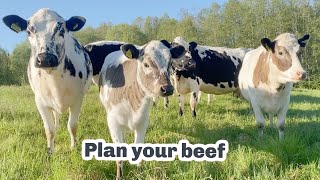
Transcript of a YouTube mini‑series video by Richard Perkins about grass, grazing and regenerative agriculture. Perkins explains fluid‑dynamics analogies to plant water movement, grass physiology (root exudates, recovery after grazing), practical grazing rules of thumb (timing, recovery periods, four true leaves), and the role of herd behavior. He also describes planned grazing charts and offers downloadable spreadsheets/templates and a Regenerative Agriculture Masterclass focused on business planning for pasture enterprises.
Chapters
Welcome back to another video folks. It's finally summer here in Sweden and today part three of our mini series. It's a free mini series on my website. On the first link in the description below is out about grass and grazing and there's continuation of free downloadables. We've given away the PDF version of the farm like a hero tour book. We've given away 3D CAD plans for our rollaway nest boxes and today's one of our planning template sheets for pasture raised beef, One of my favorite topics and such an important part of regenerative agriculture for their ability to quickly capture carbon out of the atmosphere and sequester it into the ground and bill topsoil. So let's think a little bit about the law of continuity and fluid dynamics. One of my favourite books is a book called Life in Moving Fluids by Stephen Vogel who really bridged the gap between fluid dynamics and biology. Often in academia there's a lot of siloed information chemists that don't talk to biologists along the corridor as it were. And it's really the integration of different fields that leads us to really be beautiful insights and understanding of whole systems. Now imagine there's a three lane highway with three rows of cars theoretically perfectly spaced together going at 15 kilometers of an hour and then suddenly that road instantly transforms into a single lane of traffic. The question is how fast must the cars be traveling when they go into the single lane of traffic. So three lanes of traffic at 15 kilometers an hour suddenly go into a single lane of traffic. How fast must they be moving? Have a little pause if you're not sure and think about it, because this is the law of continuity in fluid dynamics. The answer is 45 km an hour. If three lanes of traffic are going 15 km an hour, think of it like water in a pipe maybe then suddenly they must be going three times faster. 2. Keep fluid moving. Now it's for this reason that we can be quite surprised by the world around us that seems quite motionless and still a lot of the time for a big tree like this birch behind me to supply all of its hundreds of thousands of leaves with the minute amount of moisture they need for respiration. Liquid is traveling up the trunk of that tree pretty rapidly. In an old growth oak tree you can record by heating up the side of the bark with a heat gun. You can use a thermal imaging camera and measure the fluid in the trunk of a great thousand year old oak tree moving at a rate of a meter a minute, which is quite surprising given how stationary those Trees seem. But what's even more breathtaking and surprising is that a rye grass in full photosynthesis liquid can be moving through the root system at 25 centimeters a second. Unbelievable. When you sit in a waving grass field, you don't really think about how much movement is going on. And it's that movement that makes grasses so well adapted for capturing carbon from the atmosphere and storing it in the topsores as short chain polysaccharides, sugars from the root exudates, and as long chain carbon. When these plants are grazed off, some of the roots will die back to balance the hydrology of the plant. And that's a very stable form of carbon that can last in the soil for thousands of years. Now, we have a lot of respect for trees because they're so big and architecturally grand, but most people don't know a perennial bunch grass can live a thousand years. Now, at the time when Europeans first went to North America, there were estimated to be 60 to 100 million bison running around those grasslands. And they weren't turning them to desert like we have. Since we've bordered along rangeland science and taken animals off the landscape. Grasses co evolved with animals and very large amounts of them. When Europeans first went to North Africa, there's reports of people shooting several thousand gazelle in a weekend with shotguns off the back their elephants. Now think about that for a minute. If you fire a shotgun into a crowded room, people will disperse very, very quickly. So if I can shoot 3,000 off the back of an elephant in a weekend, that tells you something about the density of animals on those savannas. And the savannas were some of the most densely populated animal ecosystems on the planet. With topsails 8,9 meters deep, perennial bunch grasses. Humans have been very good at creating desert by overgrazing with animals or removing animals from the landscape. And there you see the secret of managing grass ecologies. It's all about time. It's the time that the animals stay in one place and then it's the time until they come back to that same place. Now, all of the old herds of natural animals were moved around by pack hunting predators. And so if you are a tasty meal for a lion or cheetah or whatever it is, then your safety is increased by being a herd, because you're one in a thousand or one in a hundred thousand. And so that's an important thing to observe in the way that grasslands are managed. In wild systems, you have tight bunched animals who are grazing everything. Because when you have an actual Herd like here, we just have a few cows, but when you have a herd of cows, they're competing against each other to get their food before someone else comes and takes that tasty morsel or tramples it or whatever it is. So animals behave very differently in herds. Now, they also will eat a much broader range of herbs and whatever plants are in the forage, because they have to. And that gives them a much more balanced diet, a lot more vitamins and minerals and medications, self medications. Now, that's important because if you allow animals to sit in a field with a fixed stocking rate, they will cherry pick the soft, tender stems of the grasses and then when they grow back again, they will come back and take those shoots again. Now, the problem with that is that the plant is using the energy in its root reserves to put forward the new growth. And so if you keep taking these sweet, tender stems, you are using a credit card, as it were, you're using up your root reserves. Now, if I give my son Ragnar a bowl of candy or a bowl of fried liver, he's going to go for the candy. Same with the cow. The cow will always favor these sweet, tender shoots. They don't have much fibre, they don't have much roughage, they're just sweet, juicy. This is the problem with staying too long in one place. We're over grazing. We're using our root energy without allowing the plant to express its physiology and put back the energy used in the last growth back into the root system through photosynthesis. So that's super important in our climate. Here it's about three days. If I come along and cut the grass or mow it off with a herbivore, that grass will sort of remain stunted for about three days, then it starts to grow. So that tells us the first rule of grazing. We cannot stay longer than three days in any place, or we are over grazing. Now, you can't overgraze a field. You can only overgraze individual grass plants. And that's important perspectives to take. So we're managing millions of plants on our farm to never overgraze them. Now, the other thing is to let the plants recover the rest period that allows them to grow, put forward new leaves, photosynthesize, put that energy back into their root reserves so that next time you come and graze it, you are building soil, not degenerating your soil. So how do you know when a grass is ready to graze? Well, people will tell you different things about this. The safest way to be sure is to know that a grass has four true leaves and when it starts to yellow off on the bottom leaf, then it's safe to graze that plant. Now, you've got to remember that how much we graze, whether we graze heavily or lightly, is nothing to do with overgrazing. Overgrazing is purely a function of time. Time. We stay in one place and time until we return to that place. So if I eat all of this down to the ground, that's heavy grazing, that's not overgrazing. Likewise, if I just nip the tops off, that plant will recover relatively a lot quicker. So we can manage the timing of our movements based on how the grass is growing throughout the year. Now, I have many videos on our YouTube channel of how we fill in our grazing charts and following through the year looking at how we graze. So be sure to check back on there if you're not familiar with how you would fill in. Holistic planned grazing chart, that's one thing. So four true leaves and yellowing off at the bottom, that's safe to graze. But you can also think of it like, what was there last time you came around? If I only had grasses with two tree leaves and I came around early in the year and grazed that, I would try and graze it lightly. But then if I come back and it's got now three true leaves, well, then that's good. It's put back at least the energy it took to grow the shoots previously, and so that would be safe to graze too. The rules of thumb with grazing are when the grass is growing fast, you move your animals really fast. And when the grass is growing slowly, you move your animals slowly. And if you're not sure what to do, you stop or slow down. Why is that? Well, that's all about recovery time. The recovery time is changing throughout the year. For example, here in Sweden, at the maximum rate of growth we're getting in June time, then we can see recovery in just 21, 24 days. At other times of year, that might be down to 45 days. And so you really need to learn about your grass in your specific soil, in your circumstance. And the weather changes year to year, so there's fluctuations and you're building up a picture constantly that will help you learn to manage your grass with precision and, and move in the direction, move the ecosystem in the direction that you wish to over time. It's a beautiful thing to have a grazing plan because it's like a business plan. It gives you a target and a plan to get there. And so even if things change, the weather changes or animals numbers change, you can just replan. And so I do again encourage you to look back. On our YouTube channel, we show you how to fill in a grazing plan. It's not, it's not rocket science. It's one of those things that looks complicated until you've done it and then you see, ah, okay. And then when you go through that process for a year, you'll pick up so much nuanced information that already the next year you plan your grazing, you'll have so much information to add on and to build into your plan. And that will never cease. You can go on learning about this for the rest of your life. In terms of recovery time, think about this. If I can have one cow in this field for 365 days, then I could also have 365 cows for one day. So it's about animal units and animal days per hectare. Now that's a little bit complicated to get into here, so we won't get into that. But you can hear about that in other videos I've made on YouTube, for example. But the important thing is that we need to allow every other patch of land that is under our management to recover before we get back there. So it's actually a bit mathematical algorithm, you could say. That's why when the grass is moving fast, we move quickly. A, so we can keep on top of our grass and B, because it will have recovered by the time we get back round. Likewise, when grass is growing slowly, we slow down our moves to make sure every other patch is recovered by the time we get back to it. And so the grazing plan really helps you with the mathematical numbers. It actually gives you the maximum and minimum days you can stay in any of your specific paddocks. And that allows you to build a plan with confidence to know that you'll never overgraze your grasses. So why isn't everyone doing planned grazing? Well, it's habits and entrenched patterns and ways of doing things. It's a bit more work to move your animals constantly. A lot of farmers here in Sweden and around the world will put out their animals into a big paddock on fixed grazing and then move them once or twice in the year, if that. But when you do that, when you have animals in a fixed stocking rate, you are over grazing and you're using your future resource base and consuming those grassroots, you'll see that most of the pastures around here that I document on YouTube and compare them to our Land, they stunt out at about knee height and then the grass is going into stem elongation and then seed formation by about June 20, mid summer. All the grasses are biologically programmed to go to seed by then, but then that's it. Their production is done for the year. And so we're managing our grasses to really express their physiology. Both sending roots deeper down, putting aerial plants higher up. And we've got the same species of grass. Hey, growing up to my shoulder height. Someone wants to be in the movie. Hey girl. There's a lot of flies. So the cows are hiding here in the shade and you see the way they stand together. And they'll use their tails in exchange with each other to keep the flies out of each other's eyes. It's pretty cool. One thing's for sure, there are no ecosystems on the planet devoid of animals. It's animals that drive fertility cycles in nature and that in turn drives the hydrological cycle in the soil and feeds the soil food web. It's so important, and it remains one of the quickest ways to build soil that we know of. There is so much misinformation about meat production and pasture raised versus feedlot. There's a lot of industry pressure and a lot of bad science that's looking in too narrow a context. Now, I don't want to get into all that in this video, but it remains to be said that grazing of livestock is such a fundamental part of regenerative agriculture that it warrants its own deep study on your learning journey. It's something that is a big part of any mixed farm. And as you know, I'm a big advocate of mixed farming. Animals on pasture with tree crops, annual crops in small amounts, in intensive no dig setups in our case. And by having this mixed system, we can start to really integrate the different enterprises together. The way we integrate our laying flock behind our cows and sheep and the way we use our deep litter system for winter bedding to feed the fertility into our market garden vegetable production. It's a very important aspect of what we do here and something that we get a lot of joy from. There's nothing more interesting than watching the grasslands develop over time and really listening to animals and learning about their needs and what they're telling you through their behaviors. And what's beautiful about this system of grazing is that not only are you in daily contact, observing your animals very closely, which is important, however you graze, but your animals are robust and healthy and that means they very rarely get sick. Animals don't need Drugs. They need their natural predator prey relationship and we mimic that, firing electrons down single thread wire. That's enough to keep a 5,600kilo beast in. Doesn't matter how many you have. And it's a very scalable enterprise. It's actually in some ways easier to keep a large herd of cattle than it is to keep a few like we have now. We're very restricted on land and this is a homestead herd for ourselves to have a really high quality meat supply as well as for their utility in improving the ground and cutting the grass before our poultry nets. Because poultry is our main cash provider at this farm, it remains to be said that there's really good money to be made. We have templates, spreadsheets for all the different enterprises that are presented in my book Regenerative Agriculture with boxes that are fillable so you can change the data to fit your unique time, place and circumstance. I'd like to give away a version of the grass fed beef one. Now, it's built out for Swedish conditions with the sort of animals we run in, the sort of conditions and marketplace we find ourselves in, but they're totally adaptable to any circumstance. There are fixed figures and instructions within the spreadsheet and then there are boxes that you can change according to your local prices and customs, etc. And it gives you a really quick way to analyze some of your dreams and visions and see is this going to work in my specific time, place and context. In my experience as an educator, what I've noticed is often the things that draw people to regenerative agriculture are the beautiful plants and animal systems that we get to work with and the wonderful feeling of managing an ecosystem. But it's really got to be stressed. It's the economic planning and decision making that makes businesses work. For that reason, in all my education work and on YouTube and in my book, I've put a lot of focus on the business elements of what we're doing because it's so important to share. It's very hard to get that kind of information easily and readily online. And so I've really dedicated a lot of my work so specifically to coaching people through how to design functional, intelligent, smart businesses. So this spreadsheet is downloadable for free. Just click on the link below. And as I said, we have templates for all manner of businesses that you'll find if you join us for the Regenerative Agriculture Masterclass. Eight intensive weeks to get you from a starting point to a complete business plan and land plan so that you can start off on the right foot in a smart, intelligent way, supported by your peers and with specialist mentors who are past students of ours who have gone on to build incredible businesses of their own, as well as feedback and input from myself. Whatever grazing enterprise you decide to do, you need to have solid business plans and goals with that. Now, this spreadsheet is merely a snapshot. It's not a comprehensive business plan, and it's isolated in that it's not even considering contributing to the overheads of the overall business, etc. It's an enterprise sketch and the aim of that is to say, okay, I want to do pastured poultry, market gardening and grass fed beef. Look at them in your circumstance and marketplace. Will they work? Which one gives you more cash flow for the time inputted, or whatever it is. And that's how we start to take our dreams and visions and crystallize them into a uniquely usable, workable business plan. So I hope you get a lot from that, folks. And in the last part of the mini series, we'll be looking at no dig market gardening, a topic that I'm extremely passionate about, having developed a style of no dig market gardening that's now spread all over the world. So I look forward to seeing you in that one. And then after the mini series is completed, we've got a special live event that you can sign up for while you're here. It's an evening in conversation with some of my past students who have gone on to make incredible businesses. We'll hear about the adventures they've been through starting up their farms, what's gone well, what's not gone well, and how it's working out economically, etc. And there'll be space in there to ask questions for yourself, so don't forget to sign up for that and we'll see you there. Ragnar. That is a big garfish. It.
More from Richard


A review of short and intensive season on a mixed farm and restaurant/event space in Sweden






Alskade Kyckling Exploring complexities of poultry production in Sweden and what we stand for


