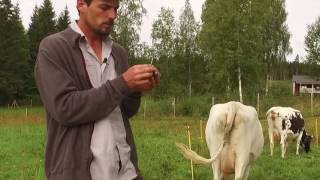
Richard Perkins explains how grasses pull carbon from the air into soil through leaky roots that feed microbes, then shed roots after grazing to create stable carbon. Grasslands sequester carbon faster than trees because grasses move water and nutrients quickly through their systems.
Chapters
So the process of moving carbon around is what's so important with grasses. As a grass photosynthesizes, is a very direct pathway for polysaccharides, or short chain carbons, down into the topsoil. And so plants have leaky roots specifically to feed the microbiology in the soil, which in turn creates this area of activity outside the plant's root, the rhizosphere, which quickly becomes anaerobic and causes some chemical changes in the soil that release nutrients for the plants to uptake right outside their cell walls, exactly where they want them. So it's a very neat design, but because the grass has evolved with very large amounts of animals, it's designed to be eaten and trampled periodically as part of its health. And when you rip off the top of a grass plant, because a plant is hydraulic, it needs to shed off some of its annual root system to balance its hydrology. And that is the material that breaks down in the soil and turns into long chain carbon, a very stable form of carbon that might be in the soil for thousands of years. Grasses are very active now. We tend to have little knowledge of grasslands, and we spend most of our time sitting on grass as a lawn, not really studying how grassland ecology works. But the rate of liquid transfer through grasses is far, far greater than that of larger, higher plants like trees and shrubs. For example, if you took a large oak tree in the forest and you heated up the side of the bark at the bottom of the trunk, you can use a thermal imaging gun to trace that heat source up the trunk of the tree. And what happens in a large old oak tree, Every single leaf is losing a minute amount of moisture in its transpiration process, which equates to water moving at the rate of 1 meter a minute up the stem, which is quite surprising. We think of large thousand year old trees as very stationary. However, it's been recorded in the roots of an annual rye grass liquid moving through the root system at 25cm a second, which is quite breathtaking. When you're sitting in long grass, watching it wave in the wind, there's a lot of movement happening. And it's that movement that is responsible for this fast carbon pathway of sugar and carbon from the atmosphere being locked down into topsoil.