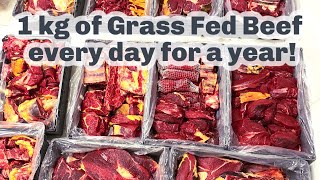
Richard Perkins breaks down a 330 kg grass-fed bull for his family and guests. His carcass was chilled at 4.5–5°C, warmer than the ideal 1–2°C, which made cutting harder. He used a bandsaw to process large cuts, mince, and stock, with trimmings saved for his dog Saku.
Questions this video answers
330 kg
About 4.5–5 °C
About 1–2 °C
Chapters
Okay, welcome back to another video, folks. In today's video, I'm breaking down a 330kg grass fed bull that we slaughtered recently. You've seen on videos here on YouTube. And I'm going to break it down to pack it ready for the freezer for our family and for the people coming to the farm next year. It. Sa. Sam. This. Sam. A couple of things I've learned from this process is that the meat wasn't cold enough to facilitate easeful cutting. And typically when you get meat down to 1 or 2 degrees, it's solid and hard. It makes cutting really easy. Now we were chilling at four and a half, five degrees and aging in that way and it wasn't cold enough. The meat was just too mobile, you could say. The other thing is getting to know the saw. The saw is pretty cool. I'm very impressed with its ability and that's been super helpful way to process big animals quickly. Obviously you lose some of the traditional skills of butchery in there, but it's very handy tool. I'm really glad that we had that to help speed through the process today. So I'm sure there's some butchers out there who will be horrified with some of the ways I've done things. But some considerations of how we eat as a family and how we feed groups, but also time and my skill limits. I'm certainly no expert butcher, I'm an expert chicken processor. But we've got some beautiful cuts here. I'm going to wrap them all up soon. But lots of beautiful ribs and steaks and stewing pieces. I've cut the legs quite large because that will make nice dinners for big groups. Beautiful steaks here, more ribs, got some roast put away there. I'm gonna wrap a lot more roast tomorrow. More ribs, more steaks and stewing bits, more leg cuts and then we got loads of bits to go for mince and for stock making. That's a lot of eats. So nothing goes to waste. Anything that doesn't make the trimmings box for either mints or, or stewing steaks will go to Saku. So we'll bag up dog food, premium dog food for our beautiful dog Saku. And that leads to minimal waste. There's basically nothing to throw away from this process. Basic clean down of this. I mean you can see there's a lot of bone dust in here, so I need to clean that up, but that shouldn't be too hard and clean up the surfaces. Big day. That was a lot of work. So I've broken down 330 kilos of grass fed beef into cuts that are suitable both for our family and for larger groups of people when we have people here at the farm. So I've done some unconventional cuts because we're using a bandsaw just to make it efficient. Still got to separate what's going for mince, what's getting cubed up for stews and we've got to mince that and we need to vacuum pack everything. We're going to leave that till tomorrow though. It's been a super long day and it's been interesting. I've learned a bunch and it's been good. I've got it done. And even if it's a little unconventional, I'm certainly no expert butcher for larger animals. It's how we do to secure for our family and that's a beautiful thing. So I hope you found that interesting in some way. Don't forget, we've got two more days if you want to join us for the Regenerative Agriculture masterclass and look forward to meeting you all in there in the new year. You can still join us for two. Two days more. See you in another video soon.