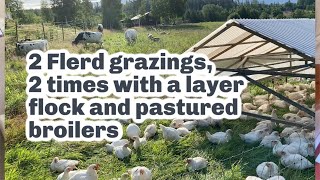
Richard Perkins gives a narrated farm walk-through update ahead of a farm-scale permaculture and regenerative agriculture training. He covers garden progress (transplants, peas, beans), poultry movements and broiler pens, a cautious grazing plan for cows and sheep affected by recent broiler usage and wet weather (delaying hay/haylage), observations of wildlife and plant ecology, and welcome logistics for incoming trainees.
Chapters
Welcome back to another episode, folks. We're going into farm scale permaculture design and regenerative agriculture training today. People from all over are arriving and setting up tents in the showers. We're getting but a little quick video updating on the grazing going on and some of the beautiful veg coming out the gardens. Moving to Nutfield. Come on up on the quad. They followed us up behind the broilers. Look, new grass. Oh, Good job. It's. So still. Lots of transplants stacking up in here. Peas and spring onions on paper pots. But glad that we've done most things in our usual 64 cells. We've got beans also getting quite leggy here, but they're in the paper pot. Lots of beans coming on in the gardens. Picked and started planning out with the jang a bit more to see if we can get things deeper in the ground than the six row for when the compost is getting dried up. Okay, moving boiler pans. We're just storing them on the grass that isn't recovered here. Boilers are coming down through and then they're going to go down to the third tree then because that's spanning the full width of the field and then take a left and we are taking cows on the fresh regrowth from the broilers a while ago. Obviously where the roller pins have been here we're not going to go down. But the cows go crazy for this kind of grass. It's obviously very vegetative and low in fiber, but high in protein from all the manures. So we still haven't cut hay or hay lich at this point. And it looks like it's going to be wet tomorrow as our students arrive and then in the middle of the week. So it's not looking favorable for cutting haylage. We need to leave it sitting two or three days and then bale it depending on how dry we want it to be. We like to have quite a dry haylage. So this is affecting the grazing plan. We knew that the date wouldn't be set and it depends on people coming in to help us. So our aim now is to go as slowly as possible through Nutfield because we need to allow top field time to recover. The layers have been going down through there, so hopefully in about 20, 22 days. But it might be tight because a lot of this field has had boilers on it that we can't graze this triangle behind me. And so we need to go slow as we can, keeping the cows well fed. Alright. It's a bit of a traffic Jam down below me in Nutfield. We're crossing past with the boiler train. And so we've got the cows on a thin strip that can be quite wet when the spring is flowing. The spring is kind of coming out just beyond the boiler pen and we've got half the batch of birds in this roller pen after the slaughter on Monday. So we've got the sheep in the thin patch. They've been on the lush vegetative growth. Tomorrow morning the boilers are going to jump a few spots ahead of where they are now and that will give us a corridor to get the cows through. Off to the east direction, off to the background. And we'll be grazing slow through Nutfield. A lot of snakes this year. This is the adder. So poisonous, but you'd have to really shove your finger in its mouth to get bitten by it. Wow. Honeydews. These are insect eating plants and we're out looking for insects. We're actually on a floating island. You can see the whole land is wobbly and these islands actually float around with the wind. But trees start to grow and it starts to fill itself back in eventually. An interesting ecology with all these insect eating plants. Pretty cool. Okay, so we're hopping over today. Boilers are coming forward right to the end of this patch, which leaves a window we can come through here. And off we go into Nutfield. Nice grass, Nice regrowth here. So this is been recovering about 35 days now. Some of the cock's foot that was obviously left standing a bit, but we've got a good sward with three or four true leaves on it. Not bad. This has had layers over it twice and it's been grazed already. So happy with this. Let's come back over now. It's naturally taller than me. That's a black walnut. Back into Nutfield. Look at this. Maliceversii. It's grown up quite significantly this year too. Just for context, that's my head height. So really putting on good growth in the nut trees this year. One of the chestnuts from seed. A lot of chestnuts doing good this year. Very nice. All right, that's it for today. It's just a quick update because we've got super busy times now. We're gonna get everyone orientated, ready for the training and welcome everyone in and get into such an exciting and special time that we always have with these amazing events. I'm really looking forward to it and great to have people at the farm bringing that lifeblood back into the land. After the quiet start that I'm sure most of us have had this year with COVID etc, so let's give you some updates as we go. Don't forget, you can find out a lot on farmlikeahero.com or in our book in the links below. See you in the video soon. Bye for now.