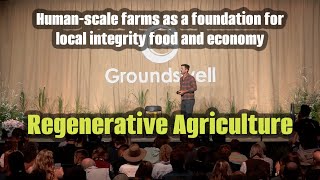
This content was created by Richard Perkins. This content was uploaded by Richard Perkins. This is a YouTube video titled "Groundswell Keynote" created on July 31, 2023, which appears to be a keynote presentation. The content type and title suggest it is likely a formal talk or presentation, but no specific details about the participants or topics are provided in the excerpt.
Chapters
Well, thanks so much for having me and congratulations to the Groundswell team. It's amazing to see so many diverse and amazing people here. It's a real privilege to be here and you're what makes it happen. So I'm going to take a photo of you lot, if I may. It's a real honor for me to be back in England and I wanted to take this time to tell you and show you around the farm I've been building in Sweden. So I've been on a long journey. I decided to be farming when I was 15. It was a vision to create a habitat to raise my kids in. That's what initially see did that. And I went to agriculture school for horticulture and organic crop production and it was pretty rubbish. I left there like, hungry for knowledge. And my journey with uninstitutions began. The trouble is that all of our public institutions are governed by public opinion, which means the leading edges are never found within those institutions. So I went on a global journey looking for strange and interesting farmers doing weird things out in their fields and tried to amalgamate that into a farm to provide a learning platform for people to address the sorts of things that I was hungry to learn about but couldn't find anywhere. So my farm is set up for two purposes. Primarily, it's a production farm to build soil and habitat and make a good city wage, working rurally, doing very nice, productive work. But it's also been a platform to educate a new generation of innovative farmers. For me personally, I want my kids to grow up in a future where farmers are the center of their communities again and treated like rock stars. I want to put nobility back into rural stewardship because farming used to be the most noble profession on the planet and it's now got the highest suicide rate of any profession on the planet. So I grew up in England, in Wiltshire, in a small rural village. I don't come from a farming background and so my journey led me globally, looking at all the major different climate zones around the world. Now I only speak English. I actually had teachers at school that told me not to learn foreign language because I would never use it. And I believe my teachers, but my friends that speak four or five languages, which is very common in the continent, they tell me that when you study language, you learn a lot about your own language. And that's exactly how I relate to climate. If you study how ecology functions in the tropics, you learn something about your cool temperate climate of England. If you extract patterns, and that's what regenerative agriculture is about for me is extracting patterns, understanding things in pattern languages. And that's how our brains are actually designed to observe and hold data. If you look at indigenous knowledge all over the world, it's held in art and dance and rhythm and song, people that have no written languages, that have 700 year long cycles to meet up from different parts of a continent, and they all show up on the right morning and we call them uncivilized. So I've been on a deep anthropological journey looking at learning, because to be a farmer you have to be a plumber, electrician, a butcher, a vet, a marketer, all these different skills, but you need to have enough knowledge of each of them. We need to have a lot more generalism in our education systems, I think, and less isolated, siloed information, which is a big problem with farming and it's a big problem with economy, governments, education, etc. Anyway, I moved to a much colder, more conservative, more expensive place in England where people said it's impossible to start small farms. And this would not even be considered a farm in Sweden because of its size. It was originally 10 hectares, but now I bought an additional piece of forestry, so 13 hectares. But this drives a very high level of economy. And the most impressive thing about this farm is I'm in the middle of nowhere. So a lot of the farms you might see on social media, they're often outside a big city of a million people. And yes, it's very easy to sell a little punnet of cherry tomatoes for $12 if you live outside New York City. But most of us, we live in the middle of villages and countryside. So this farm is mostly forestry, actually. It's hidden under the topography. And so we're driving nearly all of that production from just a few hectares of pasture. This is what the land looked like. It had been run by a couple who were very thrifty and the sort of people that would stick 40 nails on a hinge to keep a door alive for the in the last 50 years. And they've been doing horse drawn wheat and raising their own pigs and things. So I designed a farm that's future proof. It's running on perennials, grasslands with trees and berry bushes over the top. But these are things that cost money, they don't make you money. So you need cash flow. The hardest thing in any business is cash flow. And with farming, that's your biggest hiccup because all your expenses typically at the beginning of the year, and maybe you'll get paid at the end of the year. But a lot of the work that I've been doing is teaching young farmers how to plan and manage proper business. Because that's the only way I can attract young people and get them invested in this very high risk, very steep learning curve profession. It's like you can have a very nice lifestyle and make a city wage managing your own time and your own habitat, and then it's meaningful and worthwhile. So, so it's been a big part of my focus and I'll share a bit of that on the way. And so we've spent the last 10 years just 3D printing that onto the landscape and making good livings and seeding a whole generation of new farmers around the world. So what is regenerative ag? I think we're living in a time where this movement, like all movements, has started to get tribalized, maybe and co opted by big Ag, who maybe don't have holistic bottom lines. So I'm taking the liberty to define the baseline for regenerative ag as it must be carbon sequestration and soil building. If you're not building soil, you're in a degenerative situation. If you can't show you're building topsoil, then you can't really describe what you're doing as regenerative. Farms that build soil typically make a good living. Farms that damage their soil typically rely on subsidies. They don't work as businesses. And we're in England where the average age of a Farmer is what, 65 maybe. And they say to their kids, don't go into farming, go list it. You get a real job. Because they've debased the soil, which is the only resource you actually manage as a farmer. So soil building is super important. And obviously different people within the regenerative ag movement have different definitions of what regenerative ag is. But I think we can all agree it's based around building soil and habitat. I'm referring managing holistically. I'm referring specifically to Alan Savory's work, which I'm sure everyone here has heard about. And that's one of the key points to the success of our farm. We're not sitting around planning and making decisions. We are very clear what we're trying to achieve. And so decision making was very simple. And that's a really big piece. If you're not familiar with that work, I would really recommend people go and study that in depth. We're mimicking and supporting ecosystem processes using less oil, less money, less debt, so super low cost enterprises that are symbiotic ecologically, but also pay back their investment cost in the first year. And so I focused on modular, scalable enterprises that could be all of what I'm showing. You could be started on rented land behind your neighboring beef farmer or whatever it is. So you don't even need access to land. So one of the big problems I see is that young people can't get into farming because they have no money. Land access here is incredibly hard. Old people can't get out of farming because all of their money is locked up in infrastructure or dead. So you've got this big generational problem. And so I wanted to really focus on scalable, modular, replicable enterprises that can be flexed to anyone's particular circumstance. And then my job has been training up people to fit those recipes to their land based customer base, climatic zone from wherever they come from in the world. We're certified by our customers. I don't want to be organic certified. I want to run better than organic certified. But there's a couple of points where it doesn't suit my management. I need absolute flexibility of management at all times to manage my soil ecosystem processes. And an organic broiler Chicken must be 84 days old. Some guy in Brussels who's probably never raised a chicken made that number up. And it's got no relationship to the breed of chicken or the welfare of that bird. So I can't have someone in Brussels making decisions about me, a poultry expert, how to manage my birds. It doesn't work. It doesn't make sense. And everything else on our farm would meet those standards. But that one thing is enough of a reason not to certify organic for me. It's too restrictive. I need absolute precision in my decision making. And so we work certified by customers. We're relationship marketing. That's the only way for a small farm to work economically is me having a relationship with you, my customers, and farming the type of customers that we actually want. There's always a Mrs. Jones who's a pain in the ass and she wants to talk for two hours and only buy a tray of eggs. You've got to farm the customers. They got to meet you halfway. You're probably busier than they are because you're a farmer. So we've been very strict with how we create our customer base and manage it so it fits our lifestyle. And we've got very innovative models that spread across Scandinavia that I'll tell you about at the end. So we should be building soil, building biodiversity, we should be getting Paid a proper living wage, and everyone should be winning, the customers should be happy, and that's what we have to manage towards. This is a drop of rain hitting bare soil. And these are clay particles flying up in the air, which in 60% of the world's surface leads to desertification. But it happens here with clay capping. And we see you've got some very difficult soils around here where this is what we're managing. We're managing soil resources. And this old phrase of don't let anything off your farm that can't walk or fly off on its own. This is a typical site in England. This is up in the north of England. 40 mil rainfall event, and you've got tons and tons of topsoil walking out the farmer's gate. That's a pretty typical site, sadly, nowadays. But 1 millimeter of topsoil loss is 10 tons per hectare, and it ain't walking back uphill anytime soon. So it doesn't matter if you're organic, biodynamic, shamanic, whatever, if you're losing topsoil, there's nothing sustainable about that, let alone regenerative. Okay, so this old adage from one of my early mentors, you've got to be blue before green and black. If we have water under control, life happens. You're 75% water. So is a grass plant, so is a cow, so is a turkey. And so water is a limiting factor of all life on Earth. If you have water under control, life happens in exponential growth. Humans, biggest problems. We don't understand exponential growth, and we don't understand microbiology. They're the two biggest limiting factors to our thriving on Earth. You could argue. But water out of control causes catastrophic problems. And this is the pattern of all growth and decay. It's exponential. All growth comes from exponential expansive spirals, patterns that repeat themselves from the micro to the macro across the entire universe. And all death is the opposite, but it's exponential. So our job as farmers and landscape managers is to put the pieces of the picture together where we can even accelerate nature by following these processes of succession and then have the humility to step back out the way and let it go, you know, and then we are, as Joel Salatin would say, we're acting as a conductor on a symphony of the pasture. That's really what it is, you know, and in that, there's space for wildlife, there's space for biodiversity growth, there's space for leaving farms better than we found them, making a good living, and inspiring people to get involved and connected to their food. When I have a farm open day, there's 90 year old ladies crawling around scratching through cow manure, looking at dung beetles with me. They've never put their fingers in cow pats before and now they're excited about it, you know, so when we have water under control, plants grow. Where plants are growing, we all know plants are pumping out short chain polysaccharides, sugars into the soil. Wherever there's food, life happens. And so grasses and plants are putting down sugars. That's carbon, short chain carbon creatures are dying in the soil. They're pooping in the soil. So we got short and long chain carbon. And carbon's what makes soil work, right? One particle of humus in the soil holds four molecules of water to it. So if I increase my soil organic carbon by 1%, I can now store 144,000 liters of water per hectare in the topsoil, exactly where plants want it to grow. And if I'm an organic land manager, I want to increase my soil organic carbon by 5, 6, 7, 8, 9%, because that's my bank account. And then what happened in 2018? We had a big drought across Europe, didn't we? I think you had one last year. No, but what I saw in my passes, and you can go back on YouTube and see this. My neighbors had gone yellow and their grasses were stunted at knee height yellow. On 1 June, all the slaughterhouses in Sweden were booked up for the rest of the year. I had the same species of grass up to my forehead in rapid photosynthesis, with 60% of my last grazing put onto the ground trampled, which farmers call waste. That's my carbon bank. And I've got soil moisture on the soil surface. 110 days without rain. I didn't have any loss of production that year at all. And these are the things that if you didn't know what you're looking at, just looks like a field of grass. But when you see the neighbors and can compare it, these are the things that start triggering people's thoughts and how we affect how they're doing production. So carbon holds water and we want many percent more carbon. We can do that in vegetable production through the methods that we've been using, and we can instantly increase the carbon levels. We can do it with grazing very effectively. We can do it through tree planting. But however we're producing food, it should be focused on building carbon, because not only is carbon holding water is anticompaction. If you walk through an old growth forest it's spongy and bouncy, there's a whole layer of carbon before you get to the mineral soil, it's anticompacting, it buffers ph back towards neutral and then that sets the boundary conditions of what you grow. Unless you want to start doing open heart surgery on the soil and changing the ph, that's open heart surgery. That's not how nature does things. So we allow the climatic conditions to create the limitations of the most energy efficient species that we will farm. Yes. So water under control, more plants, more carbon, that means we can store more water. This is an exponential life giving spiral. Likewise, if I come along with a plow, be it biodynamic, organic, whatever, if I disrupt the soil ecosystem like that, and if I do it up and down hills because that's comfier in a tractor, then I make very fast pathway for topsoil to go to the bottom of the field. I've been to farms where there's nearly 85cm of topsoil at the bottom of their field and they're complaining of nutrient loss. It's like, no shit. It's like your topsoil is all down there. So basic stuff. Maybe I'm just preaching to the converted here, but this is a very important little moniker. One of the biggest influences on my work has been PA Yeomans who gave us the first integrated land planning system ever back in the 50s. And anyone that's dealing with larger landscape or city planning would do well to study his works. They're still the most subliminal design approach that I've come across in the ecological design frameworks, but they're written in Old English by an Australian, so they're quite hard to read. But you can find all of those books on a wonderful resource called soilandhealth.org it's out of print agriculture books. You can find Andre Vasond's work, a lot of amazing books. All of Cato and Plato's books about farming 2,000 years ago, that's a wonderful resource they put together. But keyline designs, it's a bit like holistic management. People have seen holistic management connected to grazing cows, but holistic management's decision making framework, that's all it is. And people have seen keyline ploughs and funny patterns, but it's an ordering framework for how you plan farm landscapes from one hectare to a million hectares. This is the order and priority with how we place emphasis in our design. Because you see at the bottom here, soil is extremely malleable. It's very easy to destroy soil, but it's also very easy to build soil. We built 25cm of active topsoil in the first three or four years of our farm through very high density mixed species animals and through using a key lime plow, which is just a very fancy, well designed subsoiler. So this has been a very big influence on my work and I would recommend people look into that if they're not familiar with PA Yeomans. So when we start designing farm landscapes, we need very accurate mapping, 50 centimeter topographic maps. And then I can design properties in different climates at any scale because I understand how water moves in this landscape. Water moves in a precise relationship to topography. So having an accurate map means you know exactly what's going on in the soil there. And so now with a consumer drone and a subscription of a couple of hundred dollars a year, you can map any size Property down to 50 centimeter topography, which just changes the game. I can go to sub Saharan Africa and design a landscape of hundreds of hectares where water does the maximum good possible. So that's a big part of my approach to farm layout. Pa Yeomans famously said, the only fence line that most farmers get right is their perimeter fence. We tend to lay out farms in strange patternings. But what we want to do, if we want to maximize energy efficiency in a farm and maximize gravity, the use of gravity, is follow the natural shape of landscapes. And I'm showing you this because water moves in very specific relationships to the shape of the land. All landscapes on Earth are made of these three primary landscape components. You have them on the back of your hand, main ridges off which come primary ridges and primary valleys. And water flows in an S shaped curve off ridges into valleys. Which makes you wonder why rivers and streams flow at all. Because it only rains 5, 6% of the time, Nearly all the landscape is relatively dry. It's only a tiny bit of the landscape that's relatively wet. So what we do with this understanding of the geometry of topography is we create patternings in the landscape that we can use this special tool to create incredible changes at very low cost and risk. Okay, this is a yeoman's plow. So his son Pa Omens dies, but his sons run the plow company. And this is just a glorified subsoiler. It's actually got wombat points which mimic this explosive spherical tunneling of wombats, the Australian marsupial. And it's just a very advanced subsoiler that has a huge shattering impact on the subsoil so the only difference between topsoil and subsoil is life water. So I can come along to my compacted fields, which have been ploughed by horse every year. Nowadays we have very heavy horses that plow deeper and deeper. But anytime you pull a metal thing through the soil, you create compaction. So I have a penetrometer. It's a tool. I push in the ground and I can see how deep it is and the pressure reading of how hard I'm pushing. So I can build a 3D map of my soil under the ground without disturbing it. So I did that around my farm when I moved there. And at about 18 centimeters, I've got a plow pan, I've got an area where it's more than 300 pounds per square inch to push through. Well, a plant can't root through that. But then when I get through, it gets soft again. So that tells me, oh, someone's pulled a plow here. Everywhere across the farm. Not very deep because it was a horse drawn one. So now I can use this tool to break up compaction, allow air and water into the subsoil, which means plants can root. Wherever plants root, they release sugar, more carbon, more water, exponential. Off we go. Okay, but the pattern this is used on is very particular. You can only do this on a map. You can't really easily formulate this on the landscape. But when you have a decent topographic map in front of you, you can create a pattern that falls from valley centers to ridge centers. Let's say we usually do a week long training in this. It's a little bit technical and tricky, but when we start laying out farms on this land on this pattern, I can make water do something it never did in geological history, which is spread out evenly or as evenly as possible across that landscape. And it cost me €10 a hectare to pull it. So it's very cheap. And it means I've eliminated all the wet spots out of my pasture. Because what do people do? They say, I want to grow something that wants to die. So I'm going to drain my field with field drainage, get rid of all the water. But then what happens when you have a drought year? It's addressing the wrong thing. It's like smashing yourself on the head with a hammer and taking aspirin. It's this mentality. I'm trying to build topsoil because carbon is what holds water. And then when I have a drought year, I have even better growth than normal because I've got hot sunny days and I'VE got water in the soil where the plants want it. So we're dealing with the core of the problem, not fighting symptoms. And that's what we need to do as landscape managers all the time. So that creates these funny patternings that you see in the landscape. And the beauty of keyline layouts is that they are equidistant and that means they work with farm machinery, animal pens, fences, hay, rigs, whatever it is you're using. If you look back across the Australian and American conservation farming movement, they worked on contour because contour does stand stop water dead. But contours are not regular, so they don't work with farms. So this was a massive influence to my work. It doesn't fit everywhere. But where it does fit, it's the optimal way that you can manage water on a landscape scale. So you can see here being pulled through the ground, it's a non inversion rigid time plow. So it's not turning subsoil on top of topsoil, which creates dead soil, it's shattering and heaving the ground underneath. But once I've gone through, you don't really know that I've been there. A month or two later I've just got grass expressing its physiology much nicer than my neighbors because I told you about that plow pan. If my roots can only go that deep, then my aerial part of my plant can't express itself as above, so below, quite literally. So when I allow plants to root deep, they get more nutritious, they have water resilience and I'm drought proof. And I've got grasses up. It's quite hard to find the cows sometimes. So that's what it looked like. Through our field you can see the soil was worked just with horse drawn plough. And what we did is pulled that plow on this special pattern. But that's not enough in itself. This is a mechanical kickstart to kickstart an exponential chain reaction. But what's really making this work is animals at high density. So this small farm of, you know, seven, eight acres of pasture, it's got 5000 meat chickens, a couple of hundred turkeys, 1200 egg laying hens, it's got up to 50 sheep and 10 cows moving through it. So there's a lot of kinetic energy. And when you bring a species onto an ecosystem, you create ecological niches for seven more. So when you bring like seven or eight species of farm animal in, you start having creatures moving in like you wouldn't believe. The bat population, the wild bird population and there's space for predators. I've got three nesting pairs of predator birds that have moved onto the farm since we started, but they're not eating my chickens. I've never lost a chicken to a predator at all. But this is how we're going to judge success of farms in the future. How plump and healthy our predator populations are. That is maybe a bit next level for some, but that's where it should be in our ecological thinking. We're not excluding nature. We have wolves and lynx and elk and moose, and there's still a lot of wilderness in Sweden. So the key here is animals at high density. When Europeans first went to North Africa, you can read tales where they would go hunting off elephant back and shooting 3000 Gazelle in an afternoon. But think about that. If I fire a shotgun in this room, not many of you are going to stick around, right? So if I can shoot 3000 Gazelle in a weekend, that tells you something about the magnitude of scale of animal populations we're talking about. When Europeans first went to North America, there were 62 estimated 100 million bison running around. How wide is that bison run? How long does it go for? How far away can you hear them running? You know, we don't have pictures of this anymore. We see 4,000 wildebeest on national Geographic and we get awestruck. But we're talking numbers that we can't compute. We talk about $50 million and da da da, we don't know what it means. We can't picture these things. We're talking about huge amounts of animals that managed our grasslands and that's what we need if we want to make pasture come alive again. You need animal density and you can do that through. Instead of running predators, which is not very energy and cost efficient, we can use electric fencing. So it doesn't mean anything about the number of animals on a particular farm. It's talking about density of the animals that are on the farm. One cow can't regenerate a five acre paddock, it can't do it. So this is where I ended up specializing in poultry. Because on a small farm you can have a lot of poultry and they also happen to be a fantastic cash flow organism. So we run reticulated pipes around the farm to bring water wherever our animals are moving. So we're mimicking nature by moving livestock on a daily basis. Very simple, low cost solutions. Gas pipe to take water in any direction off the main lines and these quick release pipes. So wherever the animals move, they've got water and we're not carrying water around because moving things is entropy. And then over the top of the fields on the same what we call a key line cultivation pattern, we've put in silver pasture of nuts, berries and all of the cane fruit. So we've deep ripped like digging a meter deep hole under each tree. You know, most people, when they plant trees, they don't dig very big holes. You really like. If you want to plant trees, you need to understand that trees come from very advanced ecosystems. If you look at the level of bacteria in an ecosystem, as it complexes towards forest, that decreases and the level of fungi increases radically. So if we're planting trees, we're farming microbes, we're trying to create the conditions that tree wants to thrive in the soil. And then tree looks after itself. So we often take credit for the wrong things. We get excited about the vegetables we grew. Well, they grew themselves, didn't they? Like if we put the right conditions in front of them, they do most of the work themselves. So we like to credit ourselves for things we didn't really do. Our job is just to put the pieces there and step out the way again. So to get the fungal populations going here we've deep ripped because forests grow on dead forests, that is uncompacted carbon rich land. Then we've created a vegetable bed on top to basically make it easy to plant. And then we focused on fungal foods, rock dusts, particularly phosphoric rock dust carbon material. So we've captured indigenous microorganisms from the forest systems, inoculated compost that we can make on the farm. And we've created fungal islands in the pasture. You can plant an apple tree in the grass and it will survive, but surviving isn't thriving. We have a very weird relationship to that. Because doctors know more about sickness than health. Right. Most of the health ministers in European countries do not look like a picture of health that I would like advice from. And so all of these tree systems are parallel, as I said before. So we've scaled it around what we intended to use the land for. These boiler pens are three meters wide, so I can fit three in a row. So I have north, south facing ish rows where they're nine meters apart. Then I have east west rows. And Sweden's very dark obviously, so light is a limiting factor. So I've made them 18 meters apart. So I can always fit multiples of things that are going to be using this space all the time. And they're getting the fertility to the top fruit and that creates the skeleton the pattern of land use. All farms need a pattern of land use. Most farmers just don't create one. They just use an existing hole in the fence or wherever a gate was put. But you know, on a big farm, when you scale this to tens of thousands of acres, big machines, multiple trips a year, use a lot of fuel and just driving around the landscape in an energy efficient manner can save 10, 15% of fuel. That could be the difference of farmer has holiday or farmer doesn't have holiday. That's quality of life. That's the bit missing. And the next step for this movement is yes, we can make living farming, but how do we also have a very good quality of life while doing that? So that's something that I'm starting to focus more on. So that's the pattern of land use. And then up at the top of the farm, it's like Sweden. People talk about the Swedish forest, but it's just monoculture spruce. 90% of the trees in Sweden are spruce, they're privately owned. And it's a monoculture. It has a diversity of one. It's not a forest, it's a vertical toilet roll. It's a vertical desert, basically. And I don't like it. So we had was cut down just as we moved onto the farm. The previous owner extracted capital from that. And then typically you're left behind with blueberry and sort of scrap wood. So what I do is I copy nature. Because we see in nature, ecosystems are governed by Patchy Intermittent disturbance. 60 million bison come huffing through, stamping, shitting, urinating, but they don't come back for months. Wild boar, they make a mess, don't they? But they come through, they rootle up an area, they create 3D dynamic edges on the soil surface and they create or they allow the conditions for more tree species to germinate than were there before. But they don't come back for a long time. So movement is key. Patchy intermittent disturbances. So I bring in pigs and I raise them in the forest systems in a very time controlled manner to create that disturbance. And then I bring the cows and sheep in and they deposit their gut flora and fauna all over the landscape. And I've been documenting this on YouTube for many years. You can see the progression of our neighbors who has cut at exactly the same time. They've still got all their brushwood lying around, they've still got the forest species like blueberries, et cetera, but the pigs have buried all that. So now it's decomposed. Now we've got pasture Species from the cows and sheep. And we're getting very diverse broadleaf forest grow back, which you don't see in the landscape anywhere near me. We've got 100 oak trees per hectare. There are no mature oak trees within 100km of me, except two outside my house, very big ones. So people don't even know what the native landscape looks like there because they've never allowed it to be. So I'm turning it back into broadleaf agroforestry because whatever the world economy is doing, in 100 years, oak trees are going to be useful. And I'm making 50, 60 times more income per land unit with the livestock underneath. So I get the best of both worlds. So they come through and that's allowing the cows and sheep. This is quite a long time ago. These trees are now 9, 10 meters tall, but they're pruning the lower branches and that allows a little bit more light through, which allows a little bit more pasture growth. And the quality of pasture under there is fantastic now. So we're using animals as tools. Pigs want to dig, that's why they have this shovel on their face. So if we allow animals to express that physiology, then they're healthy, they get the micronutrients they need and they do jobs for us. We don't need to do labor, that's unnecessary. But to fund this process, we needed enterprises that we could start at low cost and make money straight away. So we've done that through pastured boilers. I'm maybe going to skip through these fairly swiftly because tomorrow I will talk in depth about the different pastured poultry enterprises, if you're particularly interested in those and market gardening. I'll do a session on that tomorrow as well. But this has been a mainstay for us. We have a simple Buddha. We buy chicks, then the Buddha for three weeks and then they go outside. And in Sweden we have 3 months phosphory and that can vary 20 days either way. It's a very harsh climate. But that's kind of nice too because I get, you know, as a veg grower, I get four months off to go surfing or whatever. So I can only do six batches of birds in my summer. I'm only doing them outside. So it's a six month production window. But the most profitable livestock based enterprise you could imagine. And the best cash flow enterprise. It's got some downsides. It relies on industry, genetics and we have to import feed. But at this point where people are willing to sell me feedback, I'm happy To import it, to create the resilience for my landscape that hasn't had livestock for decades. I'm happy to do that while I can. And at the same time I can start saying, hey, Mrs. Jones, you like my pastured chicken? Have you tried a pastured rabbit? Here you go, try one lamb or geese or these kind of things. As the food system changes, we're going to have to go back to these energy efficient animals, pigeons being the best, which the UK has a lovely history of and sadly it's not so common anymore. But these are the most energy efficient livestock creatures. I have a fantastic book that if anyone wants a book on weird, wonderful livestock for eating that no one's doing anymore, I can email it to you. It's an incredible book. So this is a great enterprise because in eight weeks I've got something extremely high value that I can get the cash back straight away. And when we first launched this, we created our own farm currency and we could pre sell them up front. So suddenly I've already sold 800 chickens. I haven't even raised one yet. But that means I know how many to produce. Okay, I'll produce a thousand and sell a couple more. So I'm not producing too much, which is just as wasteful as not producing enough. And that's a massive nutrient input for the pasture. If you want to build pasture, poultry can do that faster than anything else, especially at high density like that. Broilers don't have so much of the ecosystem services that layers do. They're a little bit, you know, they're barely aware that they're a chicken yet. So they're not so good in their sort of physical properties of scratching, et cetera. So we've been doing very lightweight Saladin style pens and we've also developed a roller pen model that gives birds a lot more space and is more efficient. There's a thousand birds under here in Sweden. That's about £30,000 of chicken. Haven't lost a single one to predators. I think animal density is key. Like it puts predator birds off. If you've got two chickens in the backyard, a hawk will take them out. When you've got 400 chickens in a small space, that's a little bit of a, makes them a little bit nervous, I think. But one person can move a thousand chickens in 10 minutes in the morning, go back and feed them again. We do time controlled feeding. We want them to get hungry in between so they go and forage and get their nutrients. The American style is unlimited feed for a Certain amount of time. Inferior land management, inferior chicken production. Lazy. It's basically lazy. We're driving and honing ecosystem processes, so we're committing to do the work to make the best ecological outcome. That's what it looks like at about six o' clock in the morning. And you better be there on time because they are ready to go and they will soon just go straight through the fence. And animals have feet and wings. They can move themselves. You know, it's a very easy system. This is our low cost slaughtery. We built a slaughter facility that's approved. It's about €10,000. And that's what allows us to extract the income for this enterprise. We're not outsourcing that to someone else. We built this out of an old shipping container because they like a work cabin. And they bought out new health and safety laws so you had to have 2 inches higher roof space for health and safety. So suddenly all of these around Sweden were not worth anything. So I was like, we'll build all our infrastructure in these. And we built this without. It was me, a German guy, a Portuguese guy, and we couldn't read the Swedish regulations, so we just built it and then phoned them up and said, come and inspect it. And they were very moved. But they had never seen. This is a kill station outside and birds come through in this workflow. They've only seen machines in a big factory that's moving through 5,000 birds an hour. So the lady who was monitoring us was a little bit nervous because she'd never seen something like this before. So she bought the head vet of Sweden and it was all a bit making us nervous. But they were almost in tears when they saw this. Like all these ideas are new in Sweden. They didn't exist when I moved there. So it's a lot of like having to go out on a limb. But they were almost in tears to see people working skillfully by hand, communicating no big machines. And they've been basically promoting us. And that's something that's important. I remember when I set out, the only books I could find in the farming literature that supplied time and motion studies and finances were Joel Salatin's. There was no other farming book I could find where people shared that data. So I dedicated all my work to sharing all that data because that's the only thing that can help a young person coming into farming to make a business plan. If you haven't got a business plan, then you end up where you aimed. So that's been really important. And that was Something I got from Joel was like, with the vertical integration in America, they're always trying to get around the law. And it's like, for me, that's not a good way to build a business. It's like our inspectors, they have the same values as me and they are part of the community. So we're going to invest time and build this relationship. And for me, that's been really successful. They've allowed us to do all kinds of wacky things that I didn't think they would. And it's eased up all planning considerations, all these things, because we treat them with a lot of respect and dignity. And so that's something important I would consider is not trying to have an us them feeling because they want the same things as you. That's how they look when they go out. And we also have a smoker, so we're always dealing with waste streams. So we built a smoking facility that's also approved. It costs €200. And now we can take a bird that's damaged that we can't sell as a premium product and double its value. So our waste doubles in value. It's fantastic. Super easy gourmet product that people didn't have. So that's been really successful. It cost us £20,000 to set that up right. And we generally run about 5,000 birds. Up to 10,000 birds is considered zero farming. It's not considered farming. This doesn't meet EU standards because it's. I cull the birds on eight, nine and 10 weeks and, yeah, we could actually net 100 grand on five hectares in six months. So that old thing of Joel Salatin's book was, what was it? Pass your poultry profits. How to make $20,000 on 20 acres in six months. That was the only data I could start this enterprise from, basically. And you can see it's very out of date. So great cash flow enterprise. Then we have our eggmobiles and they are difficult for people in England, aren't they? Because you. I know some people are using exactly these and some people have had to modify them for their particularly organic certification. But there's always ways and means and we can talk about that. So we run. I designed this for very specific reasons and people have been copying this all over the world. But I've been very clear with, when I talk about it, that you shouldn't copy anything. You should copy pattern languages. But there's a reason I build it in this shape, which might not apply to anyone else, but it seems to get very popular, which is fun. So These are built around 350 birds. And most of our farm has been built up with scrap timber because we have big industrial timber yards and they can't afford to employ people. So they have big machines and the guy just drives a big machine. So when they knock over industrial pallets of wood, they can't pick him up because there's only one guy. So they just chuck them in the pile and burn them, basically. So we go and we take it all and they are happy to help us because it's good for the community. So basically all these things that are built of timber have been low cost for us. That's been important. And so I've built this based around getting through gateways and fitting birds with the right regulations. You obviously need to look up regulations for roosting space and distance from ceilings and walls and all of these things. But the problem that most people have fed back to me in England is the need for indoor scratching space. So people have solved that in multiple ways. My friend cattle in Ireland has just built a floor above with a trap door that's never open. But the inspectors are happy, that's fine. And other people have taken, like polytunnels and just say that they drag them behind the egg mobile, but they don't. And the thing is, reds, I'm not encouraging anyone to be negligent, but we do need to push back against these things. Sweden is now starting to change the regulations around eggmobiles. Only because I came along, built them, shouted about it and 50 other people have built them. Now they're actually addressing the national regulations because there's a bit of noise. Right. So you have to do a bit of that too, but you have to know more about it than the inspectors do. If I can run rings around you explaining the life cycle of E Coli, salmonella, listeria, then you're going to allow me to do what I want to do, because you know that I know. So I'm not encouraging people to be negligent, but chickens only go inside to lay an egg or to roost. So why do they need scratching space at night? Do chicken scratch at night? No. Do they eat and drink at night? No. So this makes no sense. So I'm willing to go around that regulation because it's just not good enough. My interest is the welfare of those birds and the quality of my soil, so I'm managing for them and I think we need some of that. We need people who push a bit against those things, otherwise it doesn't change. But you could easily redesign this to have that space and or you just lower the density of birds inside and it would be a pain in the butt. But that's a way around it. Simple roll away nest boxes. Now some of the commercial models are getting affordable, which is really nice to see. These are just very simple. Birds are moved on alternate days and on wet days they'll be moved daily because they have quite a high impact. That classic 2 left feet, 2 right foot, 400, 350 chickens in a small typically 400 square meter fence has a big impact if you don't have the armoring on your landscape. So we did a lot of field surveys in the beginning and we looked at the insect population in cow manure. Every six hours we would crawl through cow pats and record the different types of insects and what they're doing so that we could time the interaction of the chickens with the larger herbivores. And herbivores for us started out because we're so small scale, they're just for personal supply and they're for cutting grass. They're basically to allow us to put up poultry fencing. But the grazing is planned and it scales up and down on different years. But basically we're trying to time the hen's interaction with the herbivores to take out fly larvae, which is incredibly beneficial insect protein for the chickens. Omega six rich insects. And we've allowed all the beneficial creatures like dung beetles to do their job and move out of those piles in the meantime. So there's a lot of data collection that's led to what essentially is simple things. We're just moving animals around, but we put a lot of thought into why, when, how, where, and that's important because you read things. This is an idea that Joel Salatin came up with. In his climate it's a three day cycle, in ours it's a four day cycle. It's like when you plan grazing, you want to know the recovery time of your grasses, but it's like you can't ask your neighbor unless they're planned they're grazing because they probably don't know either. It's like no one can give you the data unless they've been asking it. So hopefully with the UK being so small, you have enough of each other to support each other in the network, which is good. Happy chickens, very nice grass, simple ways of collecting eggs. This is a certified egg packery. I'm trying to just show that things don't need to cost a lot. We swapped this workers cabin for three meat chickens and we had to put A hot water thing inside and a mousetrap, even though it's sealed. And you know you've got to follow the basic regs. But when I moved to Sweden, I wanted to build a slaughterhouse. I went looking for examples and the only small slaughterhouse I could find was a big stainless steel, double container sized thing for slaughtering rabbits in the north. And it's like, how can you pay 100 grand back selling rabbits? It's like, how many times have you bought rabbit in the last five years? It's like the only people that eat rabbits are the weirdos that grow themselves. So that was strange, but someone must be eating them. But a lot of people, the mentality there is you need to, oh, you can't do that. It's going to cost so much money. It's like that slaughtery costs €10,000, this cost €200. Now we've got an egg packery we can sell to shops and restaurants. We're moving about 8,000 eggs a week through there. Then in Sweden we have a long cold winter. Obviously this is where this enterprise interacts with the market garden. So tomato crop comes out. We top the heads of our tomatoes in early to mid August. Our season is very short and come end of October we rip out those plants and we start a deep litter system. So we're using carbon to capture the rich nitrogen manure and this is creating the compost for, for our no dig market garden. So there's 800 hens in this little tunnel and they produce about 40,000 pounds of eggs in the wintertime. So these expensive bits of infrastructure like tunnels should be constantly in use. And for us the growing season is only half the year. So by the end of the winter they're about 70cm up in the air and then they get cold. And we've sell them as pulled meat, we sell them as stewing hens or more recently we've been just selling them live to home. People who want five hens in the backyard because they paid double what we originally paid for them. So we've got a year of production out of a bird and then sold it for twice the price we bought it for. That's good maths. And then we bring out all this material and obviously with livestock manure you need a six month period for not growing crops in raw manure, but the bottom bit, six months old. So I just scrape the whole thing out and then bring back the lowest bit to create the beds for. There's a thousand tomatoes in there, so it's a little Highly productive space. This is a really low cost enterprise for me. It costs €10,10,000 to build three egg mobiles capable of running 1200 hens. We were selling eggs 34p, excluding VAT I've just seen now every time I've come to do education in the uk, farmers here seem to struggle more than most countries in Europe that I've been to. People in Germany and Scandinavia are willing to spend good money on food, much more so than the uk where you have like a national riot if the price of milk changes. But having said that, I've just been on a tour of the south coast and people are charging for eggs and meat, chickens and meat, more than I charge in Sweden. So that gives me a lot of hope because a lot of times I've come to the uk, people are like, yeah, but there's no excuse now if you can charge those prices. So that's really good to see. This is a great enterprise because like we had the broilers. That's a lot of work in a short time and then it's done and you can sell frozen birds. There doesn't seem to be any difference between fresh and frozen in our customer base. They don't care. But it's all in that summer season. Whereas the pastured layers is year round. So it's very little work every day, but all year round. So that's a big part of my work with young people is like, what do you want your life to look like? You know, do you want to go skiing for a month every winter? Do you want to go surfing in Bali every year? Okay, then, here's little things you can do. Like here's enterprises that fit what you want to do. You. And this is a really nice one in terms of if you're rooted to a place, it's year round, but it's very low input. So my farm is running. It's almost like the tropics in my climate. We don't really have spring and autumn. It's basically winter. And then you get a little bit of summer and growth is catching up. So our last frost date would be maybe 8th of June. That's an average last date where I am. But my plants will catch up with yours pretty quick because we obviously have very long daylight hours. It's never going dark in the middle of summer. But it's something to consider. Is like what you want your days to look like depicts what things you might decide to farm. The idea of Waking up at 4 in the morning every day for 40 years doesn't appeal to young people these days, does it? So very profitable. And I think the ecosystem services of this enterprise are phenomenal. Like chickens have done more to build my topsoil than anything else on my farm. And then we run a no dig market garden. So I went into organic crop production. Very traditional. Left that feeling that that hadn't really evolved for decades. You know, most of the traditional ways of growing have been around in France and England. Here they haven't really changed. The only thing that's changed is tools and planning things. And I started growing like this 20 years ago, experimenting with it and I've become convinced of, Well, a few things. I was scared to talk about this in public way. I need to be careful with my speech. But hearing people like Charles talk about it, it's given me the confidence to share that. But we basically have zero crop rotations. We don't graft tomatoes that we grow in the same place every year. We don't have pesticides, disease problems. We have rust spots on beet leaves. We get flea beetle pressure in Sweden quite badly, Everyone gets that. But there's something going on with this way of managing soil microbiology that leads to the health and vigor that I think I can't find that in a different way of producing vegetables. So it's very small, very intensive. And this is based around 100 veg boxes. Originally we don't sell boxes for some years now, but it was based around 100 family boxes on 1500 square meters of beds. And we have caterpillar tunnels and bigger tunnels for high value crops too. It's very aesthetic, but it's not the intention. That's just a happy byproduct. And it's the first thing you see when you come into the farm. So it's turned into a very strong marketing point. It's like if I come into a farm and the vegetable garden looks this beautiful, my chicken is obviously the best. That's how it translates. If you go to a messy farm, it's like there's a different signal there. It's like everything here is pristine. And as I've got older, it's like, how small can you go? And how little do you need to do? Like, what don't you need to do? It's much better to run a small intensive system than spread yourself too thin and you can't look after any of it. And that's a common problem I see with people starting out is they're trying to do too much at once. It's better to concentrate. I Can keep that place squeaky clean in about six hours of weeding a year. But I'm keeping. And what I think happens with this style of growing, a lot of people may be new to that, would think that we're just smothering out weeds, but no, we're tricking the ecosystem forward. This is now a forest floor landscape where those pioneers are not. There's no climatic trigger to say, your turn to wake up and fix the soil. Now, that's what weeds are, right? They're earth repair mechanisms. They're fast pathways for carbon to start building nutrient and water cycling in the soil. But they're there on the edges of gutters and cracks in the pavement to turn a bad situation into a situation that one day an oak tree will grow in. But now I'm creating a woodland floor that an oak tree would grow in. So the weeds that I get are tree seedlings, not annual pioneers, which is quite easy to deal with. So I'm happy about that. And then what we do with these pathways, because this land here is on the north of the farm. This is not our land originally. It was the neighbor's land. And he was like, you can use it for free, but you can't plant trees or anything like that. So we're like, okay, we'll build this. We never actually originally planned a market garden because my journey in farming started with market gardening and veg growing. And it was like super hard work, super crappy pay. And I thought there must be more to farming than veg growing. So I went off into other things. And I've come full cycle by the advent of the new tools that make human scale market gardening fun again, you know, but this was solid hard pan clay. We have quite different soils. Sweden's very new. This is 10,000 years ago. It was underwater. So it's very varied across the farm. But I started this trend of level wood chip pathways as a way of mitigating excess moisture. So it soaks it up as well as the carbon in the pathways. And you can walk around in sandals. Even in wet weather, it's dry, and that's very pleasant. But it also keeps crops clean because there's no soil bouncing up. So that means we eliminate a lot of the washing, which wash pack is 40% of a veg grower's work week. So we eliminate most of that, which is really nice. And then we have lovely things like king strafarium mushroom. I use about 50 cubic meters of wood chip in that garden every five years. It lasts five years, and then I replace it, it's spruce because that's all we have in Sweden. And if I inoculate piles of that before I spread it out, you can produce 4 or 5 tons of high value edible mushrooms just in the pathways, on the sides of your pathways. And they sell for 30 quid a kilo. So that's pretty good. And this is a water system we had to put in. We don't have. No one has mains water unless you live in a city. In Sweden everyone relies on boreholes. So we've used this geosynthetic clay liner that you can buy here for about five pounds a square meter. It's cheaper than goods pond plastic. And it works by bentonite clay expanding between two layers of geosynthetics and topsoil, pushing it down so it seals up. Amazing stuff. What's beautiful is six weeks later, that's a living ecosystem. And that's how moving soil around should look. You should plant and repair it as soon as you've moved soil around. So now we've got living water with fish poo, duck poo fur to irrigate in our market garden, which is nice. This is how we have to start all of our plants because it's minus 28, minus 30 at the time we start our seeds and there's no light. So we need light here. You can do it much easier, which is lovely. And most of you that are veg growers will be very familiar with these basic tools based around Elliot Coleman's work with 30 inch or 75 centimeter beds. But these are all the tools that 2 to 20x your time, if anything doubles your efficiency, it's worth investing in. If something 20x is your time, you are crazy not to have it, you know. So tools like this greens harvester and seeders that, you know, I can Precision Sow 12 rows of carrots on the 75 centimeter bed in a matter of 30 seconds. So these are the things that got me back into veg growing because it's actually fun when you have the right tools. Don't know if there were videos here. And we sometimes work with the Japanese paper pot that you might be familiar with. Some of you might have issues with that here in organic certifications. Maybe they tried making it's because of something that they use in cardboard production. Doesn't make sense to me because you can pull the whole chain out afterwards. So I'm not concerned about it. But this was developed 45 years ago for sugar beet and spring onion production. I thought there was A video there, but I can basically transplant 256 plants at precise spacing in about 1 minute 20 seconds. That's nice. And the seeding system that comes with it also saves a huge amount of time in the seeding process. These are just our simple tool boards. We stick tools in the middle of the gardens, minimizing movement. Everything's based around a lot of time and motion studies, which is what I put together in my book. A lot of the financials and time and motion studies. We try and extend the season but our limiting factor is not heat. It's light, it's too dark to overwinter things. And it's nice to also have a holiday for us. These are the caterpillar tunnels I designed and they're available here in the uk. My friend Jake deals with that. Caterpillar tunnels CO is where where you can find these very cheap flexible modular movable structures for season extension. Much cheaper than static houses. And then very simple means. We just use simple row covers and insect nets for crop protection. And that's it. That's the only pest disease control we do is physical barriers. Simple wash and pack station. So we harvest everything the morning it's going out and get it in the chiller. So we have big chillers running on Coolbot systems to minimize the amount of energy used. And we use these Kanga boxes. That's just a brand name, but just insulated boxes. I can keep 10 chickens in one of those frozen for 12 hours or so. So super low cost way of delivering refrigerated and frozen products without needing an expensive, expensive delivery van. Everyone aware of these things, they're used all over now in cellars like wine cellars, cheese makers, market gardeners. It's basically a way of tricking an air conditioning unit to think that it's a refrigerator and you can install it yourself without a gas technician. And it uses about a fifth of the power to make a 4 degree space which is ideal for most vegetables on average. So it's a very nice system that probably most of you have heard of. And then these go out. I'll show you the way. We sell in a second. This was a bit more expensive to set up because we built a big pond system and it averages 350 to 4 pounds per square meter in our season. I know some of my students down in this latitude doubling that like eight pounds a square meter. And you can see some of those on my YouTube or whatever we. I'm going to fly through these because on top of these we are Selling lots of other products, but at different levels each year based on breeding cycles and financial requirements. We plan finances of I want to get paid this much at this end of the year. And then we work backwards and forwards to make plans so that we get paid what we said we do, which isn't novel to anyone that runs a business, but it's often novel to farmers. Pastured turkeys. We do a couple of hundred. There's not really a market there. In Sweden, we do heritage beef, pork, charcuterie and lamb and mutton. Sometimes when it's harvest season, it's like, there's no point doing more boilers. Let's go pick mushrooms. This is what 10 minutes out my back door looks like. And these are £30 a kilo. So we can go and pick 50, 60 kilos of mushrooms before breakfast. So what's the point farming? We'll just go pick mushrooms. Today we make some preserves and ferments that we then spread the sales. This is all sold directly to customers. So in the beginning, we just had very strict protocol of big open days, but not having visitors in between, like, the farm is not open. Sometimes people in this field assume or feel like these sort of places should be open to the public and you should be allowed to come into my business and home and ask me questions for three hours. But no, you shouldn't. And so we have big, you know, we're like running big community events, feeding kids, face painting, getting people in and really showing up in the community and getting people's email addresses and building a customer list, but selling everything up front. So we only sell eggs by three months subscription. We only sell boxes a year in advance, we only sell chickens in advance. And that way we get all of our cash up front and are able to manage the business very smoothly. So we started out with these buying clubs and we were like, okay, we've got the best produce you can buy, but you got to meet us in the middle. So we're going to be. We would choose a time and a place where people would naturally be. Like a McDonald's car park at 4 o' clock is when people finish work and they're passing to go home. So we're going to show up for half an hour in this car park and you can buy whatever produce you want. And we would turn up and drop 5, 6, 7, £8,000 of products in 30 minutes flat. And that is what you want, because sales can easily take up half the time. Try to get other Swedish producers to come with us because there's a Critical mass thing. It's like if you can get your bread and your meat and your cheese and a whole critical mass of produce, then even more people are going to be excited to shop like that. But it was a bit too strange for them, so they never joined us. And then these RICO rings came out. And this is something that's now moving something like 100 million euros through Rico rings in Scandinavia. Now it comes from Finland where something like a fifth of all produce is bought through RICO rings. And these are basically pre sold farmers markets run through Facebook. And I got behind this and we set up a bunch and I promoted it a lot. And there's now 700 odd around Scandinavia. And it's basically. I've been able to teach people my methodologies and they can just start up and there's an automatic marketplace for them. So it's made it really easy for people to start farming in Scandinavia. So there's like a network of producers and we set a time and place that we meet and communicate through that. And then there's an outward facing one. And there's one in five people in the local towns that have consciously, individually gone and joined that group. One in five, that's pretty cool. And so then they get exposed to your weekly ad. You're like, okay, I've got 30 eggs, trays of 30 eggs. They cost this much. This is how I raise my birds. Here's a link to the video of my eggmobile. I do veg boxes. They look like this. I've got chickens, I've got beef, whatever. And people just write on Facebook, I want 30 eggs and a chicken, please. And that's a sales contract that gets you around trading laws. So now we can just find someone in the local town that's happy to host that. And they're usually really happy because they get passing footfall buying coffee or whatever. And it's very efficient because it's kept to an hour in summer, half, half an hour in winter because it's cold in Sweden, obviously. And all of our sales go like that. So we. That's how we sell. Everything off this farm is two, one hour drops in the summer. It's very efficient. We're not spending a lot of time on sales. So that's a cool model that I think a few of our students have taken maybe to Ireland. I haven't heard how it's going, but I don't think it's taken off here. But it's. You can find out about it online. It's a very. It's the most efficient sales model I've ever seen of any sales model. But you need someone to drive it to get a critical mass of producers. Like you need to have everything you want to shop to encourage enough people to make the trip out there sort of thing. So it needs a critical mass. But Thomas Nellman from Finland is the person behind this and you can read. He's written a book about it. So that's what we do. And yeah, I would say there's a lot of stuff if anyone wants to see that farm in action. I've been documenting that on YouTube over the years. There's a lot of good information tucked away, but it's not categorized and made YouTubey. It's just vlog that fits my time because I'm busy running around a farm. So you can find nearly all the information I talk about all the time there. And if you want it in an organized, coherent way, then that's in my book. And then the builds book I have is like CAD models for all these structures. So you can have cut lists and just follow a template if you want to build eggmobiles, boiler pens, etc. And yeah, that's enough promoting. I wanted to sort of zip through the enterprises because we're going to go into depth on those tomorrow. And that leaves us 15 minutes. If people have questions, I'm happy to go anywhere with that. I think.
More from Richard


A review of short and intensive season on a mixed farm and restaurant/event space in Sweden






Alskade Kyckling Exploring complexities of poultry production in Sweden and what we stand for


