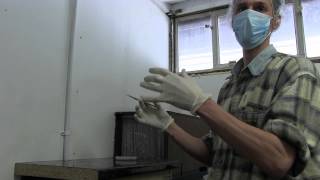
Richard Perkins (Fungal Futures) describes a social-enterprise model to convert urban organic wastes—primarily spent coffee grounds—into food by cultivating oyster mushrooms. He quantifies the waste stream (about 300 tons/week from large cafes) and the potential output (roughly 100 tons/week of oyster mushrooms), explains the spawn propagation chain (master culture → petri dishes → grain jars → sawdust spawn → coffee-ground bags), and describes sterile lab practice, key temperatures and timings, equipment needs, and approximate capital investment. The process timeline from a fingernail-sized mycelium to many fruiting bags is ~8 weeks; colonization of coffee/ cardboard mix is ~3 weeks; expected yield per bag is ~0.5 kg. He also notes exploratory work with bioluminescent fungi but doubts it will become a consumer kit.
Questions this video answers
Roughly 300 tons per week
Approximately 22 double-decker London buses
About 100 tons of oyster mushrooms per week
Approximately 20–22 °C
Roughly three weeks
Chapters
Roughly about 300 tons a week of coffee grounds are produced by the large branded cafes, like high street cafes, that you'd see regularly about the weight of 22 double decker London buses. So it's a large amount of coffee waste that will get taken to landfill and it gets back buried in landfill sites. It's quite a bulky material and underground where you've got anaerobic conditions, it will break down and produce methane, which as most people know is 20 times more dangerous to our atmosphere than carbon dioxide. From that you could produce 100 tons of oyster mushrooms a week to take this massively damaging process and produce 100 tons a week of a healthy, protein rich, nutrient rich, delicious food. I see as a massive opportunity. I think got quite inspired by the whole idea of a model for business of social enterprise and not just kind of producing something for sale, but to have a kind of a wider environmental or social benefit as well. So I've set fungal futures up as a social enterprise and I suppose the main aim initially is just to facilitate recycling a lot more coffee waste into food instead. But a longer term kind of idea or vision is to kind of widen that into also a kind of a social benefit by being able to help other businesses set up in every city in the uk. So you could almost have sort of regional centres collecting coffee waste from within that city and using it to grow mushrooms for sale in the local area. And it doesn't have to stop necessarily with coffee waste either. There's many forms of urban waste in particular which are kind of not really utilized at the moment. Breweries, for example, produce tonnes of spent grain and hops, which again is still full of nutrient and mushrooms can grow off of that. So we're in the grow room here, this is the incubation room and it's generally kept 20, 22 degrees, quite, quite nice and warm, dry, got fresh filtered air that comes in at the back there that just filters out spores from any other moulds or bacteria. And it's basically a place to propagate the mycelium which to produce a mushroom you need a big bulk of mycelium and from that it will produce mushrooms. The white there is the mushroom spawn having grown across the coffee grounds and it's now fully colonized its and when you cut a hole in there, it will then switch into mushroom production and begin to produce mushrooms. Originally it starts as a small piece of mycelium in a test tube. This is a master culture and you take a very small amount, maybe half a fingernail's worth and put that onto a petri dish plate like you used to have in school almost. And from that small piece of material there, it will grow outwards across the whole of the petri dish, takes around about a week, week or so. And you then cut small pieces of that petri dish out and add it into a jar of grain, and it will then grow outwards and across the jar of grain. So you're effectively just taking a small amount of mycelium and expanding up and getting more and more of it. One of these dishes, for example, you can make three or four jars of grain from. And from the jar of grain, you add it into bag of grain. Each jar of grain can do three or four bags of grain. And so the whole process is just kind of exponentially expanding from the grain spawn. You then add that into a bag of waste sawdust. This comes from a local timber frame company that have tons of wood shavings. And I just pick that up and it's a perfect medium for the sperm to brown. So you produce bags and bags of spawn. Each one of these can make 15 bags of sawdust spawn. And then from your 15 bags of sawdust spawn, you then mix that in with the waste, coffee ground and some shredded cardboard. Here's one that's about a week or so after having been mixed up and incubated, you can start to see the bits of white grown across the coffee waste beginning to fully colonise its food. And that takes roughly about three weeks or so till it's fully colonised like that. And at that point, it's now ready to fruit the mushrooms. So in the space of about eight weeks or so, we go from a piece of mycelium the size of your fingernail, you can have around about a thousand bags ready to fruit mushrooms, each one producing about half a kilo of mushrooms or so. So this is where we do the cultivation of the spawn itself, which is probably the trickiest part of the mushroom production, is the early stages, where you're producing the spawn and everything has to be done under very sterile conditions. So we kind of work in front of this air filter. This is a very thick sahepa air filter. It's about that thick. And inside there it filters all the spores of any other fungi or bacteria that would be present in the air. Most people don't realize, but in the air they breathe, or their hair, their breath, there are hundreds of thousands of spores of other species that they try to compete with the Russian spawn. And so really, the process of cultivating the spawn is to try and eliminate as many of those other spawn spores as possible and instead to kind of create a condition favorable to the mushroom species that we want to cultivate. Scalpel over a flame, just to kind of heat sterilize the tip of the blade. Wash my hands and arms down with alcohol. And that just kills anything that may be on dead skin or on my hands at all. And you tend to work from this side. So you be behind the petri dish and basically take a piece of the petri dish and add it into a sterile jar of grain, Close the lid up quickly, and then it will go into the incubation room where it will be nice and warm and it will start to grow. These are probably one of the most significant investments I had to make in setting up. Whether it's a stack of fresh petri dishes or a jar of grain before you've added the stuff, spawn to it, or bags of sawdust before you've added the spawn, they'd all basically go in, inside, inside. Whether it's six bags or 12 jars or hundreds of petri dishes, you basically would use this as your vessel to sterilize them. So you add them in there, add the lid on, turn the heat up and bring it up to sits around about 120 degrees or so. And at that temperature is known to kill all living species. That will then cool down overnight. And the next morning you'll bring that now sterile substrate in front of the sterile airflow and add your spawn to it. And then basically your spawn has got a free run on its food source without having to compete with other fungi or bacteria. This is basically the centerpiece, I suppose, of the whole operation. Without this, you're not going to cultivate mushroom spawn. You're just going to cultivate green blue mould and various different types of bacteria. So it's kind of fundamental really, in terms of the running of the business. I had to invest around about £12,000 in equipment, and that was for the pressure cookers for building the laboratory, the shipping containers, which is what the grow rooms are made up, retrofitted inside, and a whole host of lab equipment and various other things I needed just to go from nothing in the business. But the running costs actually, week on week can be fairly low because your raw materials are fairly cheap. Most of them are wasted. Most people, whether it's sawdust or whether it's coffee. So as a model, I suppose it's quite nice from my point of view. We've got lots of large costs to run every week. Probably your Labour is the main cost. It's probably one of the biggest benefits, I guess of being self employed or starting your own company is just the opportunity to learn is something that you can decide on now. You can drive forward what you want to learn about and how you want to learn it. This is another thing we just started playing with almost for fun, I suppose, if anything, bioluminescent fungi. There are many species around the world that give off this bioluminescence at night. And we just out of interest, really wanted to see what it was like when we cultivated and whether it was something worth developing into a grow kit for people to do themselves at home. So this is a bag that's kind of covered in the mycelium. If you had to switch the light off now, within about five minutes or so you'd start to see kind of a faint glow. And after sort of 10 minutes or so when your eyes have adjusted, you kind of see it a lot stronger. But unfortunately it doesn't look, you know, this is what it looks like to a camera. When you set the camera on a long exposure to photograph, it looks great to the camera, but to the human eye the glow is nowhere near, is kind of bright and green of that. It's kind of more of a kind of a faint whitish glow. So although it's really cool, it's probably something we'll play with a little bit more and see if we can get it to glow brighter by changing the medium it's growing on. In the end, it's probably something that we're not going to develop into a grow kit.