HEADING WEST A farm update and coastal trip with Ragnar
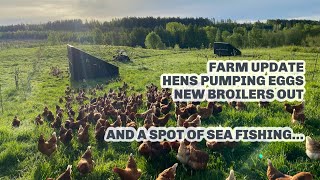
YouTube video by Richard Perkins (uploaded June 1, 2020) combining a farm update and a short coastal trip with his young son Ragnar. On the farm Richard reviews trial beds, animal management (birds, cows), nut and strawberry plantings, and practical decisions (moving young birds out at 17 days due to pecking/heat stress). The second half documents a west-coast Sweden rock-pooling and mackerel fishing trip — observations of tidepool life and multiple mackerel caught — and closes with course/membership announcements.
Questions this video answers
June 1, 2020
Approximately 10,000 meals per year
17 days old
21 days
18 meters
Chapters
All right, welcome back to another episode, folks. Ragnar and I are on the west coast of Sweden taking a trip to celebrate my birthday. Do some fishing, some rock pooling, and have a little relaxing time together in nature. So a few clips from the farm from the last days and then we'll take you a bit on our adventure. Enjoy. Look, we got squash in these beds. So a lot of people asked about these trial beds and I never got around to answering, did I? Sorry about that. But we basically didn't really notice perceptible differences. And so we kind of just harvested the crops, ate them and didn't really pay much attention. Now, I believe that it wasn't totally fair kind of experiment because the water coming off the roof, there's no gutter on here still totally smashed up. The first bed, that was a control bed. And then this is all being pig paddock underneath. So there was obviously pig manure under here that had been, you know, sitting. And. Yeah, to be honest, it just. With all the things going on here, you just to get useful data out of that would have been challenging. I think it'd be much easier if you started with raised beds and actually put material in them. You know, Charles Dowding and he's done a lot of experiments. But it's much easier when you've got a level playing field. And I think this has not been a level playing field. So I didn't feel like we got any useful data out of it at all. Like everything grew fine. So maybe the only useful conclusion is you don't need to worry too much. And as I always say, you do a bit of everything you can to improve biology, knowing that it's way more complex than you could understand. Anyway, now it's my birthday, so I wanted to get the peacocks out again. They went back in the barn for a few days and they just sat there again. But Saku loves herding birds, so the peacocks are a bit nervous again, so I imagine they might just go back in. Saku, you come. Saku, come. Good girl. Saku, come. Good girl. Let's leave them be a bit. You're just noticing that her udder is very big. She's feeding. She's feeding a beautiful calf. Cows are very happy to be back on our lands. Nice grass. Magnar is super interested in insects, so this is now a fascination. Beautiful pack choice. Cool. 4.5 degrees. So this is mushroom bags that let sit all winter just out freezing. And we actually crumbled them up and put them back into fresh medium mycelium spread good. And as you can see, they've grown pretty good. We've been needing them, so there's a lot missing. It's that time of morning, 6:30 here at this time of year, it's bright sun. Often happy birds are out. So we're getting a good amount of eggs now. And the birds are pretty settled in. They're still a little jumpy. Nut trees are all sprouting, So right up at the top of Nutfield. And we actually took two pens of very young birds out yesterday. These birds actually only 17 days old, so it's a little bit young. We Normally wait till 21 days old. But what we were seeing was the Buddha was getting a little bit full and there's a bit of heat stress and it's starting to peck on each other's oil glands. Now there's just a few birds with that. But what we've seen in the past is when that happens can it can spread like wildfire throughout the pen. They learn that behavior off each other. And so we decided to make the decision, just get two pens of the birds out to reduce the numbers and relieve the stress. And the weather's good and quite hot during the day, so we felt that that was fine. So I've just come up to check and they seem totally fine. I'm relaxing in the morning sun. I'm just filling up the waters. But we'll get the rest of the birds out today just to make sure. So always got to respond to what's going on on the ground. And the birds, like chickens especially, really learn behaviors from each other. So we've seen it once before where a couple of birds had like sores on the oil gland. Came back in a couple of hours and There were maybe 10. Came back in a couple of hours and there were maybe 50. So we took them straight out. It was a few years ago when we were doing batches of a thousand. And taking them out immediately relieved that stress. Like A, they have more space, B, they are much lower density and they have grass and things to keep them occupied and to get their senses going. So good move, I think. And that's what you got to do. Just got to observe and interact in a timely way. And that's what most of what we do in farming is all about, really. Okay. Afternoon shade cast by a really tall spruce trees on this side off our land. If you remember that video about the grazing planning, we've actually got cows and sheep nipping in here to cut the grass essentially in front of these small Birds. Now, these are out four days prematurely because of the problem I described earlier. And they seem to relax and become much more interested in pecking at grass. So, 17 days old, that's the youngest we've ever had birds out. But I think it was the right decision. That's what this type of farming is about. As I always say, it's people and management intensive. You need to look and see what's going on for yourself. Now, we've also checked the weather forecast and it's not going to be very cold in the next days. And we're actually protected here by our alder and the trees off our land acting as a windbreak against the cold air that comes down off the hilltops at night time. And then looking back over towards the lake below, you see we're quite well protected here. I'm actually off now for a couple of days with my son Ragnar to go to the west coast, because this is the time the mackerel come in and start feeding and getting bigger before their journey back to the deeper waters of the North Sea off the coast of England. And we want to have a couple of days away celebrate my birthday. And I want to take him rock pooling, because if you follow, you'll know that he's super interested in insects and gathering all kinds of little creatures. So my childhood memories of going rock pooling and crab fishing and fishing are something I'd love to share with him at this time especially. So I'll be away from the farm for a little while and then we'll get updated about all the things going on when I get back. So just for reference, this is where the first boilers came through that you'll remember from videos recently. And as you can see, the grass has really started ramping up in growth now that you barely see that they've been here. And this is the final patch where the birds were. See, the strawberries are coming up now. So we've got a lot of strawberries. Again, these have very little maintenance. They've been through just weeding once at the start of each season. And we get an abundance of berries that we mainly keep for ourselves. That's one of the benefits. We put in some nut trees that we just wanted to have these for our supply on the farm. In typical years, we've been serving 10,000 meals each year at the farm. And so it's important for us to have the berries and things so we can eat them on a daily basis all through the year till the next year. But the main reason for Getting these strawberries in was to make use of the plastic that we put in around the nut trees. So here's an example of a black walnut that I've grown from seed. You can see they're doing really good. There's a whole line of them along here. And because we wanted to, these are, you know, slow growing, unvaluable trees until they're bearing nuts. And so we didn't want to be looking after them in any way. So we put them through plastic and then we thought, well, once the plastic's there, we may as well actually use it to grow strawberries. And so whilst you could get a higher level of production by managing them much more intensively than we do, we get a lot of strawberries for doing very little work. So we like that. You can see this is up in top field, so the tree lane from here to here is 18 meters. So we didn't mind splitting up this row in our field to put in more trees that will one day totally supersede all the fruit trees, etc in the silver pasture lanes. It'll be, you know, I won't be alive when that happens. But it didn't mathematically affect the farm because we can still fit multiples of our boiler, sorry, our boiler pens in between, because there's three fit in this row. And of course with chicken netting, that makes no difference at all. So always good to plan with the spacings of the equipment or things that you're moving around on the farm in mind because that just keeps it easeful and graceful. And as you see from the aerial shots we put out on the farm, it just, it works aesthetically and functionally. Do you know how old I am?
No.
Can you guess?
No.
So we are off on a rock pool adventure on the west coast of Sweden. And we are going to have a few days at the beach relaxing, learning about aquatic creatures. Because Ragnar is super into insects right now. But we thought we'd go and find coastal creatures.
Are I gonna give their only. I think the only one that I gonna give them.
We made it. We can see the sea from here. We're gonna go catch a fish. So we are on one of the most exposed parts of the west coast of Sweden right now. And this is quite an old birch tree. For reference, that trunk is. It's been pollarded at the base, but this is a very old tree and you can just see it's no more than three and a half, four meters tall. And it's just getting battered by the onslaught of wind on this extreme coast. So this gets massive storms in spring and autumn. Very exposed and you can see the angle the trees are growing at. But that tree must be. It's definitely older than any birch tree on our farm. By a long way. Even the biggest one on our neighbour's land. But tiny stunted tree. This is sea kale. That's an edible. Where I grew up in England, it's quite rare. So it wasn't good to take it.
No, no. Look, look. That insect.
Oh, there's a ladybird on it. This is just growing in shingle. There's lots of interesting plants around here. Tide pool adventures. There is just a lot of snails, isn't there, Magna? So many. We've seen shrimps. I think there's even oysters here. So a little baby oyster, it looks like on this rock. Wow. Hopefully there's some mackerel out here. Maybe a sea trout.
I'm trying to catch a squid.
What did you find? Regna put it in here. It's a little sea star. He's lost a little leg. But they will actually grow that back. So we'll pop him back in. Little baby starfish. Ah, sea anemone. Cool. So many creatures when you take the time to look.
You know. Daddy. Sticky, sticky.
It's just an abundance of shellfish here. Oysters and all kinds of different species.
Crab claw on my crab collection. This is my crab collection.
Ragnar has got very good at walking. We have walked probably 5km today and we're walking a few more now in the evening to go scope out whether there's any sea trout or mackerel around. But we're in this wonderful moon like landscape with freshwater ponds up on the hills. We're right on the west coast on the one of the most westerly points of Sweden. Ragnar is fascinated by everything he finds. So it takes quite a while. We've been walking all day. But it's really nice just remembering as a child how much time we spent in nature and that fascination for organisms and natural processes and. Yeah, it's beautiful up here. Like every step you come across new things and it's a beautiful weather. I got a bit burnt today. What a beautiful landscape. You have walked so much today, Ragnar. Are you tired yet?
No.
Keep going forever. That's a green. We can see the sea again. What a beautiful time of day. We've walked so far, haven't we? Now we're going to see what's in the sea. Wow. Tired boy. Late at night we got a mackerel. Wagner's first sea fish. So I'm just gonna get this ready for breakfast in the morning. Okay. Full of farm food. So we've been running this off. The old Yeti. 87% that's been running all day. Butter, beer. Everything's cold. That's how we like it. Way past bedtime now. Pretty cool. Now. Move. Top 10. Okay, I'm getting toothbrush. Someone woke up. Hey, little man. Did you sleep good in here? Oh, it's in. Stretch. Another sea star. This one's only got three legs. Four legs this time, so they all seem to be missing a leg, but they'll grow them back. He's sticking to your hand. Show us the bottom. All his tentacles.
What are the tentacles for?
That's how he walks around and grazes. Wow. Baby little flounder. Tiny flatfish. Okay, day two. Ragnar has hooked up. First cast of the day. Three mackerel on. Let's get them up, Ragnar. Wow, look at that. First mackerels of the day. There are massive schools of bait fish coming up on the shore. And what you see is you start to see flurries when the mackerel are herding them out in the water, in the open water. And that's a great time. If you drop feathers in, then you catch multiple fish all in one go. It's quite different to fishing on the English coast where I grew up, where it's constantly wavy. Tends to glass off over here, so you can really see the activity out in the water. Oh, I'm on. Oh, it feels like more than one magnet.
No, Don't get big fish.
Oh, another three mackerel. Oh, last one. One got away. Watch the hooks there. There we go. Had three on, one jumped off. Seems like we're going to be able to fill the esky and take the crew home a load of fresh mackerel. So after all that walking yesterday, turns out the best fishing spot is right here, right where we're camping. Beautiful mackerel. We're just gonna gut these quickly so they stay super fresh. We're going to take these back to the farm for the crew to enjoy. I always feel when I'm fishing or out foraging that it's kind of ridiculous to farm and work so hard farming when we just have incredible, beautiful, wild food around and there's nothing like rich, oily fish like mackerel. We can put them in our smoker. We can just cook up for breakfast. Beautiful fish. And what I'm doing is just pulling the guts out, scraping the blood off the backbone like old fish. Have. I like to leave the fish whole. I just feel like it's a nicer presentation when you cook them. Often people will take the heads off straight away. I like to leave it there, and it's good for broth and things if you want to do that. It's always different fishing in different places. Growing up in England on the wavy coastline, you would never have the conditions you have here. Like the glass off, and you can actually see the activity of fish. I'm always surprised here on the west coast of Sweden. There's seemingly very little fish, I find. I would expect there to be a lot more activity from what I'm used to growing up, but it certainly is around. You just got to find it. I would expect to find more pollock and things like that, but they are about in different coastlines, Just not so much here. But I always take a day to learn the waters here because I'm not familiar with them intrinsically from growing up. So I always. After a day on the coast, I sort of realize what's going on, and that's. That's the result. Five fish in 15 minutes coming down here this morning. That's a freshwater diving beetle now. Wow, he's fast.
This is a Borat marit. This is a bot. No, it's called Borat simper. Super sipit. Nate. Diving needle. Okay.
What is it? What type of fish? Oh, look, he's floundered himself in the sand. Do you want to put him back in the water? You go a little bit deeper so he can swim away. Ragnar's on. Whoa. It's tough, isn't it? Oh, I see him.
There's two.
He's wheeling. Ah, it's tough. You have to hold so tight. Keep going. Keep going. Whoa. Feel them pulling. Feel them pulling. Keep going. They're coming closer. Every time you wind it, they get closer. Oh, maybe you've got three.
What?
Keep going forwards.
This way.
Yeah, More, More, more. Yeah, More, more, more. They're coming close. I see them now. Wow. Ragnar's got three again. Okay, we'll lift them up. Keep going. Keep going. Oh. One got away, Ragnar. One got away. Look at them. Beautiful. Now, look. You can see the little bait fish. It's been eating. Good job, Ragnar. You've caught more fish than me. Two.
Did you see that big one?
Three. Four. Five. Six. Seven. Eight. Nine. Pretty good. Ten. Okay, that's it for this episode, folks. Broke the fishing rod using too light a telescopic spinning rod for sea fishing. But just wanted to let you know that over at Richard Perkins Co. That's our main website. Now we have a free mini course for those of you that are just starting out or wanting to redefine what you're up to. So totally free course. Check that out. It asks you to do a bit of work, but it goes deep into the heart of the things that make small farms work. So go check that out. Let us know what you think about the sites, etc. See you in a video soon. I'm super excited to announce the Farm Like A Hero Experience is now live. Our 2020 special features more than 70 interviews with Europe's best regenerative farmers in long form conversation weekly Q and A sessions with myself, as well as the private Facebook group Community. Our Epic Hero membership is now only open until June 11th, so join now@farmlikeahero.com and we'll see you in there.
More from Richard


A review of short and intensive season on a mixed farm and restaurant/event space in Sweden






Alskade Kyckling Exploring complexities of poultry production in Sweden and what we stand for


