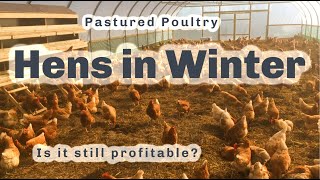
Richard Perkins (video author) discusses keeping high-production laying hens through Swedish winters, framing profitability as context-dependent and best judged across whole-season enterprise planning rather than isolated summer/winter windows. He describes renewing flocks annually (birds arrive as point-of-lay and are ~16 months when replaced), seasonal egg-production patterns (peaks ~90–95% through summer into Nov/Dec, lows around 75%), management choices (polytunnel vs barn, artificial lighting but no heat, deep-litter bedding, eggmobiles on pasture), and ecosystem benefits (rapid pasture regeneration from concentrated manure after short eggmobile rotations and improved soil/plant growth). He gives practical economics: roughly €6,7000 stated startup for two eggmobiles and a small packery (spoken figure in transcript), running ~700–800 birds, egg revenue ≈3.5× feed cost at peak production and current daily feed cost ≈1/3 of daily egg revenue at ~75% lay; he emphasizes meticulous record-keeping and resilient spreadsheet assumptions (e.g., using 80% vs observed 85% lay for planning). The farm values year-round fresh product, modest labor returns (~€22–25/hour pre-tax), and agroforestry mulch output from deep litter.
Questions this video answers
About 16 months (birds come as point-of-lay and flocks are renewed yearly).
€6,7000 (spoken figure in transcript).
About 700 birds historically; planned ~800 birds this year.
Peaks about 90–95% through summer into November/early December; lows around 75%; an annual average example given ~85% (planning conservatively as 80%).
About 3.5 times (egg revenue ≈3.5× feed cost).
Chapters
Someone asked me if it's profitable to keep chickens through the winter, and that's.
A really complex question. So today's video. Let's unpack that a little bit. So, obviously, a big factor that affects everything is the breed of chicken you keep here. We keep high production layers because of the availability of large flocks of birds that we run here in Sweden. And that's going to be down to your context. Now, for us, we sell the spent layers as stewing birds for the same price that we buy the birds. So for us, actually, it doesn't matter how long we keep the birds, we tend to now renew our flocks every year. So the birds will be about 16 months old because they come to us as point of lay hens. So it's similar to how the industry runs because we sell the birds at the same price that we bought them. The only consideration for us to replace the flock is economic. So when the production drops to a certain point, then it's not economic to keep them because we can sell them as stewing birds. Obviously, climate is going to be a major factor in how you decide to set up the enterprise. So we have. In Sweden, we have a very long daylight hour. Summer, it doesn't get dark till about 11 o' clock at night, so you have to get Miso the sheepdog onto the chickens, which she's learning to do. She's a sheepdog that's scared of sheep, but she's become a chicken dog, which is awesome. But in the winter, there's very low light levels and that can affect production. Now, we kept the layers in the polytunnel before with no artificial light and heat, and that was very good. The numbers for egg production were the same as they are now. We have them in our barn because we need to use the polytunnel much earlier in the year. But we have lights, about 600 watt equivalent bulbs on for 14 hours a day, no heat, deep litter system, same as in the polytunnel, and that's the same. So the egg production right now is at the lowest. It reaches about 75% up in the summer when the birds go in to lay, it's up at 90, 95% all the way through till November, early December. So the idea of whether it's profitable or not in summer or winter, I think obviously depends on your unique time, place and circumstance. However, I would not look at it as in a separated enterprise for summer and winter. And the reason why for us is it's really important to look at the whole plan and the succession of that plan from year to year. And for us, the overall economics is more interesting than the specifics of summer and winter.
So we're here at the top of Nutfield, on this little hilltop that's very sandy. This is a patch of land that you can see how the grass has been growing ever since we moved here.
We haven't impacted this with animals.
This has been growing all year, but it never really grows beyond this. It's very st stunted because of the lack of fertility. And so as we step back here, you see a line where there was a chicken. Grazing happened twice this season. And you see an immediate difference. Here you can see where they've been making their little dust baths in the ground. But suddenly a bit of nutrition has come in and it stimulated different forbs and flowers to germinate. And grass is growing because of that little bit of nutrition. But that nutrition is feeding the soil food web and the soil food web is feeding the plants, and the plants are then rooting better and putting more sugar in the ground. And it's an exponential cycle of regeneration. If we step back just here, you can see where an eggmobile sat overnight. This little square here shows the impact of that high manure load. And the grass is much more thick and much taller here. And that's the impact of just two days of chickens roosting above it. So you can see this area behind me, which also looked like the bare patch we saw to start with. This isn't where an eggmobile has stood, it's where the chickens have spent time pecking and feeding and dropping their manure. So it really doesn't take long to start this regenerative process.
It's a different operation when the birds are indoors, it's much less work. And the birds are also producing useful output, as it were, rather than scratching and doing work on the ground, they're producing deep litter, which is mulch for our woody systems, our agroforestry systems. So it's just as valuable an output. The costs are higher in terms of we need bedding and light, we don't use any heat, but in the summer we put more time into it. We move the egg mobiles every day and it takes a bit more time. So there's more eggs, but it takes more time. So these are all levels of complexity to look at, the economics of the whole thing. But for us, it's important as an enterprise to have some. We sell everything at drop off points in our local towns, and for us it's the only Fresh product we have through the winter. We may have frozen chickens and turkeys, etc. But once the veg box is finished, we have no fresh produce till. Not really until June. June is the first time that the broilers are processed on the farm and the veg boxes come into full swing. So it's important for us, just for that reason alone, to keep regular contact with our customers. So I think that needs to be factored in heavily. Actually, another important factor is going to be feed and other costs that are going in. So we feed only organic food, which is very expensive here in Sweden. So in terms of the economics of that, when the hens are laying, 95% in the summer, all the way through to late autumn, that's about the revenue from the eggs is about three and a half times the feed cost. And when that production. So about now is the time the egg production reaches its lowest, about 75%. And so now the daily feed cost is one third of the daily revenue of egg sales. So that's an indicating sort of value. So it's not a huge swing between summer and the depths of winter. What we do in our spreadsheets, we always build sort of multiple layers of caution into our spreadsheets, as it were. So if the egg production throughout the whole year is 85%, then we'll write it as 80% maximum. We'll have multiple layers of resiliency in our planning. So, for example, if we have 85% eggs laid each day, so for 100 hens, 85 eggs, then some of those eggs might be cracked and some of those eggs might be too dirty. So we keep meticulous spreadsheets. We have folders full of spreadsheets with. We record everything here on paper as well as in. You're not going to be able to see on the video, but we record both the eggmobiles and record how many eggs are collected, how many are dirty, how many are cracked. So we can see the percentage of eggs that are a grade sellable eggs coming from the percentage of lay. So it allows us to build up a better picture of the enterprise. Obviously the setup cost is going to be a really big factor and our egg mobiles were particularly cheap. We set up the whole enterprise for €6,7000, building two eggmobiles and this egg packery, this is a little wagon that we swapped for a few broiler chickens. And there's a few regulations that are involved. You need mousetraps and screen ventilations and water supply and all this. Different bits that you need for the regulations, but it's essentially a very cheap start up. There's different costs throughout the year. So in the summer we have fuel for the rhino to move the egg mobiles and the feed is similar to the winter. Now the birds get a lot of food from the pasture in the summer, up to 40% of their diet comes from insects and grass and forbs in the pasture. But then it's juxtaposed against the fact the birds are running around all day in electric netting. So they're using a lot more energy, maybe 30% more energy than they do in the winter. So it's actually quite similar for us, the winter and summer feed costs. That's quite interesting to factor in. In the winter we buy a lot of bedding, we buy very dry wood shavings and build deep litter systems and that works really nicely for us. And it provides woody mulch for our agroforestry system. So we like that as a way to capture all the manure, a little bit of electricity, but the work hours are much less. It's interesting. This is an enterprise for us. We've been running 700 birds, we'll have 800 birds this year and it produces a good revenue. It works out. At the speed I work, it's about 22 to €25 an hour before tax. So it's not the highest profitable sort of enterprise compared to broilers, market gardens, etc. But the ecosystem services we've seen and the ability to keep contact with our customers over the winter, they are what make it really worthwhile to us. I mean, just the absolute transformation of our tied out pastures. I'd put down 80% of that down to the hens. It's pretty amazing what they've done. So if you can find a way to sell your birds that you're replacing as stewing hens, then definitely it's a.
Very nice enterprise to do.
It doesn't take long each day. And it's a product that everyone eats every day. People eat eggs every day and it's not hard to sell good eggs. People send us photos of their dinners with their omelets and their fried eggs because they love our eggs so much. So I hope that was useful. I love talking about these kind of things. It's what I'm passionate about, it's what I'm doing every day. So thanks for watching our videos hit subscribe below if you want to keep up to date with the farm. We're putting out a lot of material this year so you can follow the whole season through the farm. It's going to be a lot of fun.
You can find out more in our.
Book, Making Small Farms Work. It's been highly regarded by a lot of awesome people in the field. You can see what they say about it on the website. So thanks so much for watching and see you next time.